Expert Analysis: "July Afternoon" by Guy Rose
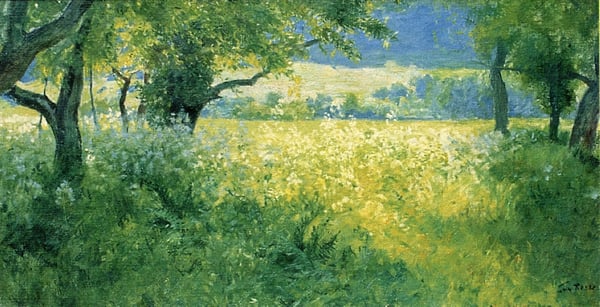
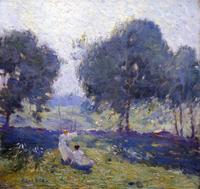
As an Impressionist landscape, Guy Rose’s "July Afternoon" exemplifies the movement’s core pursuit of capturing transient light and atmospheric effects. While specific details of the composition are not provided, the title alone points to a quintessential Impressionist subject: a specific time of day, here the height of summer light. Rose, a leading figure in the California Impressionist school, often depicted the saturated, hazy luminosity of the Pacific Coast. This work’s significance lies in its demonstration of how American Impressionists adapted French techniques—broken color, loose brushwork, and a focus on optical sensation—to a distinctly local environment. The afternoon light would allow Rose to explore contrasts between warm, golden highlights and cooler shadows, a hallmark of the style’s interest in the fleeting interplay of weather and season. As a landscape, "July Afternoon" likely emphasizes plein-air immediacy, with the artist painting directly from nature to preserve the freshness of perception. Its importance within Impressionism is thus twofold: it advances the movement’s core mission of capturing momentary visual truth, and it roots that universal Impressionist language in a specific American locale, contributing to the broader narrative of how the style evolved beyond France.