
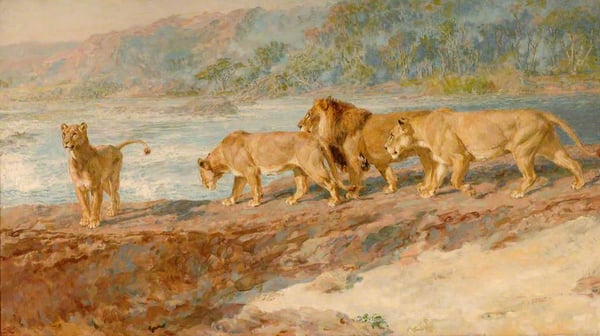
Analisi esperta di On the Bank of an African River di Briton Riviere
Stile: Realism · Genere: animal painting
Expert Analysis of "On the Bank of an African River" by Briton Riviere
Briton Riviere’s "On the Bank of an African River" stands as a compelling example of late-19th-century Realism applied to the animal-painting genre, a field in which the artist excelled. The work’s significance lies in its ability to merge meticulous naturalistic observation with a subtle narrative tension, characteristics that elevated animal painting from mere decorative or sporting subjects to a vehicle for broader artistic and emotional expression.
Realism as Precision and Presence
Riviere, a leading figure in the British animal-painting tradition, approached his subject with the scientific eye of a naturalist. In this painting, every texture—from the rough hide of a lion or the dappled coat of a grazing antelope to the reflective stillness of the river—is rendered with scrupulous detail. This commitment to visual truth aligns with the core tenets of Realism, which sought to depict the world without idealization. Yet Riviere does not simply copy nature; he selects and composes, using the riverbank as a stage where light, shadow, and anatomy coalesce into a cohesive, almost photographic scene. The result is a work that feels both immediate and timeless, capturing a specific moment in the African wilderness.
Narrative and Mood in Animal Painting
What distinguishes this work within its genre is Riviere’s ability to imbue the animals with psychological weight. The title itself invites the viewer to imagine a story: Are these creatures at rest, or is there an underlying tension of predator and prey? Riviere often explored such dynamics—his famous “The Last of the Garrison” (depicting a faithful dog) and “Sympathy” (a child with a dog) show his gift for emotional resonance. Here, the African setting adds an exotic dimension, reflecting Victorian Britain’s fascination with imperial frontiers and the “sublime” wild. The river functions as both a literal barrier and a symbolic divide between safety and danger, tranquility and threat.
Significance within the Period
Riviere’s work bridged the gap between the anecdotal animal paintings of Sir Edwin Landseer and a more modern, unsentimental approach. While Landseer often anthropomorphized animals for moral tales, Riviere—though still occasionally sentimental—leaned toward a more detached naturalism. "On the Bank of an African River" exemplifies this shift: the animals are not performing for an audience but exist in their own right, governed by instinct and environment. This alignment with the Realist movement’s emphasis on truth—whether in human or animal subjects—makes the painting a key document of how Victorian artists expanded the boundaries of animal painting from illustrative charm to serious artistic study.
In summary, Riviere’s work is significant for its masterful synthesis of Realist technique and animal portraiture, transforming a scene of wildlife into a poignant exploration of nature’s beauty, power, and inherent drama.
Visivamente simili
20 opere con composizione e palette affini
Royalty at Home
Rosa Bonheur
Lion with lioness
Antonio Ligabue
Lion in a Mountainous Landscape
Rosa Bonheur
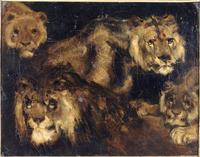
Study for Four Lions
Théodore Géricault
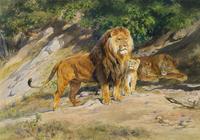
The King Watches
Rosa Bonheur
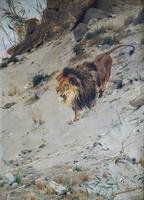
Der alte Herr vom Berg
Richard Friese
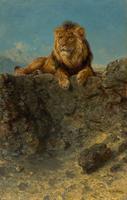
Enthroned lion
Ludwig Knaus
Study of a Lion
Rosa Bonheur
Sleeping Lioness
James Ward
The King Drinks
Briton Riviere
Lion devouring a piece of meat
Giorgio de Chirico
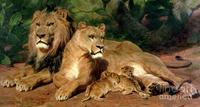
The Lions at Home
Rosa Bonheur
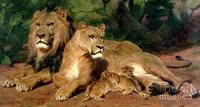
The Lion at Home
Rosa Bonheur
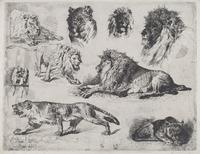
Study of Lions
Cesare Biseo
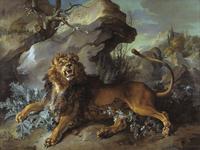
The Lion and the Fly
Jean-Baptiste Oudry
Lion Snapping at a Butterfly
Jean-Leon Gerome
Lion and Prey (also known as The Kill)
Rosa Bonheur
Lion of the Atlas
Eugene Delacroix
Study of Heads of Lions and Lionesses
Rosa Bonheur
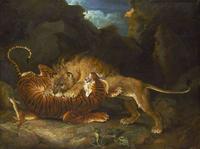
Fight between a Lion and a Tiger
James Ward