Amsterdam's Museums, Ranked
Seventeen collections judged on what they actually hold — and on the rooms they hold it in
Amsterdam is a small city carrying an implausible density of first-rank collections. Dutch museums recorded almost 32 million visits in 2024, 8.8 million of them by visitors from abroad[1], and a disproportionate share of that traffic lands within roughly two square kilometres of the Museumplein. The Rijksmuseum alone took 2.5 million people in 2024[2].
Density is not the argument, though. The argument is that several things here exist nowhere else. The largest collection of Van Gogh's work in the world — some 200 paintings, 400 drawings and 700 letters — sits in one building on the Museumplein[5]. The largest holding of Kazimir Malevich outside Russia sits in the next building along[7]. Twenty minutes away by train, a museum that has been open to the public without a break since 1784 still shows its minerals in the cases and the order an eighteenth-century curator gave them[13].
Then there is the peculiarly Dutch category of the building that is itself the exhibit. Rembrandt's house on the Jodenbreestraat, refurnished from the inventory his creditors drew up at his insolvency in 1656[12]. A clandestine Catholic church built into the attics of a canal house between 1661 and 1663 — complete, in place[19]. A seventeenth-century town hall with three marble floor maps the palace calls the largest ever made[17]. An almshouse in Haarlem hung with the group portraits its own regents commissioned[16]. In each case the room and the work were made for one another and have never been separated.
What follows ranks on three things in strict order: what the permanent collection holds and whether it can be seen anywhere else; the art-historical weight of the building and site; and only then corroborated visitor evidence. Google review counts measure footfall, not holdings — which is why several of the most-reviewed "museums" in Amsterdam do not appear here at all.
One important absence is not a judgement. Eye Filmmuseum, the Dutch film museum and archive, holds around 820,000 objects[37] and is not yet in the Caleido catalog, so it could not be given a place in the ranking.
The three great collections
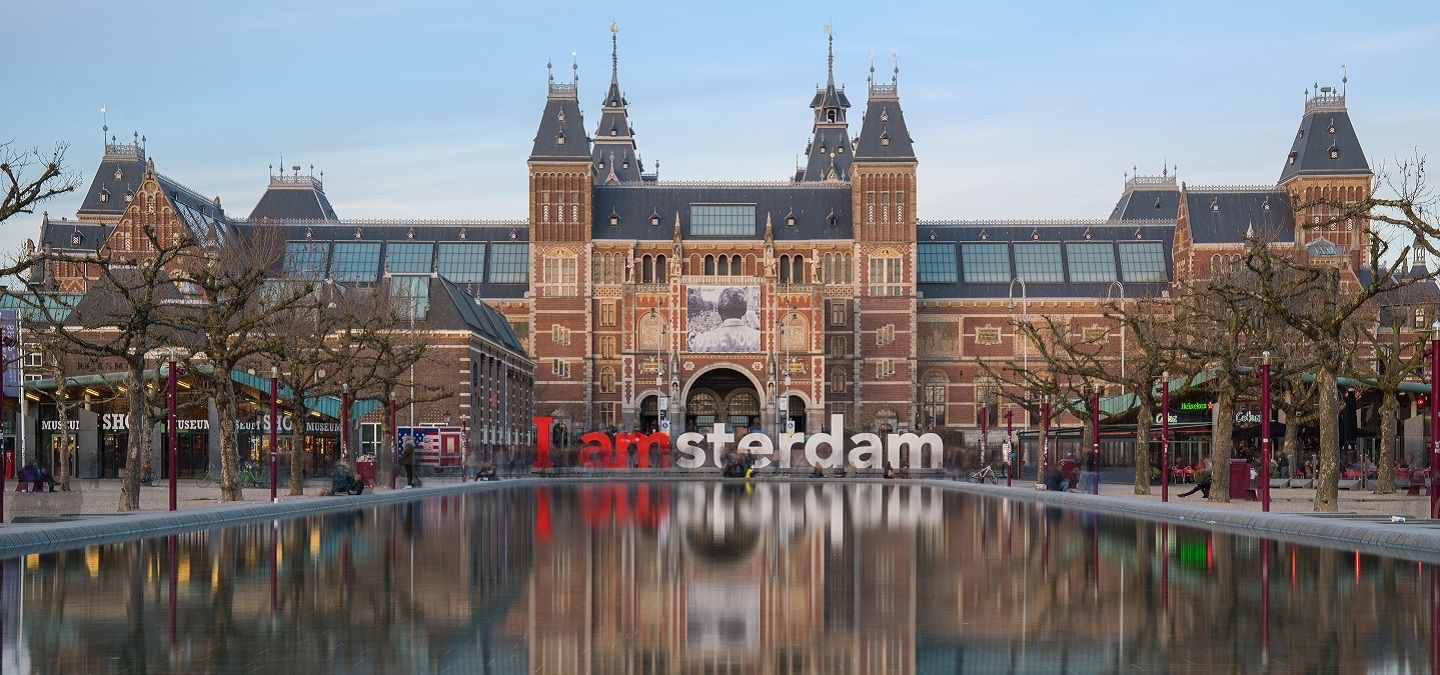
Amsterdam | Building opened 1885; reopened 2013 | National museum | 4.7★ (108,738 Google reviews)
Around a million objects, of which roughly 8,000 are on show at any time, inside Pierre Cuypers's 1885 building — reopened in April 2013 after a ten-year rebuild by Cruz y Ortiz[3]. The Gallery of Honour ends at The Night Watch; Vermeer's The Milkmaid, Frans Hals and the Asian Pavilion fill out the rest[3]. Since the end of 2024, conservators have been removing the Night Watch's varnish in a purpose-built glass chamber, in full view of the public, and the painting stays on display throughout[4]. It drew 2.5 million visitors in 2024[2].
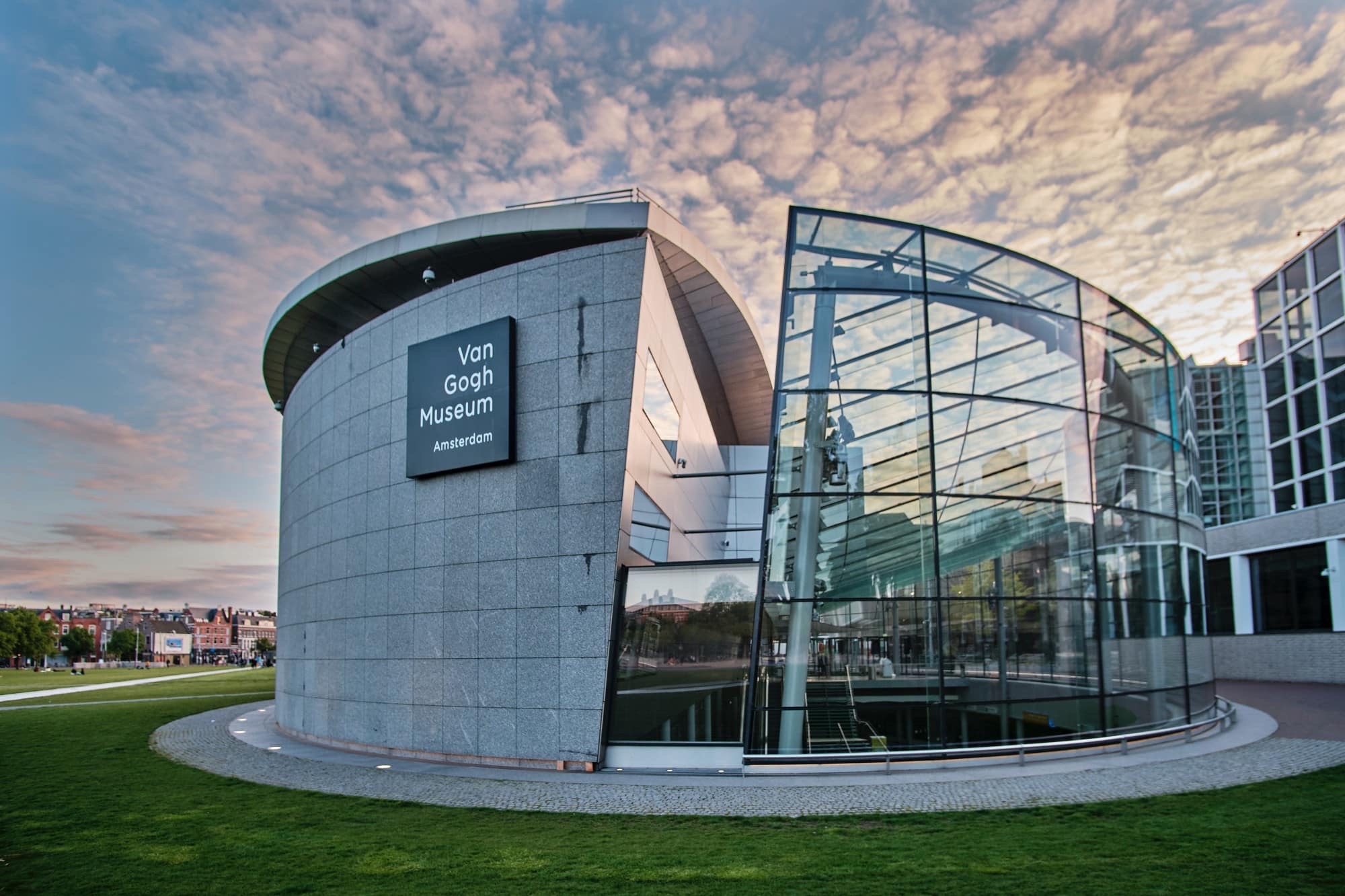
Amsterdam | Opened 1973 | Single-artist museum | 4.6★ (101,768 Google reviews)
Two hundred paintings, 400 drawings and 700 letters — the largest Van Gogh holding anywhere[5]. The Potato Eaters, Sunflowers, The Yellow House, The Bedroom, Almond Blossom and Wheatfield with Crows are all here, hung so that a working life of barely ten years reads as a sequence rather than a greatest hits[5]. Gerrit Rietveld's building, opened in 1973, holds the collection; Kisho Kurokawa's 1999 wing takes the temporary shows[5]. A three-year renovation is scheduled to begin in 2028, its funding in mediation with the Dutch state[6].

Amsterdam | Building opened 1895; extension 2012 | Modern and contemporary art museum | 4.4★ (14,850 Google reviews)
Almost 90,000 objects of modern and contemporary art and design, including the largest Malevich holding outside Russia, alongside Kandinsky, Chagall, Matisse, Pollock, Karel Appel, Warhol and De Kooning, and deep seams of De Stijl and CoBrA[7]. A. W. Weissman's 1895 neo-Renaissance block was doubled in 2012 by Benthem Crouwel's seamless white extension, nicknamed the Bathtub by critics[7]. Three thematic collection displays run in parallel; the 1880–1950 hang alone carries more than three hundred works[8].
Where the building is the exhibit

Amsterdam | 1960 | Historic house and memorial museum | 4.5★ (73,577 Google reviews)
The Secret Annex has been kept empty since the museum opened in 1960, at Otto Frank's request, and the emptiness is the exhibit[9]. You pass the hinged bookcase, the pictures Anne pasted to her wall, and the pencil marks her parents made to measure her — she grew more than thirteen centimetres in two years of hiding[9]. The front house displays the diary she was given on 12 June 1942 and the 215 loose sheets she rewrote from March 1944[9]. UNESCO inscribed her writings on the Memory of the World register in 2009[10].

Amsterdam | Opened 1911 | Artist's house museum | 4.5★ (14,404 Google reviews)
Rembrandt bought the house in January 1639 and lived in it until it was auctioned in 1658 to pay his creditors; the interior was reconstructed room by room from the inventory drawn up at his insolvency in 1656[12]. The museum owns 260 of his etchings — very nearly the complete graphic oeuvre — plus four original copper plates[11]. That is the real holding. The paintings largely left the building, but the prints, the studio and the pigment table put you inside the working method[12].

Haarlem | Foundation 1778; open to the public since 1784 | Art and science museum | 4.5★ (5,263 Google reviews)
The Teyler Foundation dates from 1778, and the museum has been open to the public without a break since 1784 — the oldest in the Netherlands[13][14]. Leendert Viervant's Oval Room survives intact, its minerals still arranged as an eighteenth-century curator left them, alongside the electrostatic generator John Cuthbertson built in 1784, the largest in the world, which Martinus van Marum used for his experiments[14]. Around 214,000 objects: fossils, minerals, coins and medals, instruments, and a drawings cabinet holding sheets by Michelangelo and Raphael[14]. The single most unrepeatable interior on this list.

Haarlem | Founded 1862; in the almshouse since 1913 | Old Master museum | 4.5★ (3,121 Google reviews)
Founded in 1862, the museum has occupied the Oudemannenhuis, a hofje for old men founded in 1609, since 1913[16]. Its two group portraits of 1664 — the regents and the regentesses of that same almshouse — hang in the building those sitters governed, which is about as close as Dutch painting comes to work still standing in its own room[16]. Five of Hals's six civic guard pieces are here too, from the first of 1616 to the last of 1639[16][43]. The separate HAL site ended its regular contemporary programme in August 2025[15].

Amsterdam | Town hall from 1648; palace since 1808 | Palace and historic interior | 4.6★ (25,754 Google reviews)
Jacob van Campen's town hall, taken in hand from 1648 and converted into a palace in 1808 for Louis Bonaparte[18]. The Citizens' Hall was conceived as a miniature universe: three maps — the two hemispheres of the world and the night sky — are set into the marble floor, each 624 centimetres across, and the palace calls them the largest maps ever made[17]. Artus Quellinus's sculpture and paintings by Govert Flinck and Ferdinand Bol remain where they were installed[18]. Louis Bonaparte's Empire furniture is still used at receptions[38]. It closes for state occasions.

Amsterdam | 1888 | Canal house and hidden church | 4.7★ (4,186 Google reviews)
A canal house of 1630 whose top three floors were converted between 1661 and 1663 into a clandestine Catholic church, galleries and altar intact — a schuilkerk, tolerated rather than permitted in Calvinist Amsterdam[19]. It opened to the public on 28 April 1888, making it the second-oldest museum in the city after the Rijksmuseum[19]. Religious paintings by Cornelis de Vos and Jan van Kessel the Elder hang in the rooms below; about 85,000 people a year pass through[19].
Ships, empire and what came back

Amsterdam | In the building since 1973; reopened 2011 | National maritime museum | 4.5★ (12,787 Google reviews)
's Lands Zeemagazijn, the Admiralty's storehouse of 1656 by Daniël Stalpaert, holds the national maritime collection: ship models, sea-battle paintings, weapons, and a cartographic room with Willem and Joan Blaeu plus a surviving copy of Maximilianus Transylvanus's De Moluccis Insulis, the first printed account of Magellan's circumnavigation[21]. The museum moved in during 1973 and reopened on 2 October 2011 after a four-year rebuild[21]. The replica East Indiaman Amsterdam, built from 1985, has lain at the museum's jetty since 1991 and is boardable[20].

Amsterdam | Building opened 1926; renamed 2023 | Museum of world cultures | 4.3★ (5,716 Google reviews)
The former Tropenmuseum, renamed in 2023, inside the Van Nieukerkens' vast Koloniaal Instituut of 1926[22]. Around 340,000 objects and photographs, among them 5,500 musical instruments and 21,000 textiles, predominantly Indonesian[22]. It is one site of the Nationaal Museum van Wereldculturen, and that group is where the restitution argument is actually being settled: in June 2025 the Dutch state returned 119 Benin Bronzes to Nigeria, 113 of them from the state collection held at the Leiden branch[23]. The permanent display now reads as an argument with itself.
Three more accounts of the occupation

Amsterdam | Founded 1932; in the synagogue complex since 1987 | Museum in a synagogue complex | 4.4★ (2,379 Google reviews)
Four former Ashkenazi synagogues on the Jonas Daniël Meijerplein, joined into a single museum in 1987 — the Great Synagogue inaugurated in 1671, the New Synagogue in 1752[24][41]. Roughly 11,000 ceremonial, art and historical objects, of which only about five percent is shown at any time[24]; among them the silver Rintel chanukiah, over a metre tall, made for the Great Synagogue and given in 1753[25]. The museum first opened in February 1932, was shut under the occupation, and reopened in 1955[24].

Amsterdam | 2024 | Memorial museum | 4.3★ (1,161 Google reviews)
Opened on 10 March 2024 by King Willem-Alexander[27], and by its own account the first and only museum to relate the persecution of the Jews of the entire Netherlands[42]. It occupies a former teacher training college on the Plantage Middenlaan, across from the Hollandsche Schouwburg and beside the crèche the Nazis used as a deportation point for Jewish children — from which hundreds were smuggled out[27][42]. Wall after wall of anti-Jewish ordinances marks the incremental stripping of rights. Some 102,000 Dutch Jews were murdered, roughly three-quarters of the community[26].

Amsterdam | In the Plancius building since 1999 | History museum | 4.6★ (3,327 Google reviews)
Housed in the Plancius building of 1876, raised by the Jewish singing society Oefening Baart Kunst, and a museum here since 1999[29]. The permanent display tells the occupation through more than 130 personal stories — collaborate, adapt, resist — rather than through a national narrative[28]. A second permanent section carries the story into Indonesia, Suriname and the Dutch Caribbean and on to independence, which few Dutch war museums attempt; the Junior wing was the country's first children's museum about the war[28].
How the city housed itself

Amsterdam | Museum since 1973 | Canal house museum | 4.4★ (2,182 Google reviews)
A house of 1672 by Adriaan Dortsman whose first resident was the painter Ferdinand Bol, a pupil of Rembrandt[30][31]. The Van Loon family lived here from 1884 to 1945, and the house opened as a museum in 1973[30]. Family portraits, silver, porcelain and period interiors survive, along with the formal garden and the classical coach house behind — canal house, garden and coach house still intact as one unit, a combination the museum says can be seen nowhere else in the city[31].

Amsterdam | 1896 | Canal house museum | 4.4★ (1,435 Google reviews)
Built around 1685 for the burgomaster Jacob Hop and given a Louis XIV front in 1739[32]. Louisa Holthuysen left the house and everything in it to Amsterdam on her death in 1895, on condition it become a museum bearing her and her husband's name; it opened to the public in 1896[32]. Decorative paintings by Jacob de Wit hang in the blue room, brought in from other Amsterdam buildings[32]. With Kalverstraat under renovation and Amstel 51 closed since 1 December 2025, it is one of only two Amsterdam Museum sites open[33].

Amsterdam | 2001 | Architecture museum | 4.6★ (1,445 Google reviews)
Michel de Klerk's housing block of 1917–20 for the Eigen Haard association — originally 102 workers' flats with a post office, meeting hall and school, and a landmark of the Amsterdam School[34][35]. Built in the wake of the 1901 Housing Act, it gave labourers several separate rooms, flush toilets and daylight when one-room dwellings were still normal[34]. Since 2001 the old school and post office have housed the museum, with a restored flat and original fittings[34]; it also runs Museum De Dageraad and Platform Wendingen[35].
How this list was made
Museums were ranked on three criteria, weighted in that order.
First, the permanent collection — what it holds, and whether it can be seen anywhere else. This is why Teylers, with roughly 214,000 objects and 137,000 visitors in 2019[14], outranks several far busier addresses.
Second, the weight of the building and site, with work still standing in the room it was made for counting heavily. That criterion alone lifts the Royal Palace, Our Lord in the Attic, and the Frans Hals Museum's almshouse well above their review counts.
Third, and last, visitor evidence — national attendance data where it exists, then Google rating and review volume read together, never separately. Review count was never allowed to set a position.
References
- 1.Fewer museum visits in 2024 than before pandemic. Statistics Netherlands (CBS), 2025 ↗
- 2.The Rijksmuseum in 2024. Rijksmuseum, 2025 ↗
- 3.Rijksmuseum. Wikipedia ↗
- 4.Operation Night Watch. Rijksmuseum ↗
- 5.Van Gogh Museum. Wikipedia ↗
- 6.Van Gogh Museum in funding mediation with Dutch government following threats of closure. The Art Newspaper, 2026 ↗
- 7.Stedelijk Museum Amsterdam. Wikipedia ↗
- 8.Annual Program 2025–2026. Stedelijk Museum Amsterdam, 2025 ↗
- 9.Inside the museum. Anne Frank House ↗
- 10.Diaries of Anne Frank — Memory of the World. UNESCO ↗
- 11.De collectie (the collection). Museum Rembrandthuis ↗
- 12.Rembrandt House Museum. Wikipedia ↗
- 13.The oldest museum in the Netherlands. Teylers Museum ↗
- 14.Teylers Museum. Wikipedia ↗
- 15.Visit the Frans Hals Museum — our locations. Frans Hals Museum ↗
- 16.Frans Hals Museum. Wikipedia ↗
- 17.The Universe of Amsterdam. Royal Palace Amsterdam ↗
- 18.Royal Palace of Amsterdam. Wikipedia ↗
- 19.Our Lord in the Attic. Wikipedia ↗
- 20.East Indiaman Amsterdam. Het Scheepvaartmuseum ↗
- 21.Het Scheepvaartmuseum. Wikipedia ↗
- 22.Wereldmuseum Amsterdam. Wikipedia ↗
- 23.Benin Bronzes from the Netherlands returning home to Nigeria. Government of the Netherlands, 2025 ↗
- 24.Joods Historisch Museum. Wikipedia ↗
- 25.Jewish Museum + junior. Jewish Cultural Quarter, Amsterdam ↗
- 26.Dutch National Holocaust Museum. Wikipedia ↗
- 27.King to open National Holocaust Museum. Royal House of the Netherlands, 2024 ↗
- 28.World War II in the Netherlands — permanent exhibitions. Verzetsmuseum Amsterdam ↗
- 29.Verzetsmuseum. Wikipedia ↗
- 30.Museum Van Loon. Wikipedia ↗
- 31.Museum Van Loon — the museum. Museum Van Loon ↗
- 32.Museum Willet-Holthuysen. Wikipedia ↗
- 33.Tickets & visits. Amsterdam Museum ↗
- 34.Het Schip. Wikipedia ↗
- 35.Museum Het Schip. Museum Het Schip ↗
- 36.H'ART Museum. Wikipedia ↗
- 37.Eye Filmmuseum. Wikipedia ↗
- 38.About the Palace. Royal Palace Amsterdam ↗
- 39.Oude Kerk, Amsterdam. Wikipedia ↗
- 40.About STRAAT. STRAAT Museum ↗
- 41.Grote Synagoge (Amsterdam). Wikipedia (Dutch) ↗
- 42.National Holocaust Museum. Jewish Cultural Quarter, Amsterdam ↗
- 43.Officers and Sergeants of the St George Civic Guard. Frans Hals Museum ↗
まだコメントはありません — 最初に投稿しましょう。