The Best Museums in Berlin
Fifteen collections ranked by what they actually hold — from Nefertiti and twenty Rembrandts to a Beuys tram stop and a wartime bunker
Berlin's museums are the result of an unusual accident: a royal collection installed in Prussia's first public museum, which opened in 1830, torn in half by the Cold War, and then reassembled building by building after 1990. The Staatliche Museen zu Berlin today hold roughly 5.3 million objects across fifteen collections and four research institutes at five sites; in 2019 they counted 4.2 million visits, of which the Neues Museum alone took 828,000 — more than any other single building in the group.[31] Five of those buildings stand on the Museumsinsel, inscribed on the UNESCO World Heritage List in 1999 under criteria (ii) and (iv) precisely because the island documents how the public museum itself was invented over the nineteenth and twentieth centuries.[30]
What that history leaves is a city where one afternoon can run from an Amarna workshop of the fourteenth century BC to Mies van der Rohe's glass hall, and where the reassembly is still visibly unfinished: the Pergamonmuseum closed completely in October 2023, its north wing due back in 2027 and the remainder not expected before 2037 at the earliest.[32] That absence is worth planning around rather than mourning. It also makes the case for this list, because Berlin's depth is not concentrated in one unmissable building. It is spread across a painting gallery at the Kulturforum, a print room almost nobody visits, a bunker in Mitte, a purpose-built Expressionist museum in the western suburbs and a Renaissance hunting lodge in the woods.
A note on what follows. The ranking is driven by collections first and buildings second, so a quiet museum with irreplaceable holdings outranks a busy one without them. Every museum ranked below was checked against its own website and all fifteen are open. And several institutions a complete Berlin guide would name are not in the catalogue this list draws on — the Altes Museum and Neues Museum as buildings, the Museum Berggruen, the Jewish Museum Berlin, the Deutsches Historisches Museum, the Kunstgewerbemuseum, the Museum für Fotografie, C/O Berlin and the Bauhaus-Archiv among them. Their absence here reflects the catalogue, not their standing.
The state collections: Museumsinsel, Kulturforum and Moabit

Berlin | Collection opened to the public 1830; Kulturforum building 1998 | State painting gallery | 4.7★ (5,508 Google reviews)
The strongest single collection in the city, and the reason to start here rather than on the Museumsinsel. Some 1,200 paintings survey European art from the thirteenth to the eighteenth century across 72 main galleries and smaller side rooms, including exactly twenty Rembrandts — one of the largest such holdings in the world — plus Vermeer's Woman with a Pearl Necklace, Caravaggio's Amor Vincit Omnia, Cranach's Fountain of Youth and Titian's Venus with an Organist.[1] Hilmer and Sattler's 1998 building is plain; the German holdings inside it are rivalled only by Vienna and Munich.[2]

Berlin | Collection from 1823; in the Neues Museum since its 2009 reopening | State archaeological collection | 4.6★ (2,274 Google reviews)
Berlin's most famous object sits inside its least replaceable collection. The bust of Nefertiti anchors a group of Amarna material — royal and court portraits from about 1351–1334 BC — alongside three complete burial chambers with reliefs of around 2500 BC, the Meroitic gold of Queen Amanishakheto, and a papyrus library holding Homer's Iliad and two complete manuscripts of the Tale of Sinuhe.[3] It occupies the Neues Museum, Stüler's building of 1843–55, bombed in 1945 and rebuilt by David Chipperfield, who left the war damage legible rather than erasing it; reopened 16 October 2009, UNESCO-listed.[4]
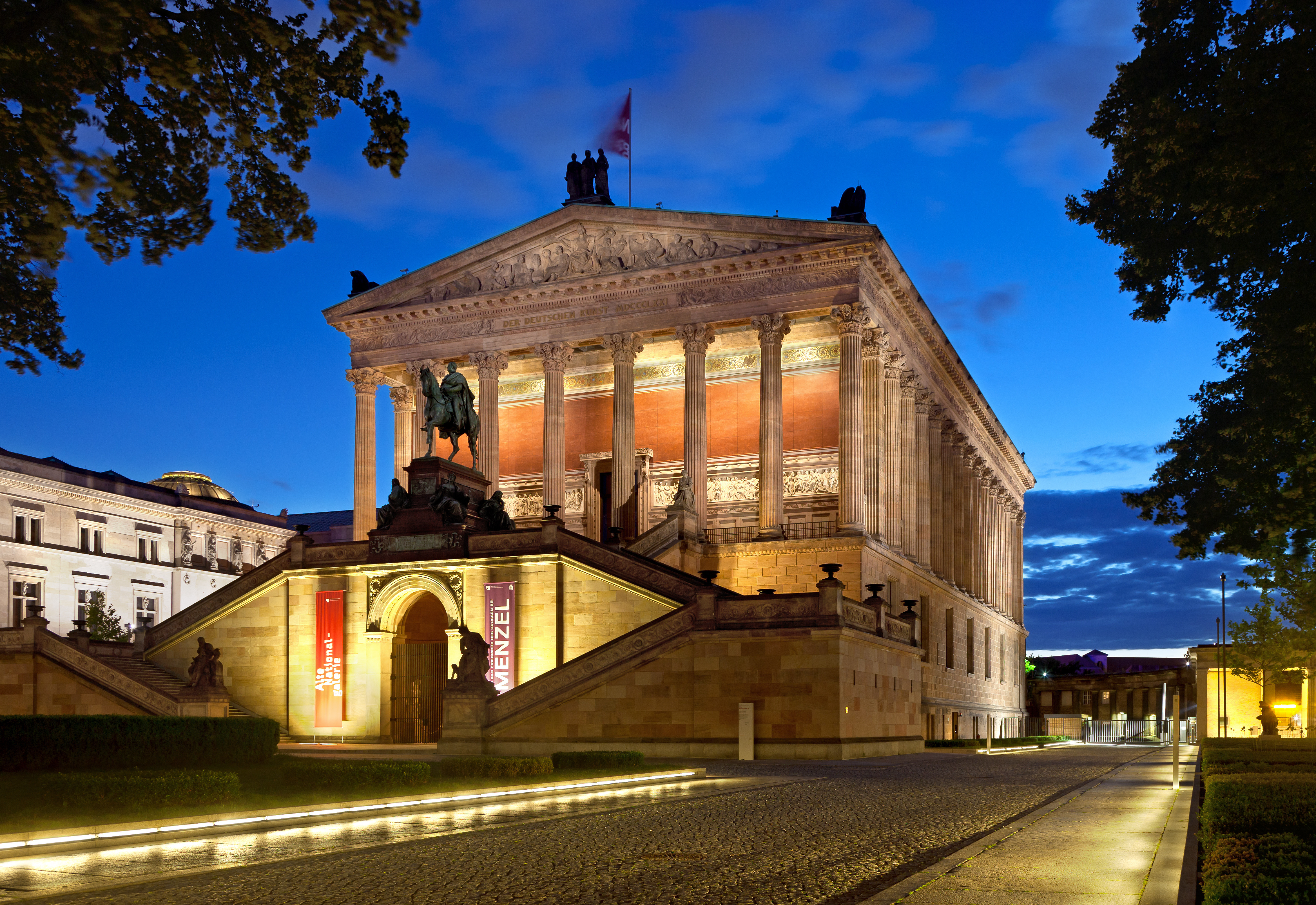
Berlin | Built 1862–1876; opened 22 March 1876 | State gallery of 19th-century art | 4.5★ (8,870 Google reviews)
A temple on a plinth — designed by Friedrich August Stüler, detailed by Carl Busse, realised by Heinrich Strack — built from 1862 and opened on 22 March 1876.[6] Part of the UNESCO-listed Museumsinsel, it holds roughly 1,800 paintings and 1,500 sculptures spanning the French Revolution to the First World War.[5] The Caspar David Friedrich room draws the crowd, but Menzel is the revelation: the Iron-Rolling Mill, Frederick the Great Playing the Flute at Sanssouci. Add Manet's In the Conservatory, Schadow's Princesses Luise and Friederike, Böcklin's Isle of the Dead and the Nazarene Joseph frescoes from the Casa Bartholdy in Rome.[5]

Berlin | Opened 1904 as the Kaiser-Friedrich-Museum; reopened 2006 | State museum of sculpture, Byzantine art and numismatics | 4.5★ (6,920 Google reviews)
The wedge at the island's northern tip, built by Ernst von Ihne, opened in 1904 as the Kaiser-Friedrich-Museum and reopened on 18 October 2006 after a €156 million refurbishment.[8] The building is shared, which is unusual in itself: sculpture from the Middle Ages to the eighteenth century, including Donatello's Pazzi Madonna, Canova's Dancer, Riemenschneider and Ignaz Günther; late-antique and Byzantine work of the third to fifteenth centuries; the Münzkabinett, over half a million objects and among the world's most important numismatic collections; and a group of paintings from the Gemäldegalerie.[7]

Berlin | Opened 15 September 1968; reopened August 2021 | State gallery of 20th-century art | 4.6★ (5,438 Google reviews)
Mies van der Rohe's last major work, opened on 15 September 1968: a black steel roof on eight columns over a column-free glass hall, and an icon of modernism independent of anything hung inside it.[9] It closed in 2015 for a €140 million overhaul by David Chipperfield Architects and reopened in August 2021.[10] The collection is twentieth-century — Cubism, Expressionism, Bauhaus, Surrealism — with Picasso's Femme assise, Kirchner's Potsdamer Platz, Kandinsky, Miró and Barnett Newman, plus Gerhard Richter's 100 Works for Berlin on long-term display.[10][29]

Berlin | Founded 1831 | State museum of prints and drawings | 4.6★ (198 Google reviews)
Germany's largest museum of graphic art, officially founded in 1831: more than 500,000 prints and around 110,000 drawings, pastels, watercolours and oil sketches.[12] Its supreme holding is Botticelli's cycle of drawings for Dante's Divine Comedy, purchased in 1882, alongside Dürer, Rembrandt and the private collections of Schinkel and Menzel.[11][12] Because paper cannot take light, nothing is on permanent display — the collection surfaces through rotating presentations, and anything else can be requested and examined at a desk in the study room.[11] With 198 Google reviews, it is the quietest great collection in Berlin.

Berlin | Station built 1846/47; opened as an art museum November 1996 | State museum of contemporary art | 4.2★ (6,708 Google reviews)
A surviving terminus of the Berlin–Hamburg railway, built to Friedrich Neuhaus's plans in 1846/47, out of railway service since 1884, converted by Josef Paul Kleihues and opened as an art museum in November 1996.[14] It carries the Nationalgalerie's holdings from 1960 onward, built around the Sammlung Marx — Beuys, Warhol, Kiefer, Rauschenberg and Twombly, including Beuys's Straßenbahnhaltestelle (1976), Warhol's Double Elvis (1963) and Rauschenberg's Pink Door (1954) — plus the Marzona collection of Conceptual and Arte Povera work and 268 pieces given from the Flick collection.[13]
Berlin collects Berlin

Berlin | Founded 1975; in Kreuzberg since 2004 | State museum of modern art, photography and architecture | 4.5★ (5,220 Google reviews)
It collects on a single rule: art made in Berlin, from 1870 to the present.[16] Founded as an association in 1975 and taken on by the State of Berlin in 1994, it has occupied a converted 1960s glass warehouse in Kreuzberg since 2004 — a West Berlin store of window panes held against another blockade, reworked by Jörg Fricke into nearly 4,000 square metres.[16] Inside: Otto Dix's Der Dichter Iwar von Lücken, Hannah Höch's Dada-Rundschau, Felix Nussbaum, Jeanne Mammen, Naum Gabo's papers in the artists' archives,[15] and some 73,000 photographs.[36]

Berlin | Founded 1696; reunified 1993 | Academy, archive and exhibition halls | 4.3★ (678 Google reviews)
Founded in 1696 by Frederick III, Elector of Brandenburg, and reunified from the divided East and West academies on 1 October 1993, this is less a museum than the working memory of German modernism.[24] Its archives — the most important interdisciplinary archives for modernist art and culture in the German-speaking world — hold more than 1,400 artists' archives, 14,000 linear metres of material, around 1.5 million photographs, 450,000 building plans and 53,000 artworks, including the Bertolt Brecht archive.[23] Exhibitions run at Günter Behnisch's glass building on Pariser Platz and Werner Düttmann's hall on Hanseatenweg.[24]
Out in the west: Dahlem and the Grunewald

Berlin | Initiated 1964; opened 15 September 1967 | Single-movement museum | 4.4★ (1,033 Google reviews)
Karl Schmidt-Rottluff, a founder member of Die Brücke, initiated the museum in 1964 with a donation to the State of Berlin; Werner Düttmann's building in Dahlem opened on 15 September 1967, and Erich Heckel later gave works from the group's early years.[17][18] It holds the world's largest body of work by the group — around 400 paintings and sculptures and several thousand drawings, watercolours and prints — among them Kirchner's Im Cafégarten (1914) and Sich kämmender Akt (1913).[18] Nothing anywhere else assembles German Expressionism's founding circle at this density.

Berlin | Built 1542 for Elector Joachim II | Renaissance hunting lodge and picture gallery | 4.4★ (1,873 Google reviews)
Berlin's oldest preserved palace, built in 1542 for Elector Joachim II and still standing in the forest that gave it its name.[20] It holds the city's largest Cranach collection — nearly thirty works by Lucas Cranach the Elder and his son, shown here since October 2011 — including nine large panels from a Passion cycle of 1537/38 painted for the collegiate church of the former Dominican monastery in Cölln.[19][20] Court portraits and paintings the Prussian royal house bought from the English merchant Edward Solly fill the remaining rooms. The separate hunting depot is closed for restoration.[19]
Contemporary art in repurposed buildings

Berlin | Bunker built 1941–42; collection opened to the public 2008 | Private collection in a wartime bunker | 4.4★ (1,673 Google reviews)
An air-raid bunker of 1941–42 by Karl Bonatz, built with forced labour to shelter up to 3,000 railway passengers and staff, then an NKVD detention prison, then a store for Cuban fruit — hence Bananenbunker — and from April 1992 to December 1996 a techno club.[22] Christian and Karen Boros bought it in 2003, and the collection has been shown there since 2008 across 3,000 square metres: international art from 1990 onward, hung in multi-year cycles and seen only in a small group on a booked guided tour.[21] The rooms matter as much as the work.

Berlin | Founded 1991 | Kunsthalle | 4.3★ (1,293 Google reviews)
Founded in 1991 in a derelict former margarine factory on Auguststraße by Klaus Biesenbach, Alexandra Binswanger, Clemens Homburger, Philipp von Doering and Alfonso Rutigliano, KW did as much as any institution to make Berlin a contemporary-art capital after the Wall.[25] It keeps no permanent collection and treats that as a virtue; 2,000 square metres across five floors have given first solo exhibitions to Absalon, Hiwa K, Wael Shawky and Mika Rottenberg. The Berlin Biennale, founded in 1996 by Eberhard Mayntz and Biesenbach, remains its sister organisation under the same roof.[25]

Berlin | Opened September 2023 | Private photography museum | 4.3★ (2,536 Google reviews)
Ranked here for its building as much as its programme. Franz Ahrens's Friedrichstraßenpassage, built 1907–08 and opened in 1909, was the city's second-largest shopping arcade; reduced to a ruin, it was occupied on 13 February 1990 by the Künstlerinitiative Tacheles, which held it as studios, cinema and galleries until eviction on 4 September 2012, and was then rebuilt under Herzog & de Meuron.[26] Fotografiska opened inside in September 2023.[27] It is privately run and non-collecting, showing rotating exhibitions, so nothing on the walls is permanent.[27]

Berlin | Pavilion built 1969; kunstverein founded 2007 | Kunstverein | 4.3★ (295 Google reviews)
A fully glazed octagon under a shallow tent roof, built in 1969 by Richard Paulick in the Kronprinzenpalais grounds; its entrance incorporates a cast-iron portal of about 1835 and terracotta reliefs salvaged from Schinkel's Bauakademie, demolished in 1962.[28] Under the GDR it housed the Schinkelklause restaurant. The kunstverein founded in 2007 shows experimental sculpture, installation and media art — Mike Kelley, Isa Genzken, Franz West, Paul McCarthy, Cyprien Gaillard. The site has form: from 1918 the Kronprinzenpalais held Ludwig Justi's Galerie der Lebenden, a model for MoMA, closed by the Nazis in 1937.[28]
How this list was made
Three signals decided the order, in this sequence.
First, the permanent collection — what it holds, and whether it can be seen anywhere else. This is why the Kupferstichkabinett, with 198 Google reviews, ranks above venues with several thousand: Botticelli's Dante drawings exist in one place. It is also why a non-collecting exhibition hall, however good its programme, cannot reach the top of a list like this.
Second, the weight of the building and the site, counted heavily where work still stands in the room it was made for — Stüler's 1876 gallery, Ernst von Ihne's 1904 wedge at the tip of the island, Mies van der Rohe's 1968 hall, and a 1542 hunting lodge hung with Cranachs.
Third, corroborated visitor evidence — the Staatliche Museen zu Berlin's own attendance figures where they distinguish one building from another, then Google rating and review volume read together. Review counts measure footfall, not holdings, and were never allowed to set the order on their own. An attendance figure for a museum group was never treated as a figure for one of its buildings.
Named works were checked against current ownership, not against reputation. Three works long associated with the Brücke-Museum are no longer there, or no longer securely there: Kirchner's Berlin Street Scene was returned to the heirs of its pre-war Jewish owners in 2006, Max Pechstein's drawing Two Female Dancers was returned to the Heymann heirs in 2024, and Kirchner's Erich Heckel and Otto Mueller Playing Chess was the subject of a 2024 settlement with the heirs of the dealer Victor Wallerstein, who was forced to sell it after fleeing Nazi Germany.[18] None of the three is named above. Restitution moves objects; guidebooks copied from older guidebooks tend not to notice.
Exclusions. Replica-and-experience attractions are out on principle. Berlin's Monsterkabinett is a ticketed twenty-five-minute automaton show rather than a collection, and it out-reviews museums holding real work — exactly the distortion this format exists to correct.[37] Commercial galleries are out for the same reason: Mojavari Gallery and Seven Star Gallery sell stock rather than keep it, and Direktorenhaus is a non-collecting design venue. "Staatliche Museen zu Berlin" is the umbrella body for fifteen collections, not a place you visit; its museums are ranked individually instead.[31] Haus Schwarzenberg is a courtyard of independent tenants — a gallery and shop, a cinema, studios, a bar and the Monsterkabinett among them — rather than an institution with a collection of its own.[38] No archaeological parks, ruins, underground tours or churches appear.
One venue was dropped for a reason worth stating. PalaisPopulaire shows the Deutsche Bank Collection in the Prinzessinnenpalais and is trading as this is written, but on 30 June 2026 it was reported that Deutsche Bank will close the space at the end of 2026, with works from the collection to be made accessible at various other locations in Berlin instead.[33][34] Ranking a venue that shuts within months would be a disservice. Fotografiska Berlin, by contrast, was checked and is operating with a programme running into 2027,[35] so it stays — with the stated caveat that it keeps no permanent collection.[27]
Fifteen is a ceiling rather than a quota. Berlin fills it comfortably, and the constraint here was the catalogue rather than the city; a city with fewer serious museums would have produced a shorter list.
Opening hours, ticket prices and temporary exhibitions are deliberately absent. They change faster than any guide can track, and each museum's own site is the only reliable source. Long-term closures and rebuilds are stated where they apply, because a museum shut for years is still reported as operating by mapping services. Every museum ranked above was checked against its own website, and none is closed.
References
- 1.Gemäldegalerie: Collection. Staatliche Museen zu Berlin ↗
- 2.Gemäldegalerie, Berlin. Wikipedia ↗
- 3.Egyptian Museum and Papyrus Collection: Collection. Staatliche Museen zu Berlin ↗
- 4.Neues Museum. Wikipedia ↗
- 5.Alte Nationalgalerie: Collection. Staatliche Museen zu Berlin ↗
- 6.Alte Nationalgalerie. Wikipedia ↗
- 7.Bode-Museum: Collections. Staatliche Museen zu Berlin ↗
- 8.Bode Museum. Wikipedia ↗
- 9.Neue Nationalgalerie: Profile. Staatliche Museen zu Berlin ↗
- 10.Neue Nationalgalerie. Wikipedia ↗
- 11.Kupferstichkabinett: Collection. Staatliche Museen zu Berlin ↗
- 12.Kupferstichkabinett Berlin. Wikipedia ↗
- 13.Hamburger Bahnhof: Collection. Staatliche Museen zu Berlin ↗
- 14.Hamburger Bahnhof. Wikipedia ↗
- 15.Berlinische Galerie: Specialised Fields of the Collection. Berlinische Galerie ↗
- 16.Berlinische Galerie: The Museum. Berlinische Galerie ↗
- 17.Brücke-Museum (official site). Brücke-Museum ↗
- 18.Brücke Museum. Wikipedia ↗
- 19.Grunewald Hunting Lodge. Stiftung Preußische Schlösser und Gärten Berlin-Brandenburg ↗
- 20.Jagdschloss Grunewald. Wikipedia ↗
- 21.Boros Collection – Bunker Berlin (official site). Sammlung Boros ↗
- 22.Reichsbahnbunker Friedrichstraße. Wikipedia (German) ↗
- 23.About the Archives. Akademie der Künste, Berlin ↗
- 24.History of the Akademie der Künste. Akademie der Künste, Berlin ↗
- 25.Mission & History. KW Institute for Contemporary Art ↗
- 26.Kunsthaus Tacheles. Wikipedia (German) ↗
- 27.Fotografiska. Wikipedia ↗
- 28.Schinkel Pavillon (Berlin-Mitte). Wikipedia (German) ↗
- 29.Neue Nationalgalerie (official site). Staatliche Museen zu Berlin ↗
- 30.Museum Island. Wikipedia ↗
- 31.Staatliche Museen zu Berlin. Wikipedia (German) ↗
- 32.Pergamon Museum. Wikipedia ↗
- 33.PalaisPopulaire. Wikipedia (German) ↗
- 34.Stefan Trinks. Berlin: Deutsche Bank schließt PalaisPopulaire. Frankfurter Allgemeine Zeitung, 2026 ↗
- 35.Fotografiska Berlin (official site). Fotografiska Berlin ↗
- 36.Berlinische Galerie: Photography Collection. Berlinische Galerie ↗
- 37.Monsterkabinett Berlin (official site). Monsterkabinett / Dead Chickens ↗
- 38.Haus Schwarzenberg: Die Mieter (official site). Schwarzenberg e.V. ↗
まだコメントはありません — 最初に投稿しましょう。