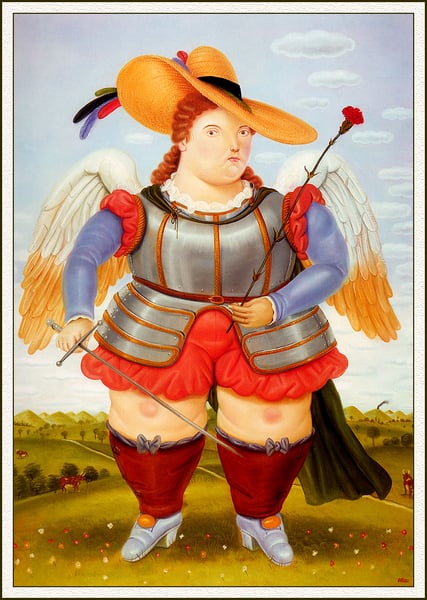
Saint Michael Archangel
Deskundige analyse van Saint Michael Archangel van Fernando Botero
Stijl: Naïve Art (Primitivism) · Genre: religious painting
Fernando Botero’s Saint Michael Archangel (1965) is a striking example of how the artist’s signature style—often termed “Boterismo”—transforms a traditional religious subject into a playful yet profound meditation on form and power. Though classified under Naïve Art (Primitivism) for its simplified shapes and direct composition, the work transcends mere folk influence through its deliberate, monumental distortion.
Significance within Botero’s oeuvre and the religious painting genre:
-
Volumetric reimagining of the sacred: Botero inflates every element—the archangel’s face, armor, wings, and even the defeated dragon—into bulbous, rounded forms. This is not a naive lack of skill but a calculated choice to emphasize mass and volume. By exaggerating proportion, Botero challenges the heroic, lean iconography of traditional Baroque or Renaissance archangels (e.g., Guido Reni’s slender St. Michael). His saint appears both imposing and oddly gentle, stripping the figure of martial tension while retaining spiritual authority.
-
Satirical and humanizing elements: The archangel’s almost comically serene expression and rotund physique introduce a note of irony. Botero often uses inflated bodies to critique vanity, power, and pomposity, yet here the treatment feels affectionate rather than mocking. The saint’s plumpness suggests an earthly, accessible divinity—a contrast to the ethereal severity of medieval or Counter-Reformation depictions. This aligns with Naïve Art’s tendency toward innocence, but Botero’s sophistication lies in his knowing subversion of canonical forms.
-
Folk and primitivist influences filtered through a modern lens: While Primitivism often draws from non-Western or untrained art, Botero synthesizes Latin American folk traditions (particularly Colombian colonial imagery) with European Old Master composition. The flat, decorative background and simplified folds of drapery recall retablo paintings, yet the artist’s precise modeling of volumes shows academic training. The result is a hybrid that feels timeless—rooted in religious narrative but speaking to 20th-century questions about beauty, perception, and representation.
-
Significance as a cultural icon: Today, Botero’s Saint Michael stands as a symbol of his unique contribution to global art: the transformation of religious painting from solemn reverence to a dialogue between weight and grace. It proves that Naïve Art need not be crude; here, it becomes a deliberate language for exploring the sacred through the absurdly human.
In essence, Saint Michael Archangel is significant because it redefines how we see a celestial warrior—not as a slender avenger, but as a robust, almost tender guardian whose power lies in his solid, unshakeable presence. Botero’s work reminds us that even in faith, form and humor can coexist.
Visueel vergelijkbaar
20 werken met verwante compositie en kleurenpalet
Archangel
Fernando Botero
The Archangel Gabriel
Fernando Botero
Self-Portrait as Spanish Conquistador
Fernando Botero
Louis XVI on a Visit to Medellin
Fernando Botero
Pala di Sant Agostino (Adoration of Pastors)
Pietro Perugino
Matthias Corvinus
Josef Kriehuber
Portrait of Giuliano II Cesarini aged 14
Sofonisba Anguissola
Kaiser Ferdinand II
Johann Peter Krafft
Portrait of a Knight
Vittore Carpaccio
The Archangel Michael
Francisco de Zurbaran
Saint George
Carlo Crivelli
Andreas I (c.1015-1060), King on Hungary from 1046 to 1060
Josef Kriehuber
Ludwig II
Josef Kriehuber
Don Juan de Austria ("Joannes Austriacus")
Anton Romako
Retrato De Jean De Croÿ, Conde De Solre
Juan van der Hamen
Alof of Vignancourt (after Caravaggio)
Fernando Botero
Prince Elector Joachim II of Brandenburg
Lucas Cranach the Elder
Portrait of Joachim II
Lucas Cranach the Elder
Robert Devereux (1566–1601), 2nd Earl of Essex
Marcus Gheeraerts the Younger
Sketch for Glinka's opera "Ivan Susanin". Guest
Konstantin Yuon