Notes
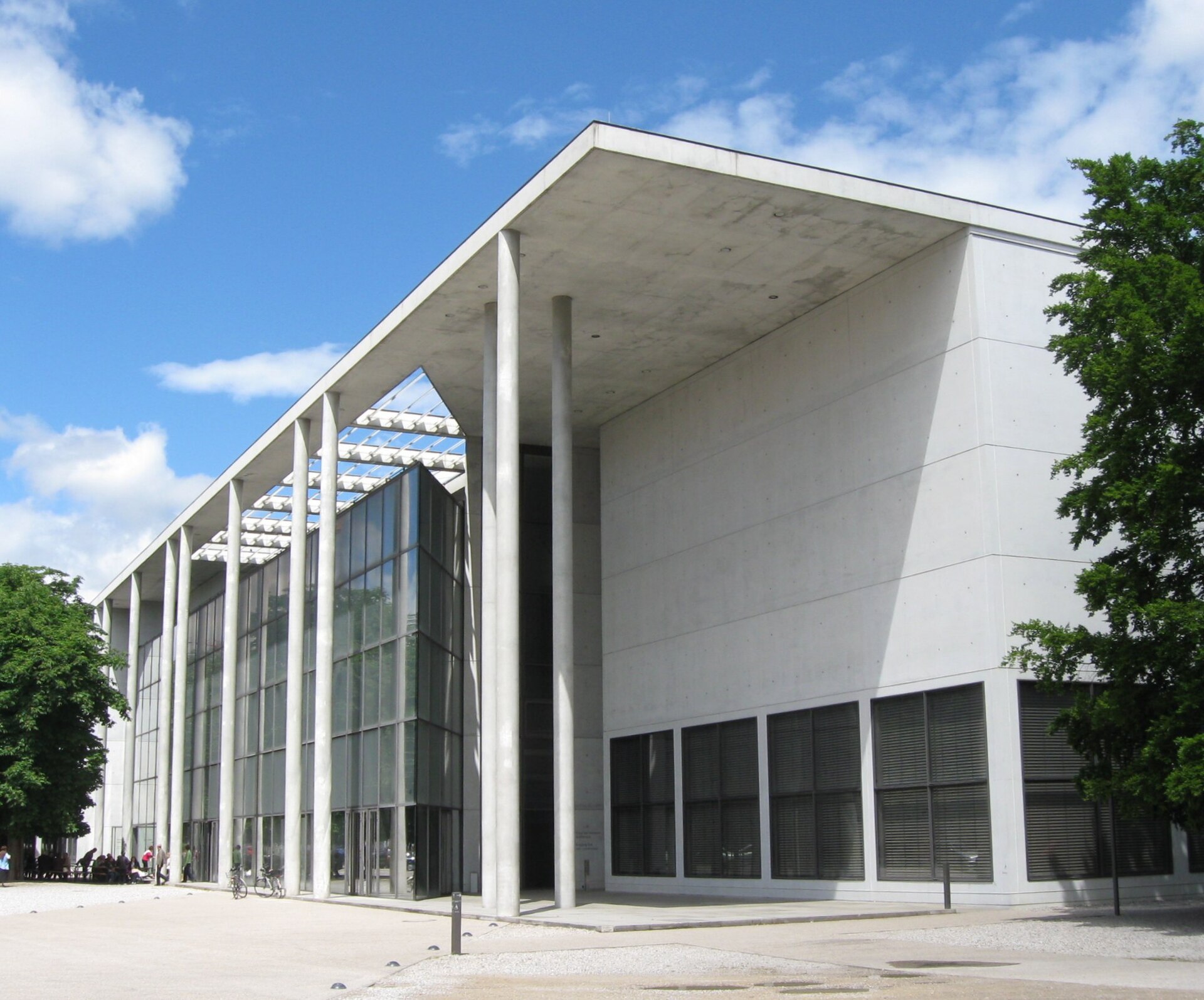
Pinakothek der Moderne is a contemporary art museum in München-Maxvorstadt, Germany, opened in September 2002 in a building designed by architect Stephan Braunfels, whose competition-winning design took roughly a decade to realize. The museum was created by unifying four previously separate collections under one roof: the National Collection of Modern and Contemporary Arts, the National Collection of Works on Paper (Graphische Sammlung), the National Museum for Design and Applied Arts, and the Architecture Museum of the Technical University of Munich. Each of these four holdings occupies its own corner of the building — Kunst, Graphik, Design, and Architektur — arranged around a central rotunda more than 30 meters in diameter beneath a roughly 25-meter-high skylight dome, a layout that lets visitors move between disciplines rather than following a single linear path.
The art collection spans 20th-century movements including Expressionism, Cubism, Surrealism, and Abstract Expressionism, with works by Picasso, Matisse, Kandinsky, and Klee, extending into contemporary art from the 1960s onward with pieces by Warhol, Rauschenberg, Beuys, and Serra. The Werkbund design collection, with around 60,000 to 70,000 objects across industrial design, graphic design, and decorative arts, ranks among the largest of its kind. The Graphische Sammlung adds Old Master drawings by Dürer, Rembrandt, and Leonardo da Vinci alongside modern works on paper, while the architecture branch holds drawings, blueprints, photographs, and models from major architects. This four-in-one structure — pairing fine art with design, works on paper, and architecture in a single Braunfels-designed building — makes the Pinakothek der Moderne a destination where a visitor can trace Kandinsky and Beuys, a Rembrandt sketch, and a design classic within one continuous circuit, a combination not offered by single-discipline museums.
Sources
Details
Locatie
Barer Straße 40, 80333 München, DE