Notes
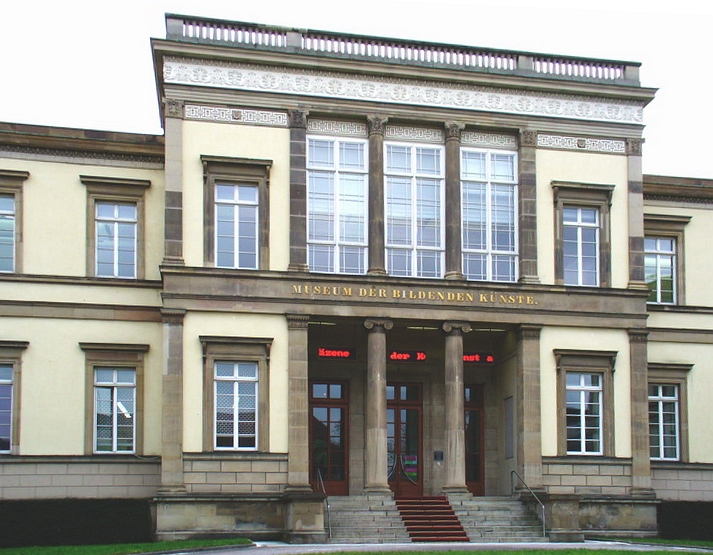
Staatsgalerie Stuttgart is a state art museum in Stuttgart, Germany, founded in 1843 as a royal gallery under King Wilhelm I in a classicist building designed by Georg Gottlob Barth. Severely damaged in the Second World War, the original structure was rebuilt between 1945 and 1947 and reopened in 1958; today it forms the Alte Staatsgalerie, housing European art from the German Renaissance and Italian painting of 1300–1800 through Dutch painting of the sixteenth and seventeenth centuries, German Baroque, and nineteenth-century Romanticism and Impressionism, with holdings that include marriage portraits by Frans Hals and Canaletto's A View of Dolo on the Brenta Canal. In 1984 the museum was joined by the Neue Staatsgalerie, an extension designed by James Stirling with Michael Wilford & Associates, built between 1979 and 1984 after winning a 1977 competition; its postmodern design echoes Schinkel's Altes Museum with galleries arranged around a central rotunda, and its opening turned the gallery from a regional institution into one of Europe's leading museums for twentieth-century art.
The Neue Staatsgalerie's collection spans the twentieth century with works by Picasso, Oskar Schlemmer, Joan Miró, Joseph Beuys, Max Beckmann, Salvador Dalí, Piet Mondrian, and Wassily Kandinsky, alongside Franz Marc's The Small Yellow Horses. The museum also maintains dedicated holdings of prints, drawings, and photographs, shown through rotating special exhibitions rather than permanent display. For visitors, this combination means the Alte Staatsgalerie's centuries of European painting can be seen alongside the Neue Staatsgalerie's twentieth-century collection and Stirling's building itself — an architectural attraction in its own right, with its curved glass entrance, travertine walls, and rotunda drawing visitors independent of the art inside.
Details
Locatie
Konrad-Adenauer-Straße 30-32, 70173 Stuttgart, DE