The Best Museums in the United States
Twenty collections ranked by what is actually on the walls — from the only Leonardo in the Americas to 4,400 glass flowers
American museums are a young country's answer to an old country's inheritance. Almost all of the great ones were founded inside a single compressed window — the Metropolitan Museum of Art and the Museum of Fine Arts, Boston both in 1870, the Philadelphia Museum of Art in 1876, the Art Institute of Chicago in 1879 — and they were filled by private fortunes buying at scale in Europe and Egypt at the moment both were selling.[1][13][15][6] The result is a country holding world-class depth in fields it has no native claim to. The National Gallery of Art in Washington owns the only painting by Leonardo da Vinci in the Americas.[5] The MFA's Old Kingdom Egyptian sculpture is, by the museum's own account, the greatest outside Cairo, and its Nubian material the largest and most important outside Khartoum.[12]
Two things follow for a visitor. The scale is genuinely different: the Met alone holds about 1.5 million objects and recorded 5,727,258 visits in fiscal 2025, making it the most-visited museum in the United States and the fifth-most-visited art museum in the world.[1] But the most distinctive American museums are frequently not the largest. A collector's house kept close to the way she left it — Isabella Stewart Gardner's Venetian-style palazzo in Boston, Albert Barnes's densely hung ensembles in Philadelphia — is a kind of institution Europe rarely produced, because there the great private collections tended to be absorbed into national museums instead. In these houses the arrangement is itself the work, and the founder's terms still govern what hangs where.[16][19]
The country also keeps the fullest record of its own art. The Whitney was founded in 1930 because American artists with new ideas had trouble exhibiting or selling their work, and it has run the Biennial since 1932 — the longest-running series of exhibitions surveying recent American art.[21] Between the encyclopaedic museums, the collector's houses and the national collections in Washington, a visitor can cover more art history in a week here than in most countries twice its age.
Distance is the practical constraint. These twenty museums are spread across ten cities and three time zones, and the top five alone are split between two coasts and the Midwest. This is a list to work through over years rather than a circuit to complete. What follows ranks them on what their permanent collections hold, not on how many people pass through them.
New York
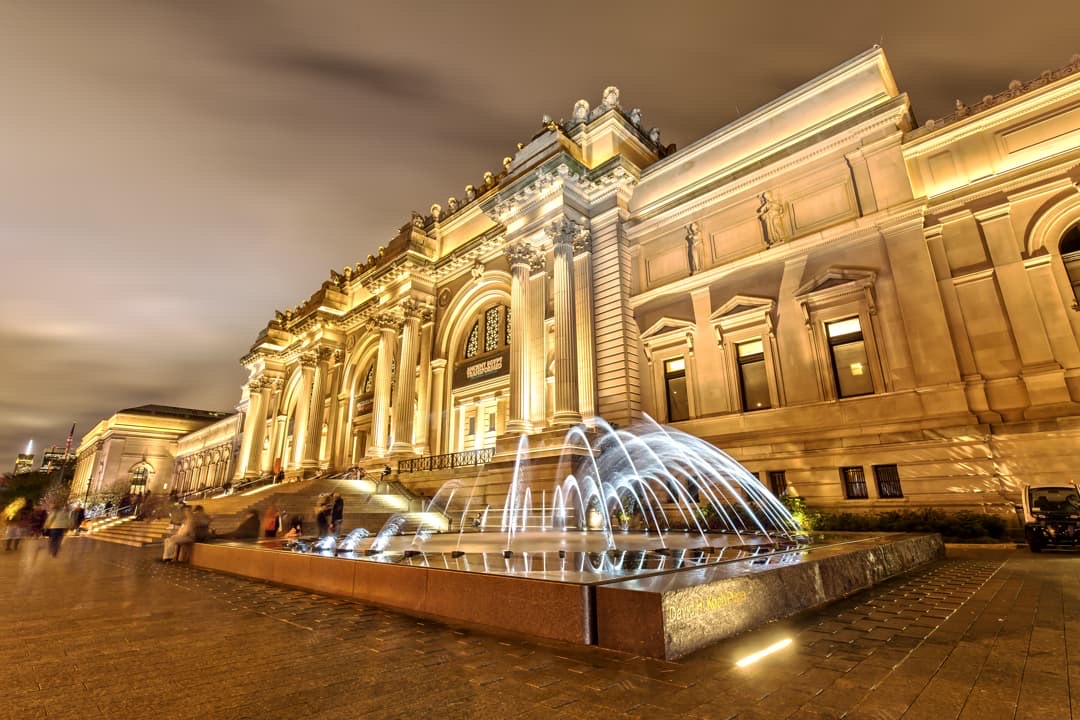
New York | 1870 | Encyclopaedic art museum | 4.8★ (88,000 Google reviews)
The Met is the only American museum that behaves like an encyclopaedia of everything: about 1.5 million objects across 5,000 years, on two New York sites.[1] Its Egyptian wing keeps the Temple of Dendur, built under Augustus between 23 and 10 BCE and given to the United States by Egypt in 1965 in thanks for American help saving Nubian monuments; it opened in its glass-walled gallery in 1978.[2] European painting, arms and armour, American period rooms and Asian art could each anchor a separate museum. It drew 5,727,258 visits in fiscal 2025, the most in the country.[1] A new wing by Frida Escobedo — the first woman to design one here — is under construction.[3]

New York | 1929 | Modern and contemporary art museum | 4.6★ (60,115 Google reviews)
Abby Aldrich Rockefeller, Lillie P. Bliss and Mary Quinn Sullivan founded MoMA in 1929, and it opened to the public on 7 November, nine days after the Wall Street Crash.[8] It went on to write much of the canon it now displays: Van Gogh's The Starry Night, Picasso's Les Demoiselles d'Avignon and Warhol's Campbell's Soup Cans are all here, among more than 150,000 works and roughly 22,000 films.[8] The 2019 expansion by Diller Scofidio + Renfro added 47,000 square feet of gallery space and rehung the collection chronologically, so painting sits alongside design, film and performance rather than in a separate lineage.[8]

New York | Wright building dedicated 1959 | Modern art museum | 4.3★ (25,052 Google reviews)
Frank Lloyd Wright's spiral, dedicated in October 1959, is the museum's chief exhibit: a continuous ramp that makes the building itself the route through the art, and part of the UNESCO World Heritage listing of Wright's twentieth-century architecture inscribed in 2019.[18] The roughly 8,000 works grew out of Solomon Guggenheim's non-objective collection, dense in Kandinsky, and were transformed by the 1963 acquisition of the Thannhauser Collection of Impressionist and early modern painting — Cézanne, Van Gogh, Picasso — which John Russell of The New York Times called the equivalent of the Frick in the domain of modern art. The rotunda shows only a fraction at a time.[18]

New York | 1930 | American art museum | 4.5★ (14,042 Google reviews)
Gertrude Vanderbilt Whitney founded the museum in 1930 because American artists with new ideas had trouble exhibiting or selling their work, and she introduced the Biennial in 1932 — the longest-running series of exhibitions surveying recent developments in American art.[21] The collection now exceeds 25,000 works by more than 3,500 artists, and the Whitney is the world's largest repository of Edward Hopper's artwork and archival material.[22] Renzo Piano's building in the Meatpacking District opened on 1 May 2015, with the city's largest column-free gallery spaces and stepped terraces looking back along the High Line.[22]

New York | Library completed 1906; public institution 1924 | Library and manuscript collection | 4.7★ (4,752 Google reviews)
J. Pierpont Morgan's library, built to Charles McKim's design between 1902 and 1906, was incorporated as a public institution in March 1924 and still reads as a collector's rooms rather than a museum's galleries.[25] It holds three Gutenberg Bibles, the Morgan Bible, the Hours of Catherine of Cleves, Dickens's manuscript of A Christmas Carol, music manuscripts by Mozart and Beethoven, and around 12,000 drawings and watercolours going back to the fourteenth century.[25] Renzo Piano's expansion opened in April 2006 after a three-year closure, knitting the historic buildings together without disturbing Morgan's study or the vaulted library itself.[25]
Washington, D.C.

Washington | 1937 | National art collection | 4.8★ (20,464 Google reviews)
Andrew W. Mellon's 1937 gift of his collection, together with the money to build a home for it, created a national collection that began at the summit instead of accumulating slowly.[4] Its centrepiece is Ginevra de' Benci of about 1474, the only painting by Leonardo da Vinci in the Americas.[5] John Russell Pope's pink-marble West Building of 1941, its rotunda modelled on the interior of the Pantheon in Rome, faces I. M. Pei's angular East Building of 1978 across a plaza.[4] The print collection alone runs to some 75,000 sheets, alongside rare illustrated books.[4]

Washington | Authorised by Congress 1962; opened 1968 | Portrait collection | 4.8★ (13,055 Google reviews)
Congress authorised the gallery in 1962 and it opened on 7 October 1968 in the Old Patent Office Building, constructed between 1836 and 1867 with porticoes modelled after the Parthenon.[32] It is the only museum in the United States dedicated solely to portraiture, with some 21,200 works. Its collection of presidential portraits is the largest and most complete in the world except for the White House's own, centred on Gilbert Stuart's Lansdowne portrait of Washington; Kehinde Wiley's 2018 portrait of Obama and Shepard Fairey's Hope hang under the same roof.[32]
Chicago and Houston

Chicago | 1879 | Encyclopaedic art museum | 4.8★ (38,603 Google reviews)
Founded in 1879 and holding nearly 300,000 works, the Art Institute has an Impressionist and Post-Impressionist collection widely regarded as one of the finest outside France.[6] Seurat's A Sunday on La Grande Jatte — 1884, painted between 1884 and 1886 and given with the Helen Birch Bartlett Memorial Collection, is ten feet of riverbank that dissolves into dots of complementary colour as you approach.[7] Hopper's Nighthawks, bought by the museum in 1942 for $3,000, is in the American galleries, as is Grant Wood's American Gothic.[6] Renzo Piano's Modern Wing, opened in May 2009, added 264,000 square feet.[6]

Houston | 1900; opened 1924 | Encyclopaedic art museum | 4.8★ (12,260 Google reviews)
Established in 1900 and opened to the public in 1924, the MFAH is the second-largest art museum in the Americas by gallery space, with nearly 80,000 works spanning more than 5,000 years and six continents.[23] Its Caroline Wiess Law building is the only Mies van der Rohe–designed museum in the United States — Cullinan Hall opened in 1958, the Brown Pavilion in 1974 — rooms that changed how American museums handled daylight.[23] Steven Holl's Nancy and Rich Kinder Building, opened in November 2020, increased the museum's overall exhibition space by nearly three-quarters.[23]

Chicago | 1893 | Natural history museum | 4.7★ (31,906 Google reviews)
Incorporated in September 1893 out of the World's Columbian Exposition and housed since 1921 in Daniel Burnham and Pierce Anderson's classical hall, the Field keeps over 24 million specimens and objects.[31] SUE is why most people come: around 90 percent complete, 250 of the approximately 380 known T. rex bones, more than 40 feet long and 13 feet tall at the hip, bought at auction for $8.4 million in 1997 and now in its own space inside the Evolving Planet gallery.[30] The man-eating lions of Tsavo are mounted in the African mammal hall.[31]
California

Los Angeles | Getty Center opened 1997 | Art museum | 4.8★ (34,503 Google reviews)
The Getty Center closes on 15 March 2027 for about eleven months of renovation, with reopening expected in spring 2028 — plan accordingly.[9] Richard Meier's travertine complex opened above the 405 freeway in December 1997, at an eventual cost of $1.3 billion, with Robert Irwin's 134,000-square-foot Central Garden folded into the hillside as a work in its own right.[9] The collection is deliberately narrow and deep: pre-twentieth-century European painting, drawings, illuminated manuscripts, sculpture and decorative arts, plus photography from the 1830s onward, including Van Gogh's Irises of 1889, bought in 1990.[9] The separate Getty Villa, holding 44,000 Greek, Roman and Etruscan antiquities, reopened in June 2025 after the Palisades Fire.[10]

San Marino | 1919; opened to the public 1928 | Library, art collection and gardens | 4.8★ (7,803 Google reviews)
Henry and Arabella Huntington's estate in San Marino, founded in 1919 and open to the public since 1928, is three institutions at once.[24] The library holds some 7 million manuscript items and over 400,000 rare books, among them one of only eleven vellum copies of the Gutenberg Bible known to exist and the Ellesmere Chaucer of about 1410, an early manuscript of The Canterbury Tales. The art collection includes Gainsborough's The Blue Boy and Lawrence's Pinkie. Outside, 120 acres of gardens include a desert garden of more than 5,000 species.[24]
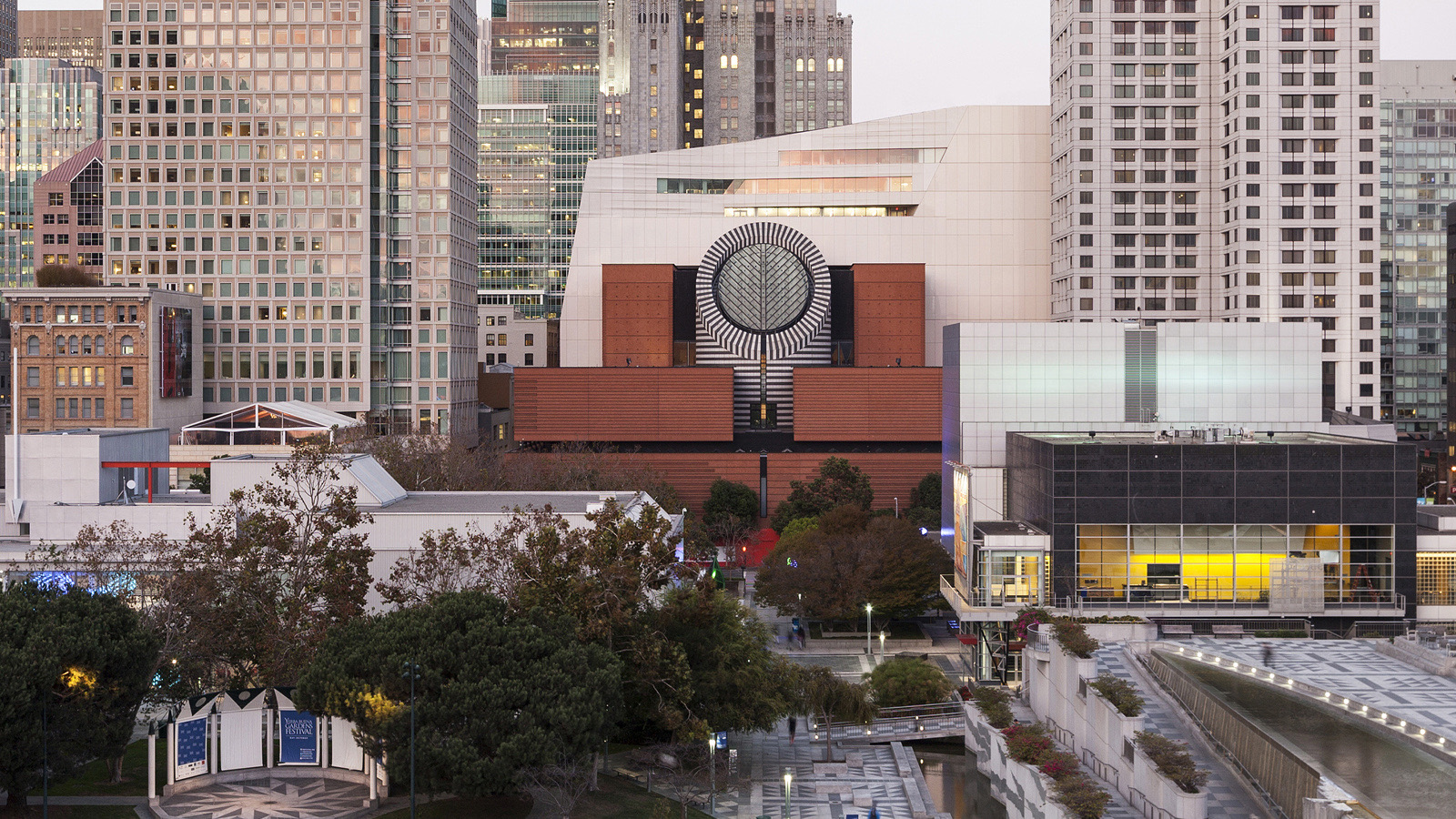
San Francisco | 1935 | Modern and contemporary art museum | 4.6★ (16,696 Google reviews)
Founded in 1935 as the first museum on the West Coast devoted solely to twentieth-century art, SFMOMA began collecting photography the following year, unusually early for an American institution.[27] Its scale changed in 2009, when the Doris and Donald Fisher collection of some 1,100 works — Calder, Richter, Kelly, Warhol — arrived on a hundred-year loan.[27] Snøhetta's addition, opened in May 2016 after a three-year closure, more than doubled the gallery space; the museum counts 45,000 square feet of the result as free public space, so a good deal of the art can be seen without a ticket.[26]

Los Angeles | 1961; David Geffen Galleries opened 2026 | Encyclopaedic art museum | 4.6★ (20,899 Google reviews)
LACMA is the largest art museum in the western United States, with a collection of 155,000 objects spanning 6,000 years of artistic expression.[28] Its four original buildings were demolished in 2020 and replaced by Peter Zumthor's David Geffen Galleries, which opened to members on 19 April 2026 and to the general public on 4 May 2026: a single horizontal floor showing up to 3,000 objects at a time, rotated rather than fixed.[29] Outside and free to walk through are Chris Burden's Urban Light, 202 antique cast-iron street lamps, and Michael Heizer's Levitated Mass, a 340-ton boulder over a trench.[29]

San Francisco | 1924 | European art museum | 4.8★ (5,252 Google reviews)
Opened on Armistice Day, 11 November 1924, the building is a full-scale replica of the 1915 Panama-Pacific Exposition's French Pavilion, itself a three-quarter-scale version of the Palais de la Légion d'Honneur in Paris; it stands alone on the headland above the Golden Gate, which is half the experience.[33] A cast of Rodin's The Thinker occupies the inner courtyard. The Achenbach Foundation for Graphic Arts, housed here, holds more than 90,000 items, the largest repository of works of art on paper in the western United States. With the de Young it forms the Fine Arts Museums of San Francisco.[33]
Boston and Cambridge

Boston | 1870 | Encyclopaedic art museum | 4.8★ (20,027 Google reviews)
Founded in 1870, the MFA holds nearly 500,000 works and is strongest exactly where American museums usually are not.[11] Its Old Kingdom Egyptian sculpture is, by the museum's own account, the greatest outside Cairo, and its Nubian material the largest and most important outside Khartoum — both gathered through excavations in Egypt and Sudan led by George A. Reisner between 1905 and 1942.[12] The Japanese collection of some 100,000 items, including over 30,000 ukiyo-e prints, is the largest under one roof outside Japan.[13] Foster + Partners' Art of the Americas Wing opened in November 2010.[13]

Boston | Opened 1903 | Collector's house museum | 4.7★ (11,273 Google reviews)
Gardner opened Fenway Court on 1 January 1903, a Venetian-style palazzo built around a glass-roofed courtyard, and her will required the collection to stay permanently as she arranged it, which is why the rooms still look as she left them.[16] Titian's The Rape of Europa of 1562 and Sargent's El Jaleo remain in place among more than 7,500 objects. So do the empty frames: on 18 March 1990 thieves took thirteen works, including Vermeer's The Concert and Rembrandt's The Storm on the Sea of Galilee, in the highest-value museum robbery in history. It is still unsolved, and nothing has been recovered.[17]
Cambridge | 1998 | University natural history museum | 4.8★ (5,779 Google reviews)
Formed in 1998 as the public face of Harvard's Museum of Comparative Zoology, Mineralogical and Geological Museum and University Herbaria, it exists above all for one collection: the Ware Collection of Blaschka Glass Models of Plants.[35] Leopold and Rudolf Blaschka made roughly 4,400 models representing over 830 plant species between 1887 and 1936, including 64 depicting the effects of fungal disease — work that generations of glassworkers have tried and failed to reproduce.[34] Around them are the mineral, gem and meteorite galleries and the only mounted Kronosaurus, and one admission also opens the adjoining Peabody Museum.[35]
Three things set the order, in this weight. First, what the permanent collection actually holds, and whether it can be seen anywhere else — the only Leonardo in the Americas, 181 Renoirs on one set of walls, 4,400 glass plants that later glassmakers have tried and failed to reproduce. Second, the art-historical weight of the building and the site, with work still standing in the room it was made for counting heavily; that is why the Gardner, the Barnes and the Guggenheim outrank larger museums with far more visitors. Third, and only third, corroborated visitor evidence: published attendance where it exists, then Google rating and review volume read together. Review counts measure footfall, not collections. The Met carries nearly nineteen times the reviews of the Barnes Foundation and roughly seventeen times those of the Legion of Honor, which is a fact about tourist traffic in Manhattan rather than about art, and it was never allowed to set a position on its own.
Several heavily reviewed entries in the catalog were excluded on principle. Replica-and-experience attractions hold no permanent collection: the Museum of Illusions, the Balloon Museum, the Medieval Torture Museum, Paradox Museum, WNDR, ARTECHOUSE and the Museum of Ice Cream. Some of them out-review real museums, which is exactly why the rule exists. Boston Tea Party Ships & Museum works from replica vessels and live reenactment. Outdoor and civic sites that Google files as museums are also out: Wynwood Walls, the Olympic Sculpture Park, Philadelphia's Magic Gardens, the Museum Campus, the San Francisco Botanical Garden, the Bunker Hill Monument, and the Philadelphia Museum of Art Steps, which is a staircase. Science and children's centres — the Franklin Institute, the Exploratorium, Pacific Science Center, Please Touch and the Chicago Children's Museum — are built around demonstrations rather than holdings. Being small or quiet disqualifies nothing; having no collection does. The Broad, Vizcaya, the Mütter Museum, the Brooklyn Museum, the de Young, Seattle Art Museum, Pérez Art Museum Miami, the Hirshhorn and the MCA Chicago are all real museums that simply lost places at twenty.
The catalog reaches ten cities, so this is not a national survey. Several genuinely essential museums are absent from it and cannot be ranked here: the Smithsonian's National Museum of Natural History, National Air and Space Museum and National Museum of African American History and Culture in Washington; the Frick Collection in New York; the Menil Collection in Houston; the Kimbell Art Museum in Fort Worth; the Cleveland Museum of Art; the Detroit Institute of Arts; the Nelson-Atkins Museum in Kansas City; Crystal Bridges in Bentonville; and Dia Beacon in the Hudson Valley.
Opening hours, ticket prices and temporary exhibitions are deliberately absent. They change faster than any guide can track, and only the museum's own site is reliable on them. Long-term building work is included, because Google reports a museum as operating whether or not the galleries you came for are open — which is why the Getty Center's closure from 15 March 2027 until spring 2028 leads its entry rather than sitting in a footnote.[9] Check the Met's wing construction and the Philadelphia Museum of Art's Gehry works before planning around any single gallery.
Philadelphia

Philadelphia | 1876 | Encyclopaedic art museum | 4.8★ (23,592 Google reviews)
Behind the film-famous steps sits a collection of more than 240,000 objects in a 1928 Fairmount building whose designers included Julian Abele, who in 1902 had become the first African American to graduate from the University of Pennsylvania's Department of Architecture.[15] The Duchamp holdings are the reason to make the trip: The Bride Stripped Bare by Her Bachelors, Even (The Large Glass), made between 1915 and 1923, partially shattered in transit and was repaired by Duchamp in 1936 — he later declared the symmetrical pattern of cracks an improvement.[14] Étant donnés, the tableau he worked on in secret, is installed nearby.[15]

Philadelphia | Chartered 1922; Parkway building 2012 | Collector's foundation | 4.7★ (4,703 Google reviews)
Albert Barnes chartered his foundation in 1922 and hung it his own way, in dense symmetrical wall ensembles that mix paintings with decorative metalwork, furniture, African masks and Native American jewellery; his final 1951 arrangement is still what you see.[19] The counts are hard to credit: 181 Renoirs, 69 Cézannes, 59 Matisses, 46 Picassos and 16 Modiglianis, together with The Dance II, the 45-by-15-foot triptych Barnes commissioned from Matisse for the main gallery.[20] After years of litigation the collection moved from suburban Merion to the Benjamin Franklin Parkway in 2012, ensembles intact.[19]
References
- 1.Metropolitan Museum of Art. Wikipedia ↗
- 2.Temple of Dendur. Wikipedia ↗
- 3.Frida Escobedo. Wikipedia ↗
- 4.National Gallery of Art. Wikipedia ↗
- 5.Ginevra de' Benci. Wikipedia ↗
- 6.Art Institute of Chicago. Wikipedia ↗
- 7.A Sunday Afternoon on the Island of La Grande Jatte. Wikipedia ↗
- 8.Museum of Modern Art. Wikipedia ↗
- 9.Getty Center. Wikipedia ↗
- 10.Getty Villa. Wikipedia ↗
- 11.About the MFA. Museum of Fine Arts, Boston ↗
- 12.Ancient Egypt, Nubia, and the Near East. Museum of Fine Arts, Boston ↗
- 13.Museum of Fine Arts, Boston. Wikipedia ↗
- 14.The Bride Stripped Bare by Her Bachelors, Even (The Large Glass), Marcel Duchamp. Philadelphia Museum of Art ↗
- 15.Philadelphia Museum of Art. Wikipedia ↗
- 16.Isabella Stewart Gardner Museum. Wikipedia ↗
- 17.Isabella Stewart Gardner Museum theft. Wikipedia ↗
- 18.Solomon R. Guggenheim Museum. Wikipedia ↗
- 19.About the Barnes Foundation. Barnes Foundation ↗
- 20.Barnes Foundation. Wikipedia ↗
- 21.History of the Whitney. Whitney Museum of American Art ↗
- 22.Whitney Museum of American Art. Wikipedia ↗
- 23.Museum of Fine Arts, Houston. Wikipedia ↗
- 24.Huntington Library. Wikipedia ↗
- 25.Morgan Library & Museum. Wikipedia ↗
- 26.About SFMOMA. San Francisco Museum of Modern Art ↗
- 27.San Francisco Museum of Modern Art. Wikipedia ↗
- 28.About LACMA. Los Angeles County Museum of Art ↗
- 29.Los Angeles County Museum of Art. Wikipedia ↗
- 30.SUE the T. rex. Field Museum ↗
- 31.Field Museum of Natural History. Wikipedia ↗
- 32.National Portrait Gallery (United States). Wikipedia ↗
- 33.Legion of Honor (museum). Wikipedia ↗
- 34.Glass Flowers. Wikipedia ↗
- 35.Harvard Museum of Natural History. Wikipedia ↗
还没有评论 — 来抢沙发吧。