The Best Museums in New York
Fifteen collections ranked by what they actually hold, the rooms that hold it, and the evidence that people come
New York has no royal collection behind it. Almost everything in its museums was bought, dug up, commissioned or argued over within the last century and a half by private citizens whose names are still on the doors, and the city's museums have the character that produces: opinionated, uneven, and extraordinarily deep in places where a national museum would be merely competent.
The concentration is the point. Within a few miles of Fifth Avenue you can stand inside an Egyptian temple that Egypt gave to the United States in 1965, look at the painting that broke European picture-making in 1907, find three Vermeers in a Gilded Age mansion, and walk up a Frank Lloyd Wright ramp that is itself part of a UNESCO World Heritage site.[3][8] The Metropolitan Museum of Art alone drew 5,984,091 visitors in 2025, more than any other museum in the United States.[2]
Scale is not the whole argument. What separates New York is that its second and third ranks would be another city's first: a borough museum holding the second-largest Egyptian collection in North America,[9] a private library with three Gutenberg Bibles,[13] a Washington Heights institution with three Velázquez, five Goya and seven El Greco.[15]
Fifteen museums are ranked below, in five groups. Several significant institutions are missing because they are not yet in Caleido's catalog, not because they were judged and rejected — among them the American Museum of Natural History, the Met Cloisters (formally part of the Metropolitan Museum, though its Fort Tryon Park building is a destination in its own right), the Noguchi Museum, the Studio Museum in Harlem, El Museo del Barrio and the Museum of the City of New York.
The first rank
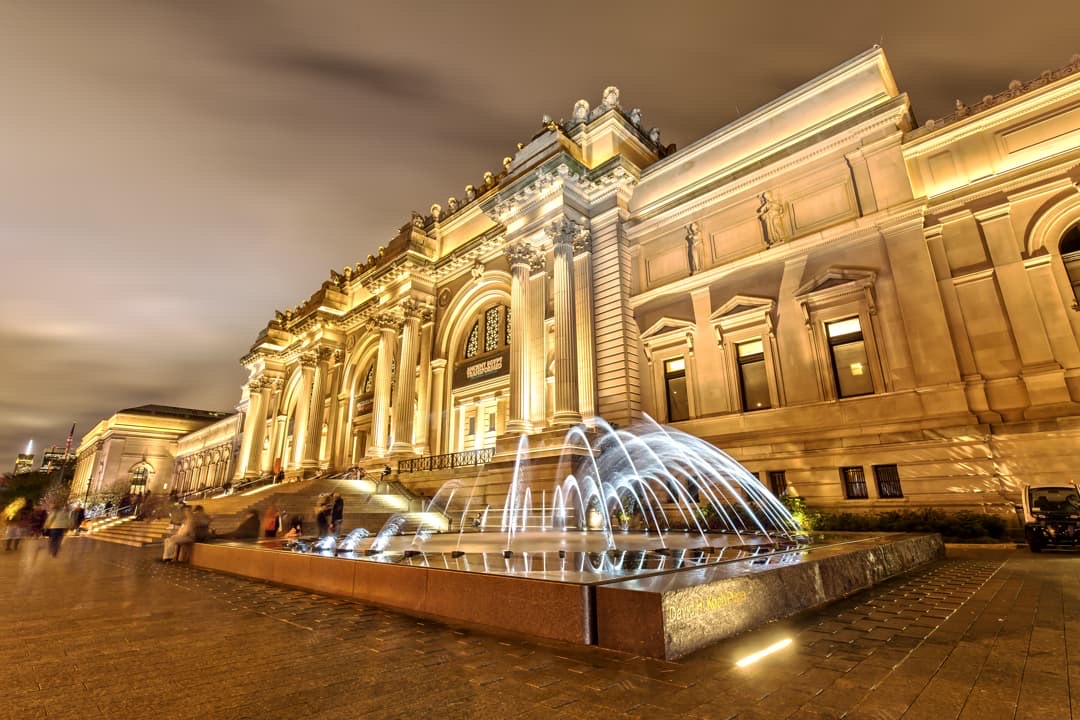
New York | 1870 | Encyclopedic art museum | 4.8★ (88,000 Google reviews)
Founded in 1870, the Met holds roughly 1.5 million works across seventeen curatorial departments, an encyclopedic range running from Sumerian seals to twentieth-century painting under one roof.[1] Egypt gave the Temple of Dendur to the United States in 1965; since 27 September 1978 it has stood indoors in a glass-walled gallery, a reflecting pool in front of it standing in for the Nile.[1][3] The American Wing keeps Leutze's Washington Crossing the Delaware of 1851 and a run of period rooms.[1] It drew 5,984,091 visitors in 2025, more than any other museum in the country.[2]

New York | 1929 | Museum of modern and contemporary art | 4.6★ (60,115 Google reviews)
Three women — Abby Aldrich Rockefeller, Lillie P. Bliss and Mary Quinn Sullivan — founded MoMA on 7 November 1929, and the collection they began still sets the terms of the argument about modern art: Picasso's Les Demoiselles d'Avignon, Van Gogh's The Starry Night, Monet's Water Lilies, Warhol's Campbell's Soup Cans.[4] Beyond painting it holds more than 200,000 works, including roughly 22,000 films, plus architecture, design and photography departments that treat the designed object as seriously as the canvas.[4] The 2019 rebuild added 47,000 square feet of galleries; 2,657,377 people came in 2024.[4][2]

New York | Reopened 2025 (museum opened 1935) | Private collection in a historic house | 4.6★ (3,785 Google reviews)
Henry Clay Frick's Fifth Avenue house, commissioned in 1913 from Carrère and Hastings, opened as a museum in 1935 and reopened on 17 April 2025 after a renovation by Annabelle Selldorf that added ten galleries.[5][6] Roughly 1,800 works hang in domestic rooms rather than white cubes: three Vermeers, Bellini's St. Francis in the Desert, Holbein's portraits of Thomas More and Thomas Cromwell, Rembrandt's self-portrait of 1658 and The Polish Rider, and Fragonard's Progress of Love panels.[5][6] The rooms are few and the standard never drops.

New York | 1937; Wright building opened 1959 | Modern art museum | 4.3★ (25,052 Google reviews)
Wright's spiral opened on 21 October 1959 and was inscribed on the UNESCO World Heritage List on 7 July 2019 as one of eight buildings in The 20th-Century Architecture of Frank Lloyd Wright — the only entry on this list with that status.[7][8] The building is half the reason to go, but the holdings are substantial: Solomon Guggenheim's non-objective collection, and the paintings Justin K. Thannhauser bequeathed from 1963, among them Picasso's Woman Ironing and The Blind Man's Meal, installed in a wing of their own from 1965.[7][35] It recorded 861,374 visitors in 2023.[2]
Collections that own their field

New York | 1823 | Encyclopedic art museum | 4.7★ (9,575 Google reviews)
Founded in 1823 and housed since 1897 in a 560,000-square-foot McKim, Mead & White building, Brooklyn holds around 500,000 objects and is a great museum that happens to sit outside the tourist circuit.[9] Its Egyptian collection is the second largest in North America, with the predynastic Bird Lady figurine and the Brooklyn Papyrus.[9] Judy Chicago's The Dinner Party, given in 2002, has been permanently installed since the Elizabeth A. Sackler Center for Feminist Art opened in March 2007, and exists nowhere else.[9][10] Nineteen American period rooms, opened in 1929, anchor the American galleries.[9]

New York | 1930 | Museum of American art | 4.5★ (14,042 Google reviews)
Devoted entirely to American art, founded in 1930 by the sculptor Gertrude Vanderbilt Whitney to back artists the establishment overlooked.[11] More than 27,000 works by Hopper, O'Keeffe, Calder, Basquiat and Ringgold sit behind the Biennial, the longest-running survey of American art.[11] It is the world's largest repository of Edward Hopper's artwork and archival material, which makes it the one place to understand him properly.[12] Renzo Piano's Gansevoort Street building opened on 1 May 2015 with the city's largest column-free gallery spaces; 888,816 visitors came in 2024.[12][2]

New York | 1924 (library completed 1906) | Library and museum | 4.7★ (4,752 Google reviews)
Charles McKim built Pierpont Morgan's library beside his house, finishing in 1906; his son transferred it to a board of trustees in 1924 with a $1.5 million endowment, turning a private hoard into a public institution.[13] The collection treats the book as an art form: three Gutenberg Bibles, more than 1,100 illuminated manuscripts, Dickens's manuscript of A Christmas Carol, music in the hands of Beethoven, Mozart and Chopin, and some 12,000 drawings.[13] Morgan's private office and vault opened to the public after Renzo Piano's 2006 expansion, and those rooms are as much the point as the cases.[13]
Collections made by one eye

New York | 1904 | Museum and research library | 4.4★ (179 Google reviews)
Archer M. Huntington founded the society on 18 May 1904 and filled a Beaux-Arts building on Audubon Terrace with Spanish art the society calls unparalleled outside Spain: three Velázquez, five Goya and seven El Greco among more than 18,000 works, backed by a library of more than 250,000 books.[14][15] He commissioned Sorolla's Vision of Spain in 1911; the fourteen panels, painted between 1913 and 1919 and running more than 200 linear feet, still ring the gallery they were commissioned for.[15] Renovation of Audubon Terrace continues, so parts of the permanent collection may be off view.[16]

New York | 2001 | Private museum of Austrian and German art | 4.4★ (2,948 Google reviews)
The galleries are closed and reopen on 12 November 2026.[19] Ronald Lauder and Serge Sabarsky's museum of early twentieth-century Austrian and German art opened in November 2001 in the William Starr Miller House on Fifth Avenue: Klimt, Schiele, Kokoschka and Gerstl alongside the Wiener Werkstätte, with Kirchner, Beckmann, Dix and the Bauhaus on the German side.[17][18] The centrepiece is Klimt's Portrait of Adele Bloch-Bauer I, bought from Maria Altmann in 2006 for a reported $135 million and shown since that July.[18] In May 2026 the museum and the Metropolitan announced plans to merge in 2028.[18]
A city, a community, a craft

New York | 1804 | History museum and research library | 4.5★ (673 Google reviews)
New York's first museum, founded in 1804 and renamed New York Historical in October 2024.[20] It owns all 435 surviving watercolours Audubon made for The Birds of America, and Thomas Cole's five-canvas Course of Empire of 1833 to 1836, acquired in 1858 and one of the most ambitious allegories an American painter attempted.[20][22] The fourth-floor gallery shows 100 illuminated Tiffany lamps and credits Clara Driscoll and the Tiffany Girls who designed many of them.[21] Robert A. M. Stern's 80,000-square-foot Tang Wing opened on 18 June 2026.[20]

New York | 1904 | Art and cultural history museum | 4.4★ (1,765 Google reviews)
The collection began in 1904 with Judge Mayer Sulzberger's gift of ceremonial objects to the Jewish Theological Seminary, and the museum describes itself as the first institution of its kind in the United States.[23][24] It now holds nearly 30,000 objects across archaeology, ritual silver, painting and media, with work by Chagall, Tissot and George Segal.[23][24] It opened in the Warburg Mansion in 1947 — a châteauesque pile of 1906 to 1908 by C. P. H. Gilbert that Frieda Schiff Warburg gave to the seminary in January 1944 — and the house frames the objects unusually well.[24]

New York | 1897 | Design museum | 4.4★ (2,987 Google reviews)
By its own account the only museum in the United States devoted exclusively to historical and contemporary design, founded in 1897 by Sarah and Eleanor Hewitt, granddaughters of Peter Cooper.[25] Its 215,000-odd objects span thirty centuries of textiles, wallcoverings, drawings, furniture and product design, and they are shown inside Andrew Carnegie's mansion on 91st Street, which is half the reason to go.[25] It ranks here rather than higher because the collection reaches visitors through rotating thematic exhibitions rather than a fixed permanent display, and the third floor is closed.[36][26]

New York | 1972 | City art museum | 4.5★ (3,446 Google reviews)
Founded in 1972 in the New York City Building on the old World's Fair grounds, which housed the United Nations from 1946 to 1950.[28] It holds one thing that exists nowhere else: the Panorama of the City of New York, built for the 1964–65 Fair by Raymond Lester & Associates at the request of the fair's president, Robert Moses. At 9,335 square feet and a scale of 1:1200, it reproduces 895,000 buildings across 273 sections, the Empire State Building standing fifteen inches tall.[27]
Small rooms, single subjects

New York | Single-artist museum | 4.8★ (491 Google reviews)
A brownstone on West 107th Street where more than 150 works by Nicholas Roerich hang across three floors, most of them permanently: Himalayan peaks in flat, saturated colour by the painter who devised The Rite of Spring with Stravinsky and made its sets and costumes.[29][30][37] The collection began at the Master Apartments, built for Nicholas and Helena Roerich in 1929, and moved here later.[30] Nothing about the place is grand, which is the appeal: three floors of one artist's vision, arranged as his keepers believe he intended.[29][37]

New York | 1990; accredited as a museum 2016 | Art museum | 4.5★ (261 Google reviews)
It began in 1969, when Charles Leslie and Fritz Lohman hung an exhibition of gay art in their Prince Street loft; during the AIDS crisis the two rescued work from families who meant to destroy it.[31][32] The foundation was granted nonprofit status in 1990 and formally accredited as a museum in 2016 — as of 2019, the only museum in the world dedicated to artwork documenting the LGBTQ experience.[31][32] It has been at 26 Wooster Street in SoHo since 2006, and counts Warhol, Hockney and Mapplethorpe among its holdings.[32]
How this list was made
Three criteria, in this order of weight.
First, what the permanent collection actually holds, and whether it can be seen anywhere else. This is why the Brooklyn Museum outranks better-attended institutions, and why the Hispanic Society — shut for years and still only partly reinstalled — ranks as high as it does: three Velázquez, five Goya and seven El Greco are not replaceable by a good temporary programme.[15]
Second, the art-historical weight of the building and the site, with work still standing where it was commissioned to stand counting heavily. Sorolla's fourteen Vision of Spain canvases ring the gallery Huntington commissioned them for; Pierpont Morgan's study and Wright's rotunda are cases where the container is part of the work.[15][13][7]
Third, corroborated visitor evidence: published attendance figures where they exist, and Google rating together with review volume where they do not. Review count measures footfall, not collections, and it was never allowed to set a rank on its own.
What was excluded. Immersive-experience venues: ARTECHOUSE NYC occupies a converted century-old boiler room in Chelsea Market and programmes rotating digital work rather than a permanent collection, yet its 5,320 reviews outnumber those of several museums ranked above it.[33] Commercial galleries and non-collecting exhibition spaces: David Zwirner, C24 Gallery, NewYorkART, Artists Space and Lehman College Art Gallery show art without holding it. Columbia University is a university. The National Academy of Design closed its museum and art school in 2015 and sold its Fifth Avenue home, so there is no museum to visit.[34] Being small or quiet disqualifies nothing — the Nicholas Roerich Museum has 491 reviews and is ranked — but holding no collection disqualifies everything.
The Newark Museum of Art appears in the catalog under New York. It is in Newark, New Jersey, a different city with its own museum history, and it is left out on geography alone, not on merit. One further catalog note: the Jewish Museum entry carries a website and description belonging to the Jewish Museum in Berlin; the institution described here is the New York one, in the Warburg Mansion on Fifth Avenue.
Closures were checked museum by museum, because Google reports an institution shut for rebuilding as operational. The Neue Galerie's galleries are closed and reopen on 12 November 2026.[19] The Hispanic Society's Audubon Terrace renovation continues, and parts of its permanent collection may be off view.[16] Cooper Hewitt's third floor is closed.[26] The Frick, by contrast, reopened on 17 April 2025 after its first major renovation in nearly ninety years.[5]
No opening hours, ticket prices or temporary exhibitions appear anywhere in this guide. They change faster than any article can track them, and the museums' own sites are the only reliable source. Everything stated here comes from the institutions' own pages or from major reference works, and every link below was fetched and returned HTTP 200 before publication.
References
- 1.Metropolitan Museum of Art. Wikipedia, 2026 ↗
- 2.List of most-visited museums in the United States. Wikipedia, 2026 ↗
- 3.Temple of Dendur. Wikipedia, 2026 ↗
- 4.Museum of Modern Art. Wikipedia, 2026 ↗
- 5.History of The Frick Collection. The Frick Collection, 2026 ↗
- 6.Frick Collection. Wikipedia, 2026 ↗
- 7.Solomon R. Guggenheim Museum. Wikipedia, 2026 ↗
- 8.The 20th-Century Architecture of Frank Lloyd Wright (UNESCO World Heritage inscription). Wikipedia, 2026 ↗
- 9.Brooklyn Museum. Wikipedia, 2026 ↗
- 10.The Dinner Party (Judy Chicago). Wikipedia, 2026 ↗
- 11.About the Whitney. Whitney Museum of American Art, 2026 ↗
- 12.Whitney Museum of American Art. Wikipedia, 2026 ↗
- 13.Morgan Library & Museum. Wikipedia, 2026 ↗
- 14.About the Hispanic Society Museum & Library. Hispanic Society Museum & Library, 2026 ↗
- 15.Hispanic Society of America. Wikipedia, 2026 ↗
- 16.Museum collections. Hispanic Society Museum & Library, 2026 ↗
- 17.Collection. Neue Galerie New York, 2026 ↗
- 18.Neue Galerie New York. Wikipedia, 2026 ↗
- 19.Neue Galerie New York — reopening notice (all galleries reopen 12 November 2026). Neue Galerie New York, 2026 ↗
- 20.New-York Historical Society (New York Historical). Wikipedia, 2026 ↗
- 21.Gallery of Tiffany Lamps. New York Historical, 2026 ↗
- 22.The Course of Empire (paintings). Wikipedia, 2026 ↗
- 23.About the Jewish Museum. The Jewish Museum, New York, 2026 ↗
- 24.Jewish Museum (New York City). Wikipedia, 2026 ↗
- 25.About Cooper Hewitt. Cooper Hewitt, Smithsonian Design Museum, 2026 ↗
- 26.Plan Your Visit (third-floor closure notice). Cooper Hewitt, Smithsonian Design Museum, 2026 ↗
- 27.The Panorama of the City of New York. Queens Museum, 2026 ↗
- 28.About the Queens Museum. Queens Museum, 2026 ↗
- 29.About the Museum. Nicholas Roerich Museum, 2026 ↗
- 30.Nicholas Roerich Museum. Wikipedia, 2026 ↗
- 31.About Us. Leslie-Lohman Museum of Art, 2026 ↗
- 32.Leslie-Lohman Museum of Art. Wikipedia, 2026 ↗
- 33.ARTECHOUSE NYC. ARTECHOUSE, 2026 ↗
- 34.National Academy of Design. Wikipedia, 2026 ↗
- 35.Justin K. Thannhauser. Wikipedia, 2026 ↗
- 36.Cooper Hewitt, Smithsonian Design Museum. Wikipedia, 2026 ↗
- 37.Nicholas Roerich Museum (visit and display). Nicholas Roerich Museum, 2026 ↗
尚無留言 — 來搶頭香吧。