The 20 Best Museums in Germany
A country with no single capital of art — ranked by what the collections actually hold
Germany never had a single court, so it never built a single Louvre. Its great collections were assembled in parallel, by rivals, and most of them are still where they were made.
Dresden's began as an electoral art chamber founded in 1560 by Augustus, Elector of Saxony, and became — once Augustus the Strong and his son started buying systematically in the early eighteenth century — one of the most concentrated hoards of Italian and Netherlandish painting in Europe.[2] Munich's Alte Pinakothek was purpose-built between 1826 and 1836 to hold what the Wittelsbachs had already been buying for three centuries.[4] Frankfurt's Städel began differently again: in 1815 the banker and spice merchant Johann Friedrich Städel left his house on the Rossmarkt, his art and book collection and his entire fortune to a foundation bearing his name — Germany's oldest museum foundation, and a civic one, with no prince involved.[12] Court, crown and counting-house, in three different cities, none of them the capital.
The practical consequence is that a museum trip to Germany is a train timetable rather than a walking route. There is no one building where the country's art is gathered, and the second-best thing in a given city is often better than the best thing in a mid-sized European capital. It also means the famous names are unevenly distributed: Saxony's treasury has no counterpart in Berlin, and Berlin's early Netherlandish paintings have no counterpart in Munich.
Berlin complicates matters just now. Museum Island is mid-operation: the Pergamonmuseum is completely closed for construction, its north wing due to reopen on 4 June 2027, its south wing not expected until 2037.[43] The Berlin entries below are the ones you can walk into today.
What follows is ranked on holdings first, on the weight of the building and the site second, and on corroborated visitor evidence third. Review counts were treated as a footfall signal and nothing more. The reasoning, the exclusions and the near-misses are set out at the end.
Dresden: the Saxon court collections, kept together

Dresden | Semper gallery building 1847–54 | State art museum | 4.8★ (8,452 Google reviews)
Raphael's Sistine Madonna, acquired in 1754, hangs here alongside Giorgione's Sleeping Venus, Titian's The Tribute Money and two Vermeers — The Procuress and Girl Reading a Letter at an Open Window.[2] Some 750 paintings, about 40 percent of the holding, are shown in Gottfried Semper's gallery wing of 1847–54, rebuilt after the 1945 bombing and reopened in 1960.[2] Correggio, Mantegna, Poussin and Watteau supply the depth.[1] Nowhere else in Germany are this many first-rank Italian and Netherlandish pictures gathered under one roof.
Dresden | Historic rooms created 1723–1729; reopened 2006 | Baroque treasury museum | 4.7★ (9,425 Google reviews)
Augustus the Strong had these rooms fitted out between 1723 and 1729 as a treasury meant to be walked through, and they were rebuilt to that plan and reopened in 2006.[7][8] The method is the point: in the mirrored Pretiosensaal and its neighbours the objects stand without showcases against reflecting walls, so the room dissolves into glitter.[8][7] Dinglinger's most theatrical goldsmith work and the 41-carat Dresden Green Diamond are shown separately, in the New Green Vault.[8] A burglary on 25 November 2019 took three sets of royal jewellery; 31 objects were recovered in December 2022.[8]

Dresden | Built 1710–1728 | Baroque palace complex and museum campus | 4.7★ (56,977 Google reviews)
Pöppelmann and Permoser's pavilion courtyard, built in stages from 1710 to 1728 and formally inaugurated in 1719 for a royal wedding, is a work of architecture first and a museum campus second.[28][27] It houses three collections: the Old Masters, the Porcelain Collection — Meissen from the manufactory Augustus founded in 1710, plus Kangxi Chinese and Edo-period Arita wares — and the Mathematical-Physical Salon.[27][29] That royal instrument cabinet, set up in 1728, keeps Blaeu's globe of about 1643, a Pascaline calculator and a drumming-bear automaton clock.[30]
Dresden | Arsenal 1873–1876; reopened 2011 | Military history museum | 4.6★ (7,873 Google reviews)
Daniel Libeskind drove a 29-metre wedge through an arsenal of 1873–76; the museum reopened in October 2011 with an indoor and outdoor exhibition area of about 20,000 square metres, which it calls Germany's largest.[38] The wedge cuts across a chronological route — 1300–1914, 1914–45, 1945 onwards — which thematic sections then interrupt.[38] Holdings include over 800 land, air and sea vehicles, some 70,000 field uniforms and the ship's bell of SMS Schleswig-Holstein.[38] Its declared subject is the causes, forms and consequences of military violence, not victory.[37]
Munich and around: Wittelsbach pictures, and the world's largest science museum

Munich | 1836 | State art museum | 4.7★ (13,391 Google reviews)
Seventy-two Rubens paintings make this the largest permanent collection of his work worldwide, The Fall of the Damned among them.[4][3] Add Dürer's Self-Portrait of 1500, Altdorfer's Battle of Alexander at Issus, Leonardo's Madonna of the Carnation, Bruegel's Land of Cockaigne and Rogier van der Weyden's Columba Altarpiece.[3] Leo von Klenze built the gallery for Ludwig I between 1826 and 1836, and more than 800 works hang at a time.[4] It is the Wittelsbach picture cabinet, still doing the job it was built for.

Munich | 1903 | Science and technology museum | 4.5★ (43,896 Google reviews)
Founded on 28 June 1903, this is the world's largest museum of science and technology.[11] Its own count is 125,000 objects in the collection and about 25,000 on show across 53 subject areas — a distinction worth making, because the larger number is often quoted as though it were all on display.[9] Half the Museumsinsel building reopened in July 2022 after a complete refit of some 20,000 square metres, running from atomic physics to robotics; the other half is an active building site, with work planned into 2028.[10]

Munich | Villa built 1887–1891; reopened 2013 | Municipal art museum | 4.7★ (4,335 Google reviews)
The largest collection of Blue Rider painting in the world, built on Gabriele Münter's donation of a thousand works on her eightieth birthday.[21] Kandinsky's Impression III (Concert) and Marc's Blue Horse I, both of 1911, are what people come for; Beuys's environment Zeige deine Wunde of 1974–75 is here too.[21][20] The setting is Franz von Lenbach's own Florentine-style villa of 1887–91 by Gabriel von Seidl, extended by Norman Foster and reopened in May 2013.[21] Munich invented this movement and kept it.
Munich | Antiquarium built 1568–1571 | Palace museum | 4.7★ (4,803 Google reviews)
The largest city palace in Germany: ten courtyards and 130 rooms on display.[24] The Antiquarium, built between 1568 and 1571 for Duke Albrecht V's antiquities, is the largest Renaissance hall north of the Alps.[24] The rooms track Wittelsbach taste from the late Renaissance through the Baroque and Rococo to Neoclassicism, with bronzes, clocks, tapestries, porcelain, miniatures and liturgical vestments.[24][23] Bombing gutted it, and most rooms were reconstructed by the 1980s — worth knowing before you go.[24]

Munich | Opened 2002 | Modern art, architecture and design museum | 4.5★ (9,729 Google reviews)
Four state collections share one Stephan Braunfels building of 2002, arranged around a central domed rotunda: modern art, works on paper, architecture and design.[32] Die Neue Sammlung alone holds around 70,000 objects of industrial design, graphic design and applied art, and calls itself the world's largest museum of industrial design.[32] The painting floor runs Picasso, Beckmann, Matisse, Kandinsky, Warhol and Richter.[32] Few museums put architectural drawings and industrial design on equal terms with painting; this is the best argument for doing it.

Dachau | Memorial site opened 1965 | Memorial site and museum | 4.7★ (18,322 Google reviews)
Survivors organised as the Comité International de Dachau opened this memorial on 5 May 1965, and roughly a million people come each year.[40][39] The permanent exhibition occupies the surviving maintenance building and follows what it calls the path of the prisoners.[40][39] The Jourhaus gate with its Arbeit macht frei inscription, three watchtowers on the eastern perimeter and the crematorium are original; the barracks were demolished and the outlines of thirty-two of them cast in concrete.[40] Knowing which is which is part of reading the site honestly.
Berlin: what you can walk into while Museum Island rebuilds

Berlin | Collection begun 1815; Kulturforum building opened 1998 | State art museum | 4.7★ (5,508 Google reviews)
About 1,250 paintings hang across 53 rooms, with some 400 more in the study gallery below.[6] Bruegel's Netherlandish Proverbs of 1559, Caravaggio's Amor Victorious, Vermeer's Woman with a Pearl Necklace and The Wine Glass, Rembrandt's Joseph's Dream and Dürer's Jakob Muffel are the anchors.[6][5] Unusually, the collection was assembled by Prussian government purchase from 1815 — the Giustiniani pictures that year, Edward Solly's 677 in 1821 — rather than inherited from a dynasty, which is why its coverage is so even.[6] Hilmer & Sattler's 1998 building is plain and superbly lit.
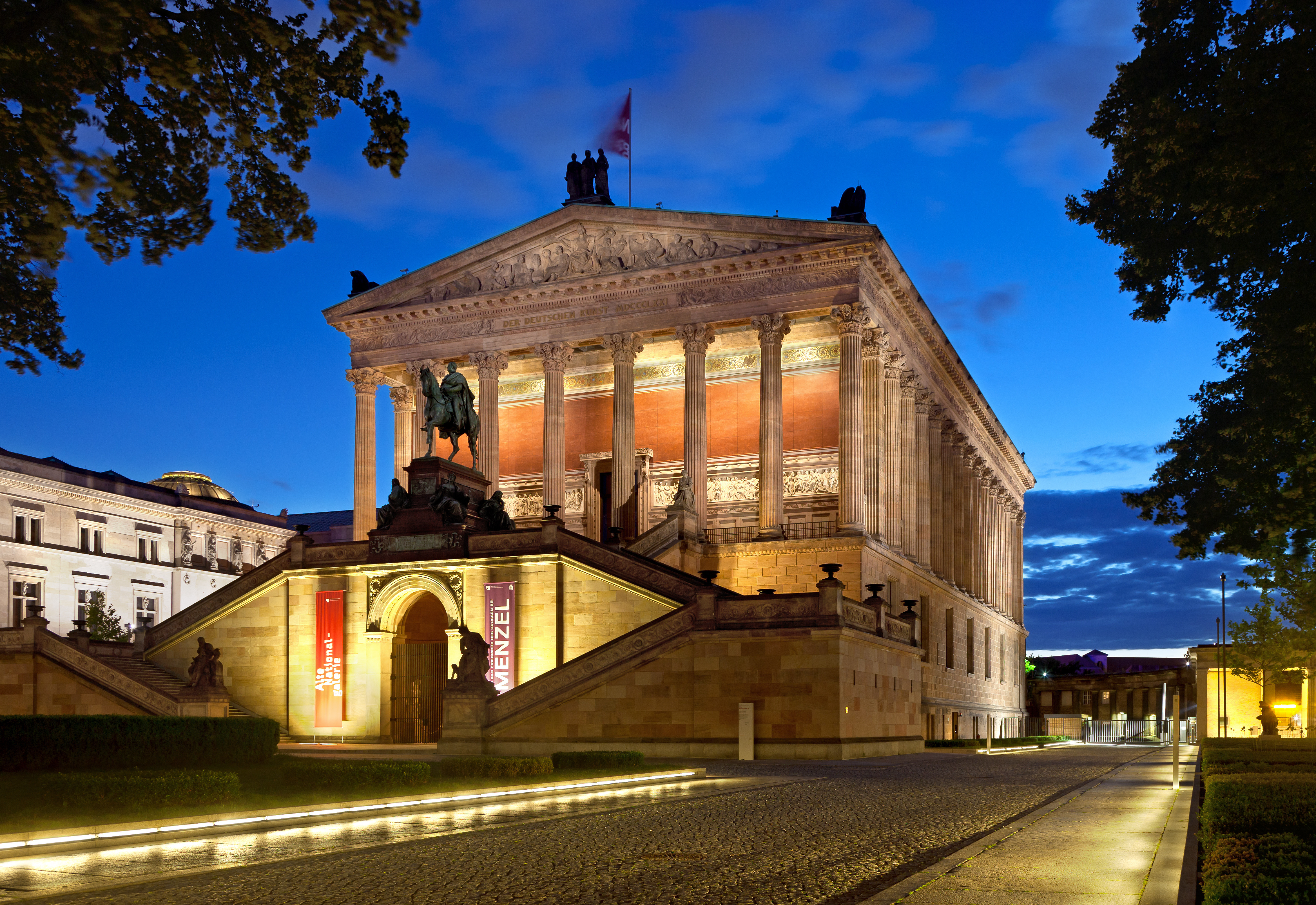
Berlin | Building opened 1876 | State art museum | 4.5★ (8,870 Google reviews)
Friedrich August Stüler's temple on a plinth, built from 1862 and opened in March 1876, holds the nineteenth century: Caspar David Friedrich's The Monk by the Sea, Menzel's The Iron Rolling Mill and Schadow's group of the princesses Luise and Friederike.[17] Gottlieb Schick's portrait of Heinrike Dannecker of 1802 is among the highlights the museum names itself.[16] HG Merz's restoration of 1998–2001 rebuilt the interior and added halls on the top floor for the Romantics.[17] German Romanticism is hung here as a sequence, not a highlight reel.

Berlin | Opened 1968; reopened 2021 | Modern art museum | 4.6★ (5,438 Google reviews)
Mies van der Rohe's glass hall, opened on 15 September 1968: a black steel roof plate on eight cruciform columns, with the permanent collection in the storey below, three-quarters underground.[22] Cubism, Expressionism, the Bauhaus and Surrealism — Picasso, Kirchner, Kandinsky, Miró, Barnett Newman — rotate through, because the building limits how much can hang.[22] David Chipperfield's €140-million overhaul ran from 2015 to 2021, and the museum reopened that August.[22] Here the architecture is genuinely half the reason to go.

Berlin | Building 1898–1904; reopened 2006 | Sculpture, Byzantine art and numismatics museum | 4.5★ (6,920 Google reviews)
Ernst von Ihne's domed wedge at the tip of Museum Island, built 1898–1904, holds European sculpture from the Christian Orient and Byzantium through the Middle Ages to the Baroque, the Museum of Byzantine Art, and a coin cabinet of roughly 500,000 items running from the seventh century BC to the present.[26][25] Tilman Riemenschneider anchors the late German Gothic, and the Flora bust — attributed by Bode to Leonardo, now widely argued to be nineteenth-century — is the museum's long-running argument.[26] It reopened on 18 October 2006 after a €156-million refurbishment.[26]
Frankfurt: a citizens' foundation and a fossil pit

Frankfurt am Main | 1815 | Civic art foundation and museum | 4.6★ (12,945 Google reviews)
Germany's oldest museum foundation, created in 1815 when the banker and spice merchant Johann Friedrich Städel left his house on the Rossmarkt, his art and book collection and his entire fortune to it.[12] Vermeer's The Geographer, Tischbein's Goethe in the Roman Campagna and Botticelli's Portrait of a Young Woman lead some 3,100 paintings and more than 100,000 works on paper covering 700 years.[13][12] Schneider+Schumacher's garden halls of 2012, lit through discs set into the lawn above, took display space from 4,000 to 7,000 square metres.[13]
Frankfurt am Main | 1821 | Natural history museum | 4.6★ (4,741 Google reviews)
Germany's second-largest natural history museum, opened to the public on 22 November 1821.[34] Its real distinction is the Messel Pit material: original fossils from the oil-shale quarry nearby, among them the horse ancestor Eurohippus messelensis, under 60 centimetres tall, which lived about 50 million years ago.[34][33] The dinosaur hall has an 18-metre Diplodocus given in 1907 and two original Triceratops skulls, with the Tyrannosaurus honestly labelled as a cast.[34] The Messel fossils, not the dinosaurs, make it unrepeatable.
Cologne: Picasso, Pop, and one great collection behind hoardings

Cologne | 1976 | Modern and contemporary art museum | 4.5★ (8,088 Google reviews)
Peter and Irene Ludwig signed the deed of gift with the city of Cologne on 23 February 1976.[14] The museum now holds around 900 Picassos — the third-largest such collection anywhere, after Barcelona and Paris — plus 600 Russian avant-garde works on permanent loan, the most comprehensive group outside Russia, and a major Pop Art collection.[15][14] Its photographic holding is among the largest and most significant in Europe for the nineteenth and twentieth centuries.[14] Busmann and Haberer's 1986 building stands between the cathedral and the Rhine.[15][14]

Cologne | Collection from 1824; Ungers building 2001 | Old master and 19th-century art museum | 4.6★ (3,193 Google reviews)
Closed. The whole museum shut for a two-year general overhaul and will not reopen until the end of 2028, when Oswald Mathias Ungers's building of 2001 is rejoined by a Christ & Gantenbein extension; the paintings are not being shown anywhere else meanwhile.[41] What is waiting goes back to Ferdinand Franz Wallraf's bequest of 1824: the medieval Cologne school, led by Stefan Lochner's Madonna of the Rose Bower of about 1450, with Rubens's Juno and Argus, a Rembrandt self-portrait, and over 170 Impressionist and Post-Impressionist works on permanent loan from Gérard Corboud.[42]
How this list was made
The ranking order. Three things decided each place, in this order of weight. First, what the permanent collection holds, and whether it can be seen anywhere else — a Sistine Madonna or a 900-strong Picasso holding is not substitutable. Second, the art-historical weight of the building and the site, with extra credit where work is still in the room it was made for: Augustus the Strong's treasury rooms and the Munich Antiquarium score on this where a good collection in a neutral shed does not. Third, corroborated visitor evidence, used to check the first two rather than to drive them.
Why review counts are not the ranking. In the ratings data behind this list, Cologne's chocolate museum has more Google reviews than the Alte Pinakothek and the Städel combined, and BMW Welt has roughly seven times as many as Berlin's Gemäldegalerie. Review volume measures footfall, parking and family appeal. It does not measure what is on the walls.
What was excluded, and why. Replica-and-experience venues are out by rule: Hamburg's Panoptikum (wax figures are replicas by definition), the Museum der Illusionen, Port des Lumières, and the Dresden Panometer, which is a single 360-degree panorama rather than a collection. Venues with no holdings at all are out for the same reason: EXPERIMINTA is a science centre, Motorworld a retail and events complex, BMW Welt a delivery centre with an exhibition hall. The chocolate and coffee museums are brand attractions. Two very good institutions fail the collection test cleanly and are excluded despite their quality — the Schirn Kunsthalle in Frankfurt and the Kunsthalle der Hypo-Kulturstiftung in Munich are exhibition halls without permanent collections. Cologne Cathedral is excluded as a working church rather than a ticketed museum complex, notwithstanding the Gero Cross and the Shrine of the Three Kings. The historic ships — the Rickmer Rickmers and the submarine U-434 — are single preserved objects rather than collections.
Being small or quiet disqualifies nothing. Several palaces with genuine holdings were left out for space alone, not merit: Moritzburg, Pillnitz, and the UNESCO-listed Augustusburg at Brühl with its Balthasar Neumann staircase. The closest near-miss was the Bavarian National Museum in Munich, whose Riemenschneider sculptures and Bustelli porcelain figures would walk into most national collections.
Closures were checked individually, because Google reports a museum under renovation as operational. One ranked entry, the Wallraf-Richartz in Cologne, is entirely shut until the end of 2028 and its paintings are not being shown elsewhere; it is ranked anyway, because this list ranks collections, and flagged in its first word. The Deutsches Museum is half a building site, with work planned into 2028. One more trap is worth naming because it is not a closure at all: Dresden's Green Vault is two separate displays, and the Dinglinger showpieces and the Dresden Green Diamond are in the New Green Vault, not the historic rooms listed here.
Not in the catalog. Several museums that belong in any honest national ranking could not be included because Caleido does not yet list them: the Pergamonmuseum and Neues Museum in Berlin, the Germanisches Nationalmuseum in Nuremberg, Museum Folkwang in Essen, the Kunstsammlung Nordrhein-Westfalen in Düsseldorf, Schloss Wilhelmshöhe in Kassel, the Kunsthalle Bremen, the Jewish Museum Berlin and the Ruhr Museum at Zeche Zollverein. The catalog also concentrates on six cities, so treat this as the best of those six rather than an even survey of the country.
No hours, prices or temporary exhibitions appear here, deliberately. They change, and a guide that carries them is wrong within months. Check the museum's own site before you travel — particularly for the two entries with building work in force.
Hamburg: the northern picture gallery and its design museum

Hamburg | Collection begun 1849 | Municipal art museum | 4.6★ (12,450 Google reviews)
Caspar David Friedrich's Wanderer above the Sea of Fog and The Sea of Ice hang here, with Philipp Otto Runge, Menzel and Manet's Nana.[19] The collection dates from 1849 and opened to the public a year later; it now runs through three linked buildings — Schirrmacher and von der Hude's original of 1869, Fritz Schumacher's domed hall of 1914–21, and O. M. Ungers's 5,600-square-metre Galerie der Gegenwart of 1997.[19] The museum calls itself one of the few offering a tour through eight centuries of art.[18] It drew 601,612 visitors in 2024.[19]
Hamburg | 1874 | Applied arts and design museum | 4.5★ (3,919 Google reviews)
Founded in 1874, the MK&G calls itself one of Europe's leading design museums, with a collection reaching back 9,000 years.[36][35] Complete interiors are its strength: the Paris Room, much of it bought at the 1900 world's fair, Otto Eckmann's Swan Carpet of 1897, a Japanese tea house, and Verner Panton's Spiegel canteen of 1969.[36][35] It also holds historic keyboard instruments — harpsichords, virginals, clavichords, fortepianos — and the Expressionist works acquired under Max Sauerlandt between 1919 and 1933.[36]
References
- 1.Gemäldegalerie Alte Meister. Staatliche Kunstsammlungen Dresden, 2026 ↗
- 2.Gemäldegalerie Alte Meister. Wikipedia, 2026 ↗
- 3.Alte Pinakothek. Bayerische Staatsgemäldesammlungen, 2026 ↗
- 4.Alte Pinakothek. Wikipedia, 2026 ↗
- 5.Gemäldegalerie. Staatliche Museen zu Berlin, 2026 ↗
- 6.Gemäldegalerie, Berlin. Wikipedia, 2026 ↗
- 7.Historisches Grünes Gewölbe. Staatliche Kunstsammlungen Dresden, 2026 ↗
- 8.Green Vault. Wikipedia, 2026 ↗
- 9.Deutsches Museum. Deutsches Museum, 2026 ↗
- 10.Modernisierung des Deutschen Museums. Deutsches Museum, 2026 ↗
- 11.Deutsches Museum. Wikipedia, 2026 ↗
- 12.The Städel — history of the museum. Städel Museum, 2026 ↗
- 13.Städel. Wikipedia, 2026 ↗
- 14.Das Museum Ludwig. Museum Ludwig, Cologne, 2026 ↗
- 15.Museum Ludwig. Wikipedia, 2026 ↗
- 16.Alte Nationalgalerie. Staatliche Museen zu Berlin, 2026 ↗
- 17.Alte Nationalgalerie. Wikipedia, 2026 ↗
- 18.The Museum — Hamburger Kunsthalle. Hamburger Kunsthalle, 2026 ↗
- 19.Hamburger Kunsthalle. Wikipedia, 2026 ↗
- 20.Lenbachhaus. Städtische Galerie im Lenbachhaus, Munich, 2026 ↗
- 21.Lenbachhaus. Wikipedia, 2026 ↗
- 22.Neue Nationalgalerie. Wikipedia, 2026 ↗
- 23.Munich Residence. Bayerische Verwaltung der staatlichen Schlösser, Gärten und Seen, 2026 ↗
- 24.Munich Residenz. Wikipedia, 2026 ↗
- 25.Bode-Museum. Staatliche Museen zu Berlin, 2026 ↗
- 26.Bode Museum. Wikipedia, 2026 ↗
- 27.The Dresden Zwinger. Der Dresdner Zwinger, 2026 ↗
- 28.Zwinger (Dresden). Wikipedia, 2026 ↗
- 29.Porzellansammlung. Staatliche Kunstsammlungen Dresden, 2026 ↗
- 30.Mathematisch-Physikalischer Salon. Staatliche Kunstsammlungen Dresden, 2026 ↗
- 31.Pinakothek der Moderne. Pinakothek der Moderne, Munich, 2026 ↗
- 32.Pinakothek der Moderne. Wikipedia, 2026 ↗
- 33.Senckenberg Naturmuseum Frankfurt. Senckenberg Gesellschaft für Naturforschung, 2026 ↗
- 34.Senckenberg Natural History Museum. Wikipedia, 2026 ↗
- 35.Museum für Kunst und Gewerbe Hamburg. Museum für Kunst und Gewerbe Hamburg, 2026 ↗
- 36.Museum für Kunst und Gewerbe Hamburg. Wikipedia, 2026 ↗
- 37.Militärhistorisches Museum der Bundeswehr, Dresden. Militärhistorisches Museum der Bundeswehr, 2026 ↗
- 38.Militärhistorisches Museum der Bundeswehr. Wikipedia, 2026 ↗
- 39.Dachau Concentration Camp Memorial Site. KZ-Gedenkstätte Dachau, 2026 ↗
- 40.KZ-Gedenkstätte Dachau. Wikipedia, 2026 ↗
- 41.Vorübergehend geschlossen — Generalinstandsetzung bis Ende 2028. Wallraf-Richartz-Museum & Fondation Corboud, 2026 ↗
- 42.Wallraf–Richartz Museum. Wikipedia, 2026 ↗
- 43.Pergamonmuseum — Profile and renovation. Staatliche Museen zu Berlin, 2026 ↗
No comments yet — be the first.