Expert Analysis of Fruit of Life by Frida Kahlo
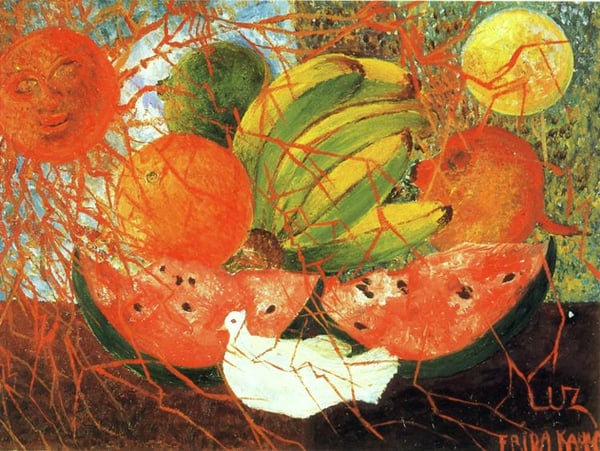
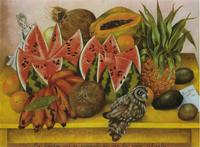
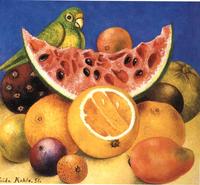
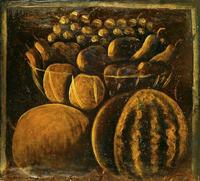
While Frida Kahlo is best known for her haunting self-portraits, her still lifes—exemplified by Fruit of Life—offer a vital window into her symbolic universe and her mastery of Naïve Art (Primitivism). This work is significant because it transforms a modest, often decorative genre into a deeply personal and culturally resonant statement.
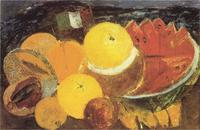
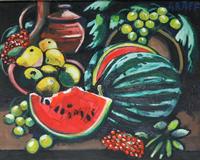
Within the Naïve style, Kahlo employs simplified forms, vibrant, unmodulated colors, and a flattened, intuitive perspective that eschews academic precision. These elements, typical of Primitivism, give the painting a direct, almost folk-art quality. Yet Kahlo infuses this naive surface with complex meaning. The fruits—often depicted with cuts, seeds, and organic textures—are not passive objects. In her iconography, they allude to fertility, life cycles, and the raw sensuality of the natural world, often intertwined with the artist's own physical suffering and Mexican heritage.
Fruit of Life is significant as a testament to Kahlo’s ability to elevate still life beyond mere representation. By merging a deceptively simple, childlike aesthetic with potent personal and cultural symbolism, she challenges the hierarchy of genres. The work stands as an intimate meditation on vitality and decay, making it a crucial example of how Primitivism could be harnessed to express the most profound human experiences.