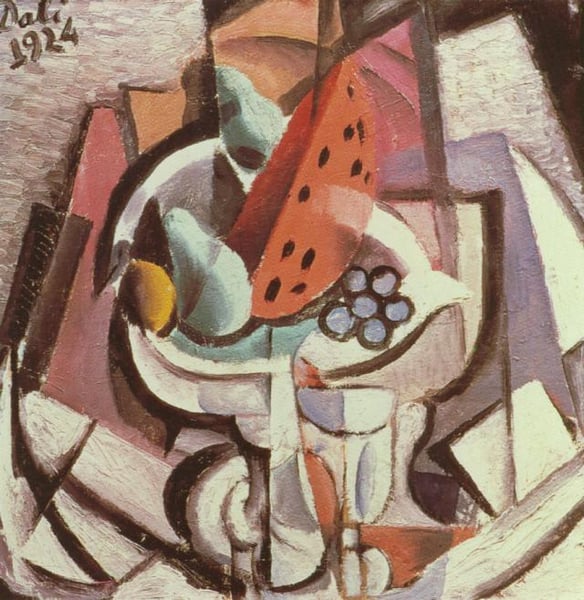
Expert analysis of Salvador Dali’s Still Life. Watermelon
Style: Cubism · Genre: still life
Expert Analysis: "Still Life. Watermelon" by Salvador Dalí
This painting stands as a crucial document of Salvador Dalí’s formative years, long before he became the high priest of Surrealism. Created during his Early Years (1917–1927), it belongs squarely within the Cubist style—a radical departure from the dreamlike biomorphism that would later define him. Its significance lies in demonstrating Dalí’s rigorous technical experimentation with the Cubist vocabulary, borrowed from Picasso and Braque, while still revealing personal touches that presage his mature genius.
-
Period and Stylistic Context: Executed during Dalí’s student period at the Royal Academy of Fine Arts in Madrid, this work reflects his immersion in avant-garde currents. Cubism here is not merely imitative; Dalí fragments the watermelon and surrounding table objects into geometric facets (planes, cylinders, arcs) that challenge traditional perspective. The muted earth tones—ochres, browns, grays—are typical of Analytical Cubism, yet the subject (a watermelon) introduces a natural, organic form rarely seen in pure Cubist still lifes, hinting at Dalí’s future obsession with organic decay and surreal transformation.
-
Thematic Significance: As a still life, the watermelon is a humble, everyday object. However, Dalí’s treatment emphasizes the tension between solidity and fragmentation. The seeds, rind, and flesh are broken into discrete geometric shards, forcing the viewer to reconstruct the fruit mentally. This intellectual approach contrasts with the sensuous realism he would later apply to melting watches and eggs. The painting thus represents a critical stepping stone: Dalí mastering the tools of analysis (Cubism) before he would abandon them for the irrational synthesis of Surrealism.
-
What Makes It Significant: "Still Life. Watermelon" is historically important as evidence of Dalí’s eclecticism and his ability to absorb multiple modernist languages. It shows that he was not merely a provincial talent mimicking Paris, but a young artist capable of sophisticated spatial abstraction. The work also contains seeds of his later iconography—the watermelon’s red flesh and black seeds anticipate the vivid, often unsettling color contrasts and organic motifs of his Surrealist phase. In short, this painting is a vital missing link: Dalí the Cubist, meticulously deconstructing the world, just before he would reconstruct it through the lens of dreams.
Genre
Style
Visually similar
20 works with related composition and palette
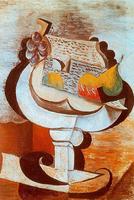
Fruit dish
Pablo Picasso
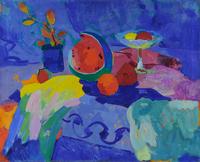
Still-life. Watermelon
Minas Avetisyan
Still life with fruit
Mary Fedden
Fruit and Dishes on the Table
Marcel Janco
Nimes
Louis Marcoussis
Still Life: Playing Cards, Coffee Cup and Apples
Jean Metzinger
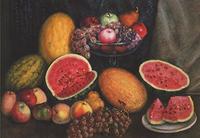
Still Life
Ilya Mashkov
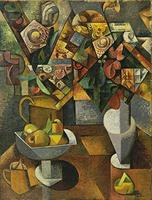
Dessert
Auguste Herbin
Still Life
Louis Marcoussis
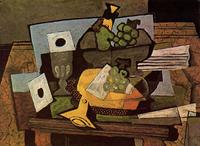
Still life (with clarinet)
Georges Braque
Botella Y Frutero Sobre Una Mesa
Maria Blanchard
A Slice of Watermelon
Louis Marcoussis
Watermelon and grapes
Ilya Mashkov
Still Life With Grapes and Flowers
Constantin Piliuta
Still life
Niko Pirosmani
Still-life
Bela Kadar
Fruit Dish
Georges Braque
Still Life With Fruit Bowl
Corneliu Michailescu
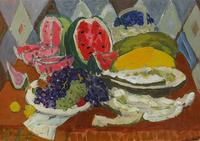
Still life with fruits and watermelon
Pyotr Konchalovsky
The Bowl
Robert Delaunay