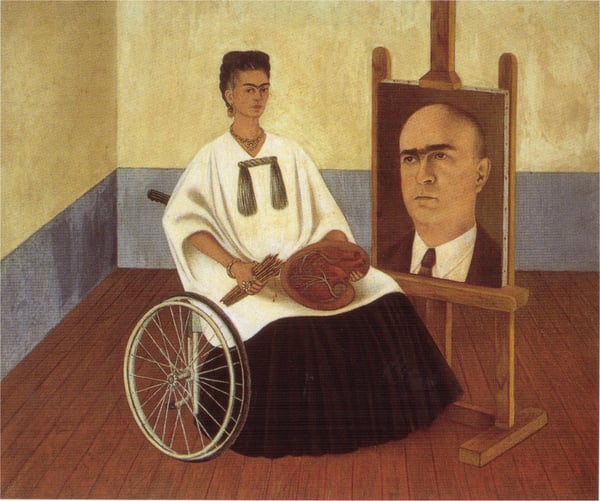
Self-Portrait with the Portrait of Doctor Farill
Details
Expert analysis of Frida Kahlo’s Self-Portrait with the Portrait of Doctor Farill
Style: Naïve Art (Primitivism) · Genre: self-portrait
Expert Analysis of "Self-Portrait with the Portrait of Doctor Farill" by Frida Kahlo
Style and Genre Context
Frida Kahlo’s work is firmly rooted in Naïve Art (Primitivism), a style characterized by flat perspective, bold colors, and a deliberate avoidance of academic naturalism. This self-portrait exemplifies those traits while also breaking from traditional self-portraiture by incorporating a second portrait within the frame—that of her surgeon, Dr. Juan Farill.
Significance within the Self-Portrait Genre
Kahlo’s self-portraits are famously autobiographical, often chronicling her physical and emotional suffering. In this 1951 painting, she depicts herself in a wheelchair, palette in hand, with a small portrait of Dr. Farill pinned to her chest like a brooch. The composition directly links her creative identity to her medical dependence, making the artwork a visual testament to the symbiotic relationship between artist and healer. By including the doctor’s image within her own, Kahlo collapses the boundary between self and other, foregrounding how her life was sustained by his skill.
Significance within Naïve Art
Naïve Art often employs childlike directness to express profound truths. Here, Kahlo’s simplified forms—the flat, frontal pose, the bold reds and greens, the stark division of space—lend a raw emotional urgency. The palette-knife texture on her face and dress contrasts with the smoother handling of the doctor’s portrait, subtly emphasizing her own physical fragility against his steady presence. This stylistic choice heightens the work’s narrative of survival, turning autobiographical pain into a universal icon of resilience.
Why It Matters
This painting marks a turning point in Kahlo’s late career: painted after a grueling spinal surgery and a year-long hospitalization, it is one of the few works where she openly acknowledges an external figure as integral to her existence. The blending of self-portrait with a portrait-within-a-portrait is a sophisticated metapictorial device for a Naïve-style work, demonstrating how Kahlo used apparent simplicity to explore complex themes of vulnerability, gratitude, and the interdependence of the body and the spirit.
Visually similar
20 works with related composition and palette
Self-Portrait
Horace Pippin
Self-Portrait with Brushes
Else Berg
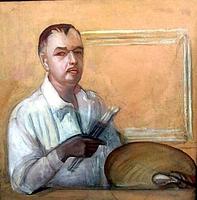
Self-portrait
Serge Sudeikin
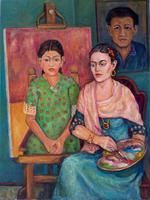
Frida Kahlo
Andrey Allakhverdov
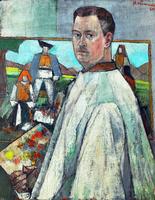
In Front of the Easel (Self-portrait)
George Stefanescu
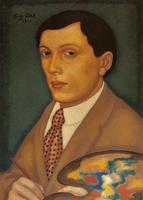
Self-Portrait
Eugeniusz Zak
Gabriele Munter
Andrey Allakhverdov
Self Portrait with Stalin
Frida Kahlo
Frieda and Diego Rivera
Frida Kahlo
Amadeo Modigliani
Andrey Allakhverdov
La femme peintre
Pierre Roy
Attempting the Impossible
Rene Magritte
Self Portrait. Myself at Work
Archibald Motley
Self-portrait
George Pemba
Self Portrait
Rita Angus
Korovin in Gurzuf
Alexander Roitburd
Itzcuintli Dog with Me
Frida Kahlo
Bela Czene, Sitting Women
Czene Béla
Self-Portrait
Periklis Vyzantios
Self-Portrait with Palette
Igor Grabar