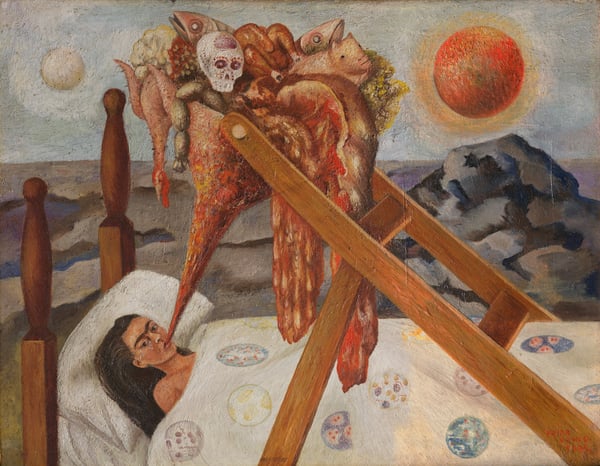
"Without Hope" by Frida Kahlo is a significant work that masterfully bridges Naïve Art (Primitivism) and Surrealism, while operating as both a deeply personal self-portrait and a potent symbolic painting. In the context of Naïve Art, Kahlo employs a deliberately flat, unrefined technique and a direct, childlike perspective that strips away academic artifice, lending the image an intimate, raw emotional honesty. This approach makes her symbolic content—likely drawn from her own physical and emotional suffering—feel immediate and unmediated, as if the viewer is peering directly into her psyche. Simultaneously, the painting’s surrealist dimension elevates these personal symbols into a dreamlike, often unsettling narrative realm. By merging the two styles, Kahlo creates a visual language where the fantastical feels palpably real and the personal becomes universally resonant. As a self-portrait, it forgoes idealized representation in favor of visceral truth-telling; as a symbolic painting, every element functions as a cipher for inner turmoil. Its significance lies in how it boldly fuses the accessibility of primitivist art with the psychological depth of surrealism, transforming a specific moment of personal anguish into an enduring, archetypal image of human struggle and resilience.