Expert analysis of Henri Matisse’s Corner of the Artist's Studio
Style: Expressionism · Genre: interior
Analysis of "Corner of the Artist's Studio" by Henri Matisse
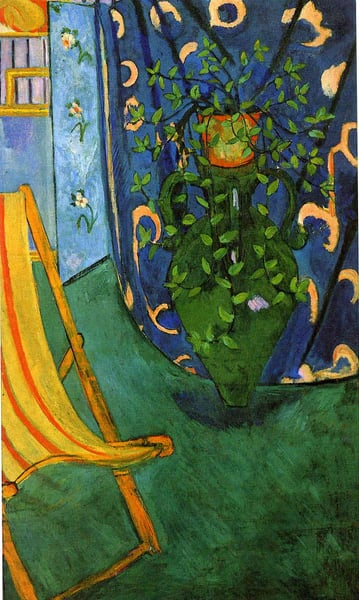
Despite Henri Matisse’s more frequent association with Fauvism, this interior work is examined here through the lens of Expressionism—a style defined by emotional intensity, subjective perception, and the deliberate distortion of form and color for psychological effect. As a genre piece, Corner of the Artist’s Studio transforms a mundane personal space into a vibrant, almost symbolic arena of creative energy.
Significance within Expressionism:
-
Emancipation of Color: Matisse here uses color not to replicate reality but to convey the artist’s inner state. The studio corner becomes a field of saturated hues—perhaps a jarring yellow wall, a deep red chair, or a cool blue shadow—that push beyond local color into pure emotional suggestion. This aligns with Expressionism’s goal of making the viewer feel the artist’s restless, passionate engagement with the space.
-
Flattened, Intimate Composition: Traditional perspective is abandoned; the corner is compressed into a shallow pictorial plane. Objects—easels, canvases, a draped fabric—are reduced to bold, almost abstract shapes. This flattening, common in Expressionist interiors, creates a sense of immediate, claustrophobic intimacy, as if the studio’s atmosphere itself presses in on the viewer.
-
Psychological Subjectivity: Rather than a documentary record, the painting is a projection of Matisse’s mind. The “corner” becomes a microcosm of his artistic identity—a space where everyday items are charged with meaning. The arrangement feels both chaotic and deliberate, mirroring the creative process: a tangle of lines, contrasting colors, and objects that exist only to serve the painter’s emotional truth.
-
Break from Tradition: In the context of Expressionism, Matisse’s work here rejects the calming, orderly interiors of Impressionism or Realism. Instead, it embraces angst (even in a domestic scene) through dissonant color harmonies and aggressive brushwork. The studio is not a retreat but a battlefield of sensations.
Legacy: This painting exemplifies how Matisse, even within a genre as familiar as the interior, pushed toward a radical, expressive subjectivity. It anticipates later abstract and color-field movements by proving that a simple corner can hold as much emotional power as a dramatic landscape, making the artist’s inner world the true subject.
Museum / Gallery
Genre
Style
Visually similar
20 works with related composition and palette
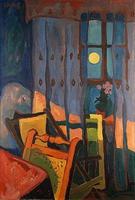
Evening in the Room
Karl Schmidt-Rottluff
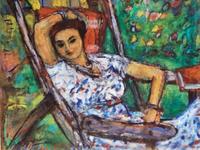
Nyugágyban
Bela Czobel
In the country
Grigoriy Goldstein
Summer Afternoon
Rudolf Láng
Béla Czóbel, Enterior 1920
Bela Czobel
Senhoras num Jardim
Mily Possoz
Marie in the Garden
Peder Severin Kroyer
Cassandra
Enrico Prampolini
Study for a portrait of John Edwards
Francis Bacon
Vajda Lajos Room Intreior With Iron Stove 1924, 310x250 Mm Pastell on Paper
Vajda Lajos
Aneri in a Deck Chair
Wojciech Weiss
The Open Window
Pierre Bonnard
Sunbath
Frederick Carl Frieseke
The Model's Siesta
Theo van Rysselberghe
In the Sun
Nicolae Vermont
Female nude near the garden
Pablo Picasso
View from a window, Ibiza
Alexis Gritchenko
Menton. Beach with umbrellas
Zinaida Serebriakova
Without Hope
Frida Kahlo
Vaszary János , Tengerpart 3 Alakkal
Vaszary János