Expert analysis of Giorgione’s Arithmetic
Style: High Renaissance · Genre: still life
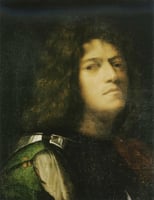
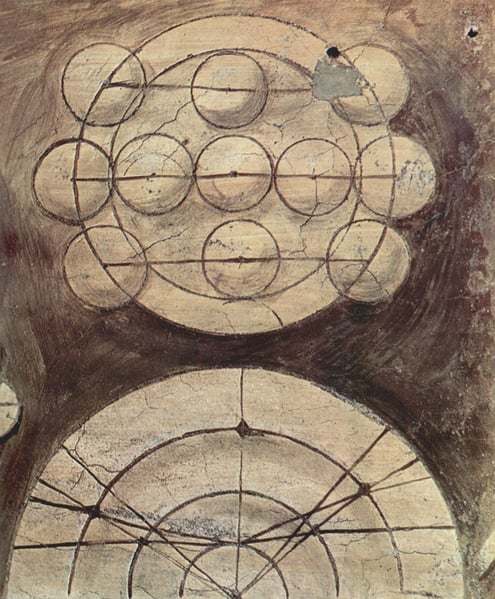
Expert Analysis of "Arithmetic" by Giorgione
Within the context of the High Renaissance, Giorgione’s Arithmetic stands as a remarkably early and sophisticated example of the still-life genre—a category that would not fully flourish until the Baroque era. The work’s significance lies in its elevation of a seemingly mundane subject (arithmetic tools, numbers, or measuring instruments) to a subject of philosophical and aesthetic contemplation, reflecting the High Renaissance fascination with harmony, proportion, and the order underlying nature.
Giorgione, best known for his atmospheric pastoral scenes and enigmatic allegories, here applies his signature sfumato technique—soft, blurred transitions of light and shadow—to objects rather than figures. This treatment imbues the still life with a meditative stillness, suggesting that even the tools of calculation possess a quiet beauty. The composition likely emphasizes balance and geometric clarity, echoing the mathematical principles that Renaissance artists like Leonardo and Piero della Francesca saw as the foundation of art.
As a High Renaissance still life, Arithmetic is notable for bridging two worlds: the symbolic tradition of earlier vanitas images (where numerals and compasses allude to human mortality or divine order) and the emerging genre of pure object study. By focusing on arithmetic—the science of number and measure—Giorgione aligns his painting with the era’s Neoplatonic belief that mathematical truth reveals the divine structure of the cosmos. In doing so, he transforms a humble still life into a quiet hymn to rationality and beauty, marking an important step toward the autonomy of the genre in later centuries.
Museum / Gallery
Visually similar
20 works with related composition and palette
Huwelijksaankondiging
Anton Heyboer
Pan-tree (back)
Xul Solar
The Roman antiquities, t. 2, Plate XXVI. Previous cross-section of large urn and other details.
Giovanni Battista Piranesi
Composizione IV
Filippo De Pisis
Revolving
Kurt Schwitters
Diagram for Gesture Dance
Oskar Schlemmer
Suicide Precedent
Oleksandr Aksinin
The Fourth 'Book of Schemes'. Album #1, the Second Folder
Valerii Lamakh
Untitled
Hilma af Klint
Study of the Graduations of Shadows on Spheres
Leonardo da Vinci
Linneus escriba
Modest Cuixart
The Fourth 'Book of Schemes'. Album #2, the First Folder
Valerii Lamakh
Second vision. Adam as Mankind
Hildegard of Bingen
Vrijheid
Anton Heyboer
Untitled
Lolo Soldevilla
Map of the Antonine column
Giovanni Battista Piranesi
Formoosa Island in the Indian Ocean
Adolf Wölfli
Fixed points
Wassily Kandinsky
Ritmi astrali
Gerardo Dottori
Into Orbit
Stanley Pinker