Expertenanalyse zu Wassily Kandinskys Fixed points
Stil: Abstract Art · Genre: abstract
Expert Analysis of Wassily Kandinsky’s “Fixed Points”
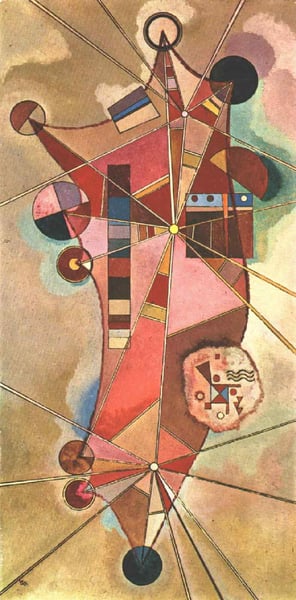
Wassily Kandinsky’s “Fixed Points” stands as a quintessential example of early Abstract Art, a movement the artist himself helped pioneer. Created during a period when Kandinsky was deeply exploring the spiritual and emotional resonances of pure form and color, this work embodies his revolutionary belief that art should not mimic the physical world but instead evoke inner sensation through non-representational means.
The title “Fixed Points” provides a key to understanding the composition. In Kandinsky’s lexicon, “points” are not mere marks but dynamic entities—concentrated energy that can anchor or disrupt a visual field. Here, the fixed points likely serve as stable, grounding elements amid a symphony of swirling lines, floating planes, and vibrant color contrasts. This tension between stillness and movement, order and chaos, reflects Kandinsky’s theoretical framework, where every geometric element carries psychological weight. The painting’s significance lies in how it balances structural clarity with expressive freedom, a hallmark of his mature abstract style.
Kandinsky’s contribution to Abstract Art was twofold: he not only created the language of non-objective painting but also codified it in writings such as Concerning the Spiritual in Art. “Fixed Points” can be read as a visual manifestation of these theories—where color vibrates like sound (Kandinsky often associated hues with musical tones), and where each shape interacts to create a harmonious or dissonant chord. The work’s abstraction is not a denial of meaning but an invitation to a direct, sensory experience.
Historically, “Fixed Points” is significant because it represents a key moment when Kandinsky moved beyond the last vestiges of representational imagery (such as his earlier Improvisations still rooted in landscape metaphor) toward a fully autonomous visual language. It demonstrates how abstraction can generate its own logic—fixed points providing a rhythmic structure that guides the eye while allowing the viewer’s emotion to wander. In short, this artwork encapsulates the very essence of Kandinsky’s groundbreaking project: to make visible the invisible, to give form to feeling, and to prove that abstract painting could be as profound and structured as any classical art.
Museum / Gallery
Genre
Stil
Visuell ähnlich
20 Werke mit ähnlicher Komposition und Farbpalette
Composizione IV
Filippo De Pisis
Composition VIII
Wassily Kandinsky
Composition 8
Wassily Kandinsky
Delicate Tension. No. 85
Wassily Kandinsky
Small dream in red
Wassily Kandinsky
Blue
Wassily Kandinsky
Untitled
Sandu Darie
Ideomorphic Composition #1
Perle Fine
Composition
El Lissitzky
Third Symphony in 3 Movements
Rudolf Bauer
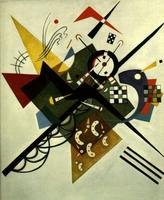
On White II
Wassily Kandinsky
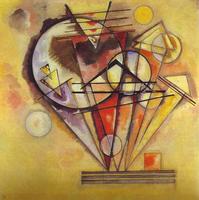
On the points
Wassily Kandinsky
The Study of Dynamisme et Cinetisme
Enrico Donati
Untitled from The Atelier Project
Lee Bontecou
Proun G7
El Lissitzky
Astrazione di una linea n. 2, disegno
Bice Lazzari
Orange
Wassily Kandinsky
Composizione II
Filippo De Pisis
In Blue
Wassily Kandinsky
Contrasting sounds
Wassily Kandinsky