
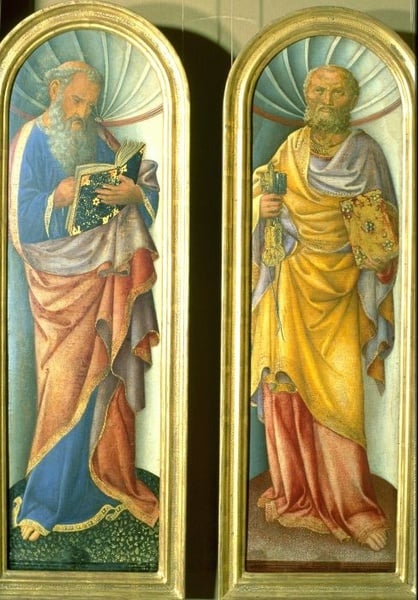
Jacopo Bellini sanatçısının John the Evangelist, the Apostle Peter eseri hakkında uzman analizi
Tarz: Early Renaissance · Tür: religious painting
Expert Analysis: "John the Evangelist, the Apostle Peter" by Jacopo Bellini
Significance within the Early Renaissance
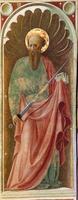
Jacopo Bellini’s John the Evangelist, the Apostle Peter occupies a pivotal position in the history of Early Renaissance religious painting. As a Venetian master active in the mid-15th century, Bellini stands at the crossroads between the lingering Late Gothic decorative tradition and the emerging Renaissance ideals of naturalism, spatial coherence, and humanist dignity. This work exemplifies that transition in several key ways:
-
Individualized Saints in Dialogue – In contrast to the flattened, iconic figures of Gothic altarpieces, Bellini gives each apostle a distinct, weighty presence. John the Evangelist (often youthful and contemplative) and Peter (older, with a rugged face and key attribute) are rendered with subtle psychological differentiation, reflecting the Renaissance emphasis on individual character and emotional engagement.
-
Early Venetian Adaptation of Perspective – Bellini was one of the first Venetian painters to absorb the linear perspective and volumetric modeling pioneered in Florence by Masaccio and Donatello. Although his spatial construction may still retain certain Gothic flatness, the gentle foreshortening and carefully placed halos suggest an intentional move toward creating a believable, sacred space—a hallmark of the Early Renaissance.
-
Luminous Color and Surface – The painting’s rich, glowing palette and fine handling of drapery reveal Bellini’s training in the International Gothic tradition, yet the soft modeling of faces and hands introduces a new natural light. This fusion foreshadows the coloristic achievements of his sons, Gentile and especially Giovanni Bellini, who would define Venetian Renaissance painting.
-
Narrative and Devotional Function – As a religious painting, the work serves both as an object of devotion and as a didactic image. The pairing of John (the beloved disciple and visionary) with Peter (the rock of the Church) likely alludes to the complementary roles of contemplation and leadership in early Christianity, a theme popular in Renaissance altarpieces and private devotional panels.
Conclusion: John the Evangelist, the Apostle Peter is significant not only as a fine example of Jacopo Bellini’s mature style but as a key document of the Early Renaissance’s spread to Venice. It demonstrates how Northern Italian artists adapted Florentine innovations while preserving a lyrical, luminous grace that would become the Venetian signature. This work stands as a bridge—both retrospective in its Gothic elegance and forward-looking in its humanist realism—making it a crucial step toward the full flowering of the Renaissance in the Veneto.
Görsel olarak benzer
İlişkili kompozisyon ve renk paletine sahip 20 eser
St Lucy
Filippino Lippi
The Doctors of the Church
Filippo Lippi
Linaioli Tabernacle
Fra Angelico
Nativity and St. Anthony
Martin Schongauer
Saint Peter
Ambrogio Bergognone
St. Stephen, St. Jacobo, St. Peter
Domenico Ghirlandaio
Tríptico abierto: Busto de Cristo, San Juan Bautista y San Pedro. Cerrado: San Juan Evangelista y Santa Columba
Antoniazzo Romano
Saint Gregory
Cennino Cennini
Saint John the Evangelist
Il Sassetta (Stefano di Giovanni)

Polyptych Annunziata (St. Illuminata)
Pietro Perugino
Triptych of the Virgin
Jacopo Bellini
St. Catherine of Siena and St. Lawrence
Domenico Ghirlandaio

Saints Benedict and Apollonia (left) and Saints Paul and Frediano (right)
Filippino Lippi

Two Apostles
Carlo Crivelli
Three Saints (Matthew, Catherine of Alexandria and John the Evangelist)
Stefan Lochner

Santo André E São Pedro
Álvaro Pires de Évora
The prophets Ezekiel and Daniel
Maerten van Heemskerck
Two Saints
Filippo Lippi
São Paulo E São João Baptista
Álvaro Pires de Évora
St.Paul
Paolo Uccello