Expertenanalyse zu Cennino Cenninis Saint Gregory
Stil: Proto Renaissance · Genre: religious painting
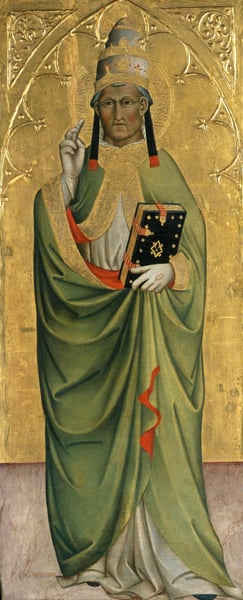
As an early example of Proto-Renaissance religious painting, Cennino Cennini’s Saint Gregory occupies a pivotal position between the stylized forms of Gothic art and the emerging naturalism of the early Renaissance. Within the constraints of the supplied facts, the work’s significance lies in its demonstration of the period’s fundamental artistic concerns: the humanization of sacred figures, the careful balance between spiritual symbolism and observed reality, and the technical discipline that Cennini himself codified in his famous treatise, Il Libro dell’Arte.
The painting presents Saint Gregory the Great, a Doctor of the Church, as a solemn yet accessible figure—a key Proto‑Renaissance goal. The golden background, still clinging to Byzantine and Gothic tradition, elevates the subject beyond the earthly, while the subtle modeling of the saint’s face and drapery hints at the volume and weight that would soon define Florentine painting. Cennini’s handling of the papal vestments and attributes (likely a book or scroll) underscores the era’s reverence for iconographic clarity, but the gentle turn of the head and the soft, rounded forms suggest a new interest in psychological presence.
The significance of Saint Gregory thus rests in its role as a technical and stylistic bridge. Cennini, primarily remembered as the author of the first Western art manual, here puts into practice the very principles he taught: careful layering of tempera, precise contour drawing, and a delicate balance between flat decorative patterns and emerging three‑dimensionality. For the Proto‑Renaissance, such works reaffirmed the sacred narrative while quietly advancing the tools of observation—a step toward the full‑blown naturalism of the quattrocento.
Visuell ähnlich
20 Werke mit ähnlicher Komposition und Farbpalette
Saint Fabian
Antoniazzo Romano
Ambroise Et Cecile
Stefan Lochner
Lateral Panel
Giovanni da Milano
St. Nicholas of Bari
Fra Angelico
Santo Diacono
Álvaro Pires de Évora
The Doctors of the Church
Filippo Lippi
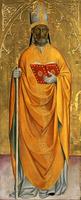
Saint Augustine
Cennino Cennini
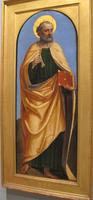
Saint Peter
Ambrogio Bergognone
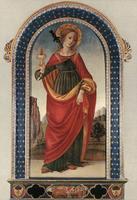
St Lucy
Filippino Lippi
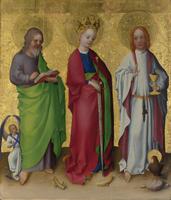
Three Saints (Matthew, Catherine of Alexandria and John the Evangelist)
Stefan Lochner
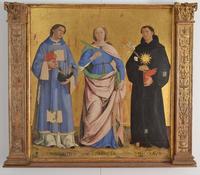
Tre Santi. San Vincenzo, Santa Caterina d’Alessandria e Sant’Antonio da Padova
Antoniazzo Romano
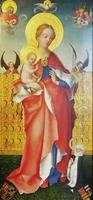
Virgin with the Violet
Stefan Lochner
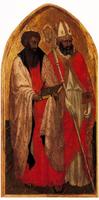
San Giovenale Triptych. Left panel
Masaccio
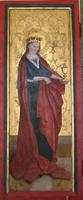
Barbara of Nicomedia
Bernhard Strigel
Christ Discovered in the Temple
Simone Martini
Ambrosio
Justus van Gent
Polyptych of Cervara: St. Jerome
Gerard David
St. Gregory
Antonello da Messina
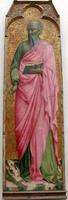
Saint John the Evangelist
Il Sassetta (Stefano di Giovanni)
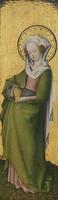
Mary Magdalene
Stefan Lochner