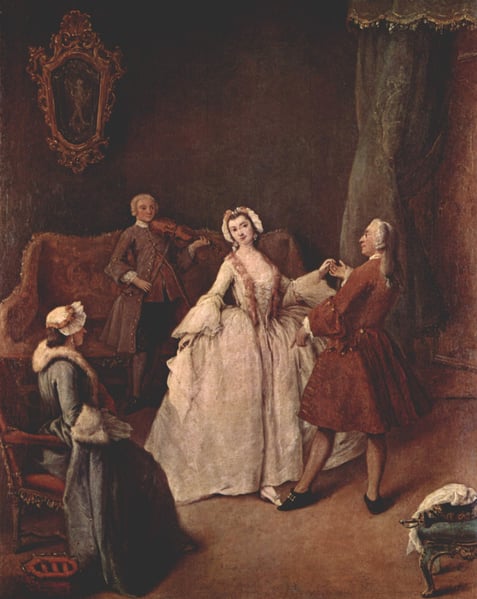
The Dancing Lesson
Analisi esperta di The Dancing Lesson di Pietro Longhi
Stile: Rococo · Genere: genre painting
Expert Analysis of "The Dancing Lesson" by Pietro Longhi
Pietro Longhi’s The Dancing Lesson (c. 1740s–1750s) is a quintessential example of Rococo genre painting, offering a window into the intimate, domestic world of 18th-century Venetian society. Executed in oil on canvas, the work depicts a private music lesson, likely in a well-to-do home, where a dancing master instructs a young woman while a seated chaperone or family member observes. The composition is modest in scale and focus, eschewing the grand mythological or historical narratives favored by earlier Baroque artists in favor of an unassuming, everyday moment.
What Makes It Significant
-
Rococo’s Shift to Interiority and Leisure: Unlike the theatrical grandeur of the Baroque, Rococo art celebrated private pleasure, polite sociability, and the refined rituals of daily life. Longhi’s painting exemplifies this by centering on a leisurely activity—dance instruction—presented with a quiet, almost documentary intimacy. The figures are not heroic but human, engaged in a simple, elegant pursuit that reflects the era’s fascination with manners, music, and movement.
-
A Social Chronicle of Venice: Longhi is often called the “Canaletto of domestic life” because his work provides a detailed visual record of Venetian customs, especially among the middle and upper classes. The Dancing Lesson captures the polite education of young women, a key aspect of 18th-century social reproduction, while also hinting at the subtle hierarchies of master, pupil, and patron. This blend of observation and gentle satire (without the moralizing bite of later realist painting) makes Longhi’s oeuvre a vital historical document.
-
Rococo’s Characteristic Palette and Handling: The painting likely employs the soft, pastel hues and fluid, delicate brushwork typical of Rococo—pale pinks, blues, and creams that evoke a sense of lightness and grace. Longhi’s figures are often elegantly dressed but slightly stiff, suggesting both the formality of the lesson and the artist’s interest in capturing gesture and posture with a naturalistic warmth.
-
Influence and Legacy: Longhi’s genre scenes, including The Dancing Lesson, directly influenced later Venetian painters such as the Guardi brothers and, through prints, reached a wider European audience. They also anticipate the narrative domesticity of 18th-century British painters like William Hogarth (though without Hogarth’s intense moral allegory) and the fêtes galantes of Watteau, yet are more earthbound and specific to Venice. This localization of Rococo themes—the universal quest for pleasure and refinement rendered through local costume, architecture, and customs—gives the work its distinctive significance.
In sum, The Dancing Lesson is significant not for dramatic action or symbolic complexity, but for its quiet perfection as a Rococo genre piece: it encapsulates the era’s delight in the fleeting, the charming, and the socially precise, while preserving a living record of how Venetians moved, taught, and spent their hours of leisure.
Visivamente simili
20 opere con composizione e palette affini
The Family
Pietro Longhi
A Nobleman Kissing a Lady's Hand
Pietro Longhi
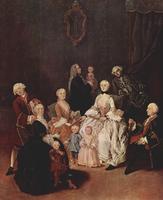
A Patrician Family
Pietro Longhi
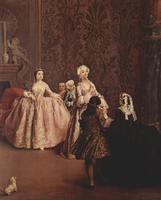
Presentation
Pietro Longhi
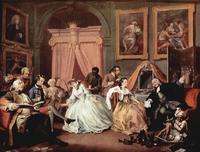
The Countess's Morning Levee
William Hogarth
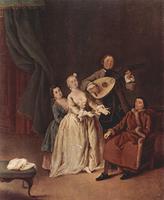
The Family Concert
Pietro Longhi
The Tailor
Pietro Longhi
The Western Family
William Hogarth
The Geography Lesson
Pietro Longhi
The Coming of Age
William Maw Egley
The Duke of Valois in his cradle in a lower room of the Palais-Royal, October 1773
Alexandre Antigna
Lady at the Dressmaker
Pietro Longhi
Reception of August the Strong in the Berlin City Palaces
Antoine Pesne
Lady at her Toilette
Pietro Longhi
The Sagredo Family
Pietro Longhi
The Painter in his Studio
Pietro Longhi
A young Woman mocking an elderly Admirer
Louis Leopold Boilly
Portrait of the crown prince Friedrich Ludwig of Württemberg and his wife Henriette Marie of Brandenburg Schwedt
Antoine Pesne
The Graham Children
William Hogarth
Rosalind and Celia
James Archer