Figures in a Landscape
Dettagli
Analisi esperta di Figures in a Landscape di Jackson Pollock
Stile: Expressionism · Genere: figurative
Expert Analysis: "Figures in a Landscape" by Jackson Pollock (Early Works)
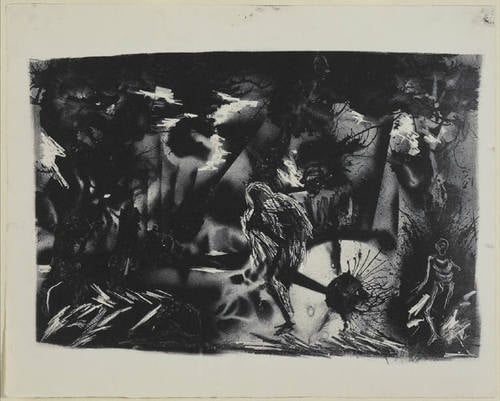
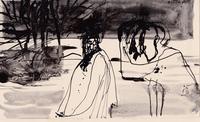
This early painting by Jackson Pollock—long before his iconic drip canvases—reveals the foundational struggle and dramatic intensity that would later explode into his signature style. Created during his formative period, Figures in a Landscape exemplifies figurative Expressionism, a phase in which Pollock grappled with the influence of Thomas Hart Benton (his teacher) and the mythic, psychological currents of Mexican muralists like José Clemente Orozco and David Alfaro Siqueiros.
Significance within Pollock’s Oeuvre:
-
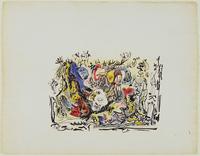
Bridging Figuration and Abstraction: While the title suggests a literal scene, Pollock distorts bodies and environment into writhing, almost unrecognizable forms. The figures are not realistically rendered; instead, they are thickly outlined and engulfed by agitated, swirling lines. This tension between representation and pure mark-making foreshadows his later "all-over" compositions.
-
Expressionist Emotional Charge: The work’s Expressionist style is evident in its raw, gestural brushwork and somber palette (earthy browns, deep blues, and flashes of white). The figures appear trapped or in motion, conveying a sense of existential anxiety—a theme Pollock would continue to explore through his "myth-making" period of the early 1940s.
-
Evidence of Artistic Growth: This piece shows Pollock absorbing European modernism (Picasso, Miró) and American Regionalism, yet pushing toward a personal language. The landscape itself is not a passive backdrop but an active, turbulent force—an early sign of his belief that the entire canvas should be a unified field of energy.
Why It Matters: Figures in a Landscape is significant precisely because it is not a "typical" Pollock. It documents his transition from a student of narrative figuration to a pioneer of action painting. The painting’s raw, unfinished quality—the figures bleeding into the landscape—prefigures the physicality and rhythmic chaos that would define his masterpiece Number 1A, 1948. For scholars, it is a crucial entry in Pollock's early vocabulary: a work where the struggle between control and spontaneity is already fully engaged, even within the bounds of figurative representation.
Museum / Gallery
Visivamente simili
20 opere con composizione e palette affini
Dantesca
Oswaldo Vigas
Conversation
Jean-Paul Riopelle
Primordial Scene
Walter Battiss
Self-portrait
Ernst Ludwig Kirchner
Iesus a Satana tentatur (Mark 1:13)
Salvador Dali
Three Pierrots and Harlequin
Albert Bloch
Soleil agathe
Mario Prassinos
Pardon
Oleg Holosiy
Prisoner of the Mirror: Transfiguring Your Death
Andre Masson
White hairy
Oleg Holosiy
Disasters of Mysticism
Roberto Matta
Le tumulte à la mâchoire crispée
Marcel Barbeau
Kleine Attacken
Bernard Schultze
Traveler in rich soil
Jean Dubuffet
Untitled
Vasile Kazar
Le culte
Louis Soutter
Execution (vertion)
Oleg Holosiy
Untitled
Vasile Kazar
Babits: The book of Jonah III,
Maria Bozoky
Untitled
Jackson Pollock