Expertenanalyse zu Jackson Pollocks Untitled
Stil: Abstract Expressionism · Genre: figurative
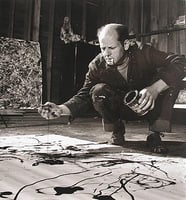
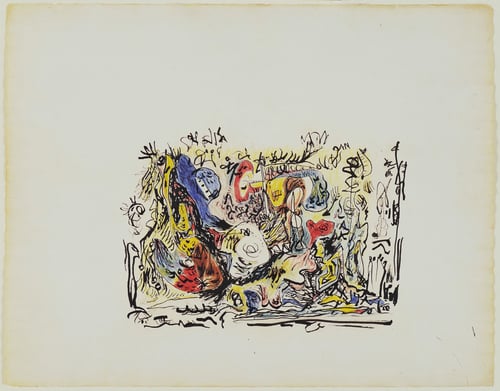
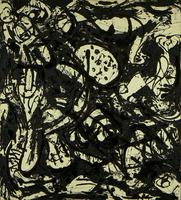
While Jackson Pollock is best known for his revolutionary drip paintings and is a central figure in Abstract Expressionism, the designation of this Untitled work as figurative places it within a distinct and critically important phase of his career. Most viewers associate Pollock with pure abstraction, but his early to mid-1940s output—often categorized as his "mythic" or "totemic" period—is deeply rooted in figurative imagery.
Analysis: Significance within Abstract Expressionism
-
A Crucible of Gesture and Myth: This figurative work is significant because it demonstrates that Pollock’s explosive, gestural energy did not emerge from a vacuum of pure form. Instead, it was forged through the distortion and fragmentation of the human figure. The "figurative" genre here is not realistic representation but a semiotic or symbolic figure—often biomorphic, mask-like, or derived from Native American sand painting and Surrealist automatism. This places the work squarely in the "existential" wing of Abstract Expressionism, where the artist’s struggle is rendered through the violent alteration of the human form.
-
The Figure as a Site of Action: Unlike the later drip paintings where the entire canvas becomes a field of action, this Untitled work uses the figure as a concentrated vessel for that action. The paint application is likely aggressive, linear, and tangled—what critic Harold Rosenberg would later call "action painting." The figure is not painted but attacked onto the canvas. This establishes the core principle of Abstract Expressionism: the process (the act of painting) is as important as the final image. The figure becomes a record of the artist's physical and psychological gesture.
-
Precursor to the "All-Over" Composition: Pollock’s figurative works from the early 1940s (such as The Moon-Woman Cuts the Circle) are essential to understanding his later breakthrough. In these pieces, the line that defines the figure begins to unravel, escaping its outline and spreading across the surface. This Untitled work likely shows that tension: the figure is still recognizable, but the energy of the paint is threatening to break free from the figurative cage. This is the exact moment where Abstract Expressionism discovered its signature "all-over" composition—by freeing the line from the figure.
Conclusion: This artwork is not "figurative" in a traditional sense, but figurative as a threshold. It is significant because it captures the transition from Surrealist-inspired myth-making to pure painterly abstraction. It proves that even in his representational mode, Pollock was not illustrating a story; he was using the figure to externalize an inner, chaotic state of being—a core tenet of Abstract Expressionist philosophy.
Museum / Gallery
Genre
Visuell ähnlich
20 Werke mit ähnlicher Komposition und Farbpalette
Untitled
Vasile Kazar
Rush (Ruée) from the portfolio Pencil on Shell
Pierre Alechinsky
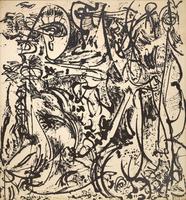
Echo (Number 25)
Jackson Pollock
The last judgment
Wassily Kandinsky
Untitled (O'Connor-Thaw 770)
Jackson Pollock
Flying
Endre Rozsda
Bird's Eye View of the Sea (L'eau à vue d'oeil d'oiseau)
Pierre Alechinsky
Bones and Chrysalids
Andre Masson
Untitled
Vasile Kazar
Composition VII
Wassily Kandinsky
Untitled
Corneille
Untitled
Wassily Kandinsky
Untitled
Helen Frankenthaler
Untitled
Willem de Kooning
Black & White (Number 20)
Jackson Pollock
Untitled
Vasile Kazar
Primordial Scene
Walter Battiss
Composition V
Wassily Kandinsky
First abstract watercolor
Wassily Kandinsky
In Society (En société)
Pierre Alechinsky