Analisi esperta di Blue (Moby Dick) di Jackson Pollock
Stile: Abstract Expressionism · Genere: figurative
Analysis of "Blue (Moby Dick)" by Jackson Pollock
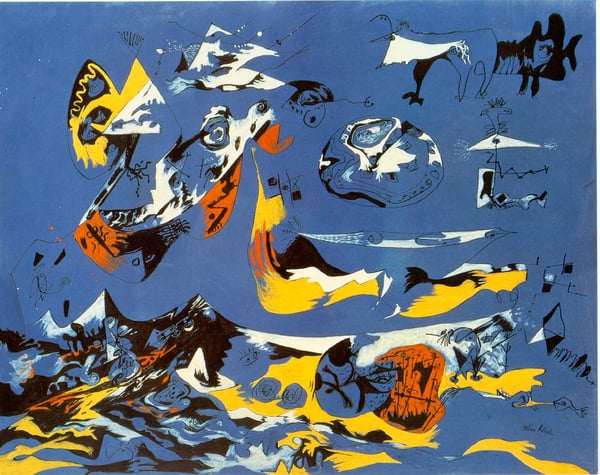
Jackson Pollock’s Blue (Moby Dick) stands as a pivotal work within his early career, offering a rare figurative glimpse into the artist’s development before his iconic drip paintings redefined Abstract Expressionism. Created during a period when Pollock was still grappling with narrative and representational imagery, this painting draws its title and thematic inspiration from Herman Melville’s epic novel, Moby-Dick. The work is significant precisely because it bridges Pollock’s early engagement with mythic, literary subject matter and the radical non-objective language that would soon become his hallmark.
In Blue (Moby Dick), Pollock employs a predominantly blue palette—evocative of the ocean and the whale’s deep-water domain—while retaining recognizable forms: a whale-like silhouette, perhaps a ship’s hull, and swirling currents that suggest both movement and menace. The brushwork is energetic, with thick impasto and agitated lines that foreshadow the all-over compositional chaos of his later poured works. Yet the painting remains legible as a scene, anchored in the figurative tradition of expressing narrative through symbolic imagery.
This work’s significance lies in its tension between representation and abstraction. Pollock was deeply influenced by the Surrealists’ concept of automatism and by the mythic archetypes explored by artists like Picasso and Orozco. Blue (Moby Dick) channels that influence into a personal myth: the white whale as an emblem of obsession, struggle, and the sublime. The painting captures Pollock at a crossroads—still tethered to figurative storytelling but already pushing toward the instinctual, physical mark-making that would define Abstract Expressionism. As an early work, it provides essential context for understanding how Pollock’s revolutionary style emerged not from a rejection of subject matter, but from a deep, even violent, engagement with it.
Museum / Gallery
Genere
Visivamente simili
20 opere con composizione e palette affini
Untitled
Vasile Kazar
The Garden in Sochi
Arshile Gorky
Time
Georges Valmier
White oval
Wassily Kandinsky
Untitled
Eva Hesse
Echo (Number 25)
Jackson Pollock
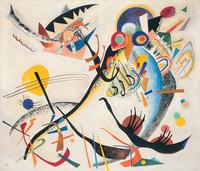
Blue segment
Wassily Kandinsky
Clock in Szentendre
Piroska Szanto
Figure at Night Guided by the Phosphorescent Tracks of Snails
Joan Miro
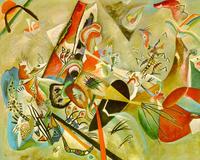
In Grey
Wassily Kandinsky
Small worlds III
Wassily Kandinsky
Untitled
Esteban Frances
Troubled
Wassily Kandinsky
Italian Landscape in 2073 BC
Carloluigi Colombo
Figures in Front of a Metamorphosis
Joan Miro
Composition IX
Wassily Kandinsky
Untitled
Mark Rothko
Landscape of Olympia
Yiannis Tsaroychis
Untitled
Jackson Pollock
Study for "Composition VII"
Wassily Kandinsky