Экспертный разбор работы «Full fathom five» художника Jackson Pollock
Стиль: Action painting · Жанр: abstract
Expert Analysis of Jackson Pollock’s Full Fathom Five
Full Fathom Five (1947) is a landmark work from Jackson Pollock’s Drip period, executed in the Action painting style and belonging to the abstract genre. Its significance lies in how it epitomizes the core tenets of Action painting—where the physical act of painting becomes the subject itself—while also marking a pivotal moment in Pollock’s development of the drip technique.
Significance within Action Painting
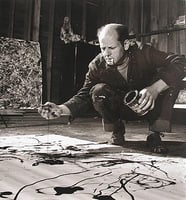
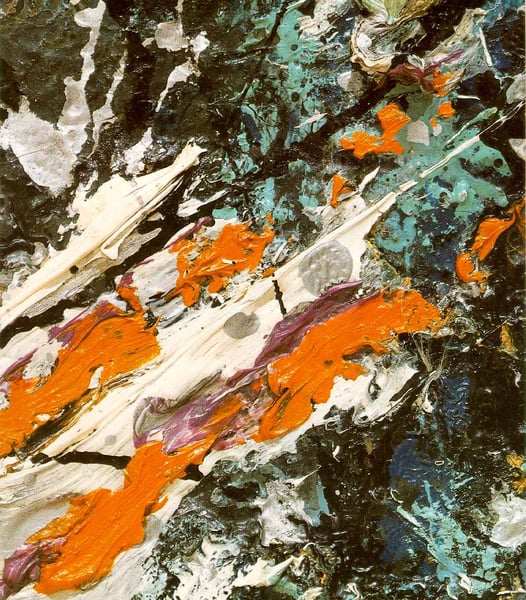
As a canonical example of Action painting, Full Fathom Five foregrounds the artist’s bodily engagement with the canvas. Pollock placed the canvas on the floor, allowing him to move around it freely, and poured, dripped, and splattered liquid paint using sticks, trowels, and hardened brushes. This method eliminated traditional brushwork and spontaneous gestures, transforming the painting into a record of kinetic energy. The resulting layered web of black, white, and metallic silver lines, punctuated by embedded cigarette butts, nails, and other detritus, blurs the boundary between painting and object. The work’s significance stems from its radical insistence that the process of making—the rhythm, velocity, and physicality of the artist’s movements—is as important as the final composition.
Significance within Pollock’s Drip Period
Created during the peak of his Drip period (c. 1947–1950), Full Fathom Five demonstrates Pollock’s mature command of all-over composition. Unlike earlier drip works, here he achieves a dense, intricate surface that seems to extend infinitely beyond the canvas edges—a hallmark of his “drip” innovation. The title, drawn from Shakespeare’s The Tempest (“Full fathom five thy father lies”), alludes to depth and submergence, mirroring the painting’s layered, aquatic-like interplay of paint and embedded objects. This work is significant because it represents a breakthrough: Pollock no longer painted an image; he painted the act of painting itself, making the canvas an arena for action. The abstract result is both chaotic and controlled, a visual record of entropy and intention that redefined what painting could be in the mid-20th century.
In sum, Full Fathom Five is a crucial artifact of the Drip period that exemplifies Action painting’s emphasis on physical gesture and process, cementing Pollock’s role as a revolutionary force in abstract art.
Визуально похожие
20 работ с близкой композицией и палитрой
TausendSterne-Diptychon-Detail-2011
Harry Meyer
Oceanic Flow
Jacob Farkas
Oceanic Flow
Jacob Farkas
Beauty of Ariel
Jules Olitski
Miss T
Edward Avedisian
Mistral de partout
Francois Arnal
No Jardim IV
Paulo Fontes
Subiaco
William Congdon
Hawk
Dan Goorevitch
Number 279
Roger Weik
Koushin-san
Kazuo Shiraga
Cullipool
Gillian Ayres
Untitled
Vilen Barsky
Waterfall
Endre Bartos
One World
John Ferren
The Beauty of Lauren
Jules Olitski
E.O.W. on her blue Eiderdown III
Frank Auerbach
Temptation Temple
Jules Olitski
Boundsplayedpause
Stanley Boxer
Laundry Wars Green Load
Dan Goorevitch