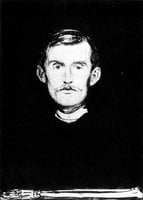
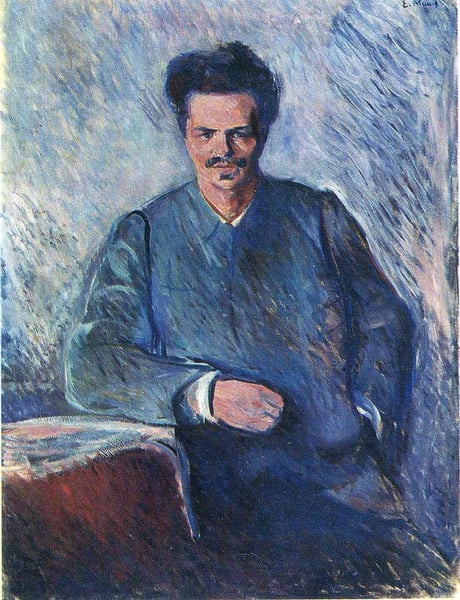
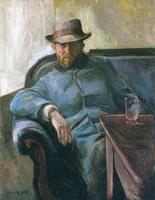
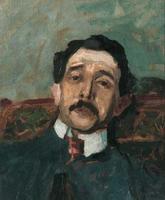
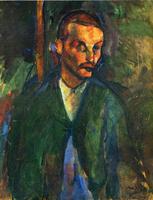
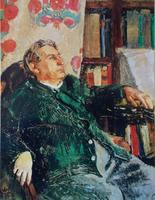
Edvard Munch’s August Strindberg is a landmark of Expressionist portraiture, capturing not the sitter’s physical likeness but the turbulent psychological undercurrents that defined both artist and subject. Painted during Munch’s European period, the work presents the Swedish playwright and polemicist—a close, if combative, friend—as a spectral, almost menacing figure. Munch abandons naturalistic detail in favor of bold, agitated brushstrokes and a somber, near-monochrome palette, with the face emerging from deep shadows as if lit from within by an inner fire. The composition is tight and confrontational: Strindberg’s gaze is fixed, piercing, and haunted, reflecting the shared interest of both men in the darker realms of human emotion, misogyny, and existential dread. This portrait is significant because it epitomizes Munch’s ability to externalize internal states—here, the anxiety, paranoia, and creative torment that Strindberg himself channeled into his works. It stands as a visual manifesto of Expressionism’s core ambition: to render the subjective truth of a personality over objective reality.