Expertenanalyse zu Valentin Serovs Portrait of Sergei Diaghilev
Stil: Impressionism · Genre: portrait
Expert Art Historical Analysis: "Portrait of Sergei Diaghilev" by Valentin Serov
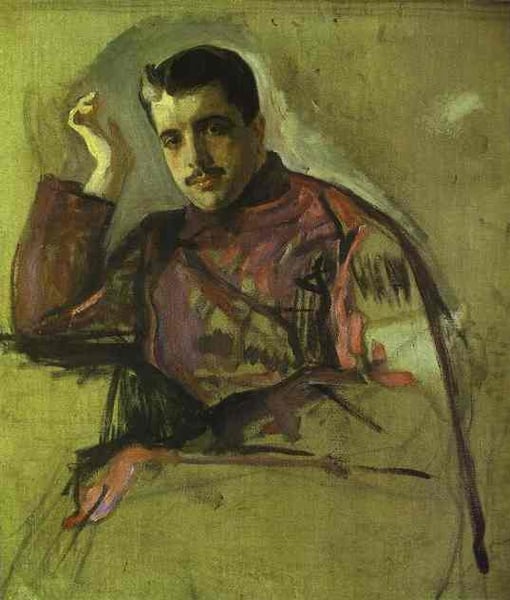
Valentin Serov’s Portrait of Sergei Diaghilev (1904) stands as a masterful fusion of Impressionist technique with penetrating psychological realism, marking a significant moment in Russian portraiture. While Serov is often celebrated for his early Impressionist works—such as Girl with Peaches—this later portrait demonstrates his mature ability to use the style’s fluid brushwork and atmospheric light not merely for decorative effect, but to reveal the inner character of his sitter.
Significance within Impressionism and the Portrait Genre
-
Impressionism as Psychological Instrument
Serov adopts the Impressionist emphasis on capturing a fleeting moment, but here the “moment” is not a sunlit landscape—it is the restless energy of Diaghilev himself. The loose, feathery strokes around the figure’s shoulders and background dissolve into a hazy, almost theatrical atmosphere, echoing the ephemeral nature of Diaghilev’s world of ballet and opera. Yet the face—treated with sharper, more controlled touches—anchors the viewer, forcing a direct confrontation with Diaghilev’s knowing, slightly imperious gaze. This duality between vibrancy and precision makes the work a sophisticated example of how Impressionism could be adapted for portraiture beyond its French origins. -
Capturing a Cultural Catalyst
Sergei Diaghilev, the visionary impresario of the Ballets Russes, is depicted at a pivotal moment in his career—just before he would revolutionize European dance and art. Serov, a friend and contemporary, understood that Diaghilev was not merely a patron but a live wire of ambition and intellect. The portrait’s slight asymmetry (the turned shoulder, the uneven lighting) suggests a man in constant motion, while the dark, undefined background isolates him as a force of nature. This is no passive society portrait; it is a study of creative power. -
Russian Impressionism’s Distinct Voice
Unlike French Impressionists who often prioritized overall optical sensation, Serov retained a strong sense of structure and narrative. The palette here is subdued—grays, blacks, and muted ochres—reflecting Moscow’s more sober cultural climate. The brushwork in the clothing is brisk but deliberate, hinting at the sleek modernity of Diaghilev’s public persona. The significance lies in Serov’s ability to marry the spontaneity of Impressionism with the depth of a timeless character study, proving that the style could transcend its initial associations with light and leisure to engage with intellectual history.
What Makes This Artwork Truly Significant
- A Bridge Between Movements: The portrait stands at the cusp of Symbolism and Modernism. The blurred edges and psychological intensity anticipate the work of later Expressionists, yet the technical debt to Impressionism is clear. Serov shows that Impressionism could evolve into a tool for exploring the psyche, not just the eye.
- Icon of a Cultural Epoch: Diaghilev’s face—with its shrewd, heavy-lidded eyes—has become synonymous with the daring spirit of early 20th-century art. Serov’s rendering immortalizes that spirit: confident, elegant, and slightly unsettling.
- Mastery of Atmosphere: The way the light falls across Diaghilev’s face, picking out the high cheekbone and dark brow, creates a sense of immediacy that feels both candid and composed. It is a portrait that breathes, in the best Impressionist tradition.
In sum, Valentin Serov’s Portrait of Sergei Diaghilev is significant because it redefines Impressionist portraiture as a vehicle for psychological biography, all while capturing the essence of one of the most influential figures in modern art. It remains a touchstone for how a style rooted in fleeting light can preserve a personality for eternity.
Visuell ähnlich
20 Werke mit ähnlicher Komposition und Farbpalette
August Stindberg
Edvard Munch
Portrait of Count Nikolay Sumarokov-Elstone
Valentin Serov
Portrait of man
George Bouzianis
Self-portrait with Black Bandage
Rik Wouters
Portrait of An Armenian Artist V. Akhikyan
Fedir Krychevsky
Portrait of an Officer
Konstantin Korovin
Alden Brooks
Roderic O'Conor
Portrait of Brother Ettore
Mario Sironi
Writer Hans Jaeger
Edvard Munch
A soldier
Ilya Repin
Portrait De Victor Hugo
Jules Bastien-Lepage
Connop Thirlwall, Bishop of St David's
Frank Holl
The beggar of Livorne
Amedeo Modigliani
Seated Young Man in a Jacket with an Umbrella
Edgar Degas
Portrait of a son
Pyotr Konchalovsky
Portrait of Grósz Andor
Lajos Tihanyi
Young Boy of the Corot Family
Camille Corot
Portrait of Paul Nauen
Olga Boznańska
Portrait of a Man
Edgar Degas
Reading Self Portrait
Kmetty János