Expert analysis of Edvard Munch’s Spring
Style: Expressionism · Genre: genre painting
Artwork Analysis: "Spring" by Edvard Munch
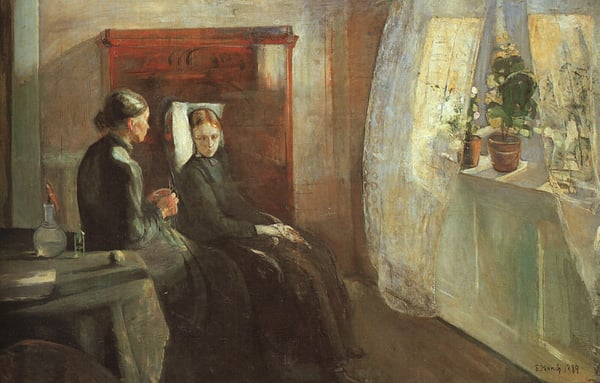
Edvard Munch’s "Spring" stands as a profound example of early Expressionism, a movement that prioritizes emotional intensity over literal representation. Although the title evokes renewal and light, Munch subverts these expectations, channeling the work’s energy through his characteristic psychological tension.
Significance within Expressionism:
Munch’s brushwork here is deliberately agitated and visible, creating a surface that feels almost raw. The palette—muted earth tones with sharp accents of white and pale green—refuses the sentimental pastels typical of seasonal allegories. Instead, the figures (likely a mother and child, or a young couple) are rendered with elongated, anxious contours. Their faces are indistinct, suggesting identity is secondary to the emotional atmosphere. This approach aligns with Munch’s core mission: to depict the inner life, not outward appearances.
Genre and European Context:
As a genre painting, "Spring" might initially appear to capture everyday life—a common motif, for example, in 19th-century realist works. But Munch transforms the mundane into a psychological drama. The composition feels compressed, the figures are pushed close to the picture plane, and the space lacks classical depth. This mirrors the claustrophobic intimacy of his famous "The Scream," reinforcing his belief that modern European life was fraught with existential dread. The season of rebirth becomes a metaphor for the fragile, often painful awakening of human consciousness.
Why It Matters:
This painting bridges the gap between Munch’s symbolist roots and full-blown Expressionism. It shows how he used a conventional subject (spring) as a vehicle for universal human emotions—unease, longing, and the fleeting nature of joy. The work’s significance lies in its rejection of mere visual pleasure; it demands that viewers feel the ambiguity beneath the surface. In doing so, "Spring" helped redefine what a "seasonal" painting could be, paving the way for later Expressionists like Kirchner and Schiele to invest every scene with raw, subjective power.
Museum / Gallery
Visually similar
20 works with related composition and palette
Sewing Woman
Harriet Backer
A Blind Woman in Her Room
Anna Ancher
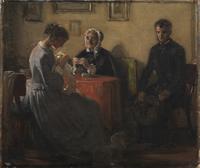
The suitor's visit
Wilhelm Marstrand
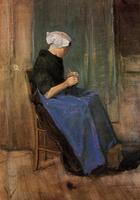
Young woman knitting
Vincent van Gogh
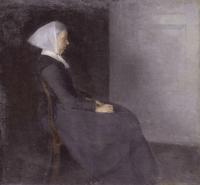
Frederikke Hammershøi, the artist's mother
Vilhelm Hammershoi
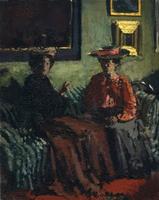
Young Belgium Women
Walter Sickert
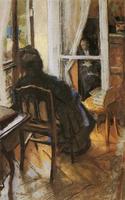
The Window
Edouard Vuillard
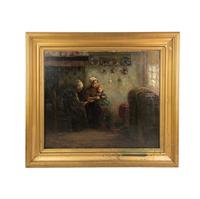
Figural Kitchen Scene
Melbourne Havelock Hardwick
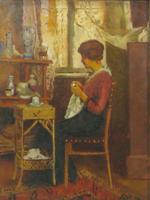
In atelier
Stefan Luchian
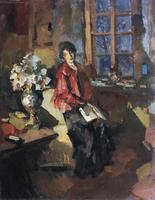
Actress Hope Komarovskaya
Konstantin Korovin
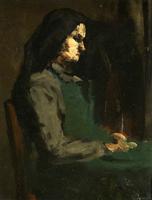
Woman with a Green Apron
Theodule Ribot
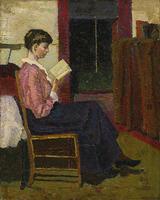
The Reader
Grace Cossington Smith
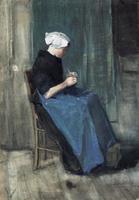
Scheveningen Woman Knitting
Vincent van Gogh
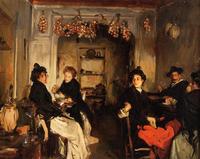
Venetian Wineshop
John Singer Sargent
The arrival of rural teachers
Vasily Perov
The lesson
Silvestro Lega
Waiting Room
Vincent van Gogh
Before vows
Vasily Perov
A Lady Reading
Gwen John
Portrait de la tante Octavie
Maximilien Luce