Expertenanalyse zu Vasily Perovs The arrival of rural teachers
Stil: Realism · Genre: sketch and study
Analysis of "The arrival of rural teachers" by Vasily Perov
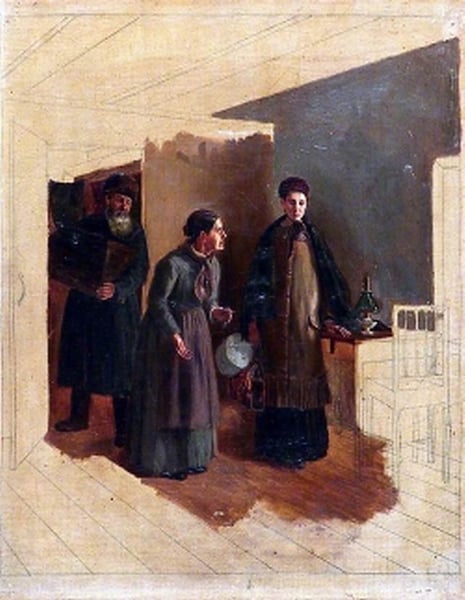
As an expert art historian, I examine Vasily Perov’s The arrival of rural teachers within the framework of Realism and its specific genre as a sketch and study. This work is significant precisely because it belongs to the preparatory phase of artistic creation, offering a raw, unpolished glimpse into the Realist method and the social concerns that defined Perov’s oeuvre.
Significance within Realism and the Russian Context
Perov was a leading figure of the Russian Realist movement, which sought to depict the harsh truths of everyday life—especially the struggles of the lower classes—with unidealized sincerity. This sketch is a prime example of how Realist artists used studies to capture authentic, unposed moments. The subject matter—rural teachers arriving in a provincial setting—reflects the Realist commitment to portraying the lives of ordinary people and the social transformations of 19th-century Russia, where education was slowly reaching the countryside.
What Makes This Sketch and Study Important
As a sketch and study, the work reveals the artist’s process: the loose, rapid handling of line and tone suggests a focus on capturing the essential narrative and emotional content rather than finished detail. This is critical because it shows how Perov (and other Realists) valued direct observation over academic polish. The composition, even in its preliminary state, likely emphasizes the contrast between the teachers (bearers of enlightenment) and the rural environment—a theme of cultural tension and hope that was central to Russian Realist social critique.
Significance for Art History
This piece is significant because it documents the interaction between art and social reform. Perov’s sketches often served as the basis for finished paintings that critiqued the Russian social order (e.g., the oppression of peasants, the failings of the clergy). Here, the arrival of teachers hints at progress and the spread of literacy, a positive yet realistically tempered subject. In the context of Realism, such studies are invaluable for understanding how artists translated social observation into visual art, preserving the immediacy of a moment that a more polished work might lose.
In summary, The arrival of rural teachers is not merely a preparatory work—it is a testament to the Realist ethos: an honest, unvarnished look at a transformative social moment, rendered with the directness that only a sketch can achieve.
Visuell ähnlich
20 Werke mit ähnlicher Komposition und Farbpalette
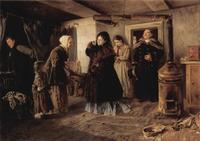
Visiting a poor people
Vladimir Makovsky
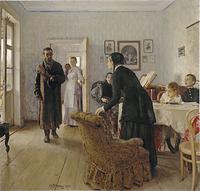
Unexpected Visitors
Ilya Repin
A Visit from the Old Mistress
Winslow Homer
Young Woman in the Atelier
Janos Tornyai
Spring
Edvard Munch
Hope
Frank Holl
Household Conversation
Konstantin Makovsky
The introduction of the engaged couple
Gerolamo Induno
Return of the Runaway
Joseph Clark
A scene of two ladies in an interior
Harry Brooker
The Village Choir
Anton Azbe
A concern
Felix Schlesinger
Verdict
Vladimir Makovsky
In the Kitchen
Vladimir Makovsky
Grandpa's Day
Jules Breton
peasant woman
Vincent van Gogh
Woman Knitting
Jozef Israëls
The lesson
Giacomo Favretto
Return from the masquerade
Luigi Da Rios
Per Degn ("Per, the deacon") sings for a glass of akvavit, An incident from the Ludvig Holberg comedy, Erasmus Montanus (Act 1, scene 4)
Wilhelm Marstrand