Expert analysis of Edvard Munch’s White Night
Style: Expressionism · Genre: landscape
Analysis of "White Night" by Edvard Munch
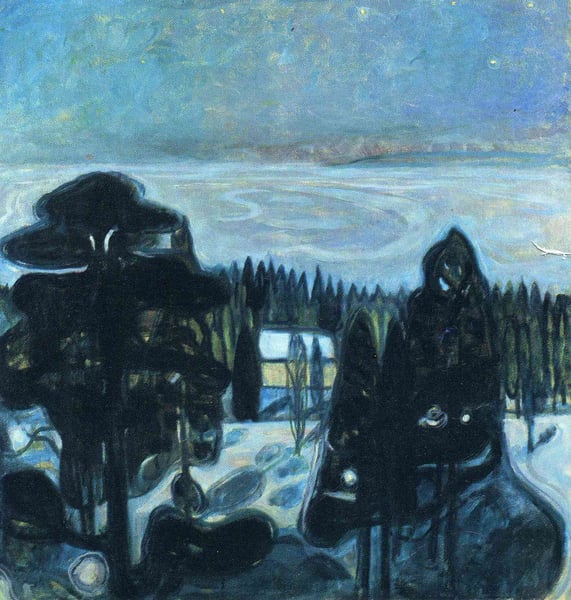
This landscape, painted during Munch’s European period, exemplifies the core tenets of Expressionism by transforming a seemingly natural scene into a psychological arena. Rather than depicting a literal "white night" (the phenomenon of persistent twilight in northern latitudes), Munch uses the pale, eerie illumination to evoke a sense of existential solitude and emotional tension.
Significance within Expressionism:
- Subjective Color and Mood: The "white" light is not neutral; it is stark, almost spectral, bathing the landscape in a cold, unearthly glow. This choice rejects naturalism in favor of a symbolic color palette that mirrors an inner state—perhaps anxiety, longing, or a melancholic clarity.
- Brushwork and Form: Munch’s fluid, restless brushstrokes dissolve the landscape into a shimmering, almost hallucinatory surface. Trees, water, and sky bleed into one another, suggesting that the boundary between the self and nature is permeable. This technique prioritizes visceral emotional impact over topographical accuracy.
- Psychological Landscape: Unlike the serene landscapes of Impressionism, Munch’s scene feels inhabited by an unseen presence. The lack of human figures amplifies the loneliness; the viewer becomes the solitary observer confronting an indifferent cosmos. This aligns with Munch’s lifelong exploration of fear, love, and death.
Period and Context: Created during his European period (often associated with his time in Germany and France), White Night reflects the influence of Symbolism and the emerging Expressionist movement. It shares thematic kinship with works like The Scream (1893) and Starry Night (1893), where the sky becomes a mirror of psychic distress. However, White Night offers a quieter, more hypnotic dread—a nocturnal counterpart to the overt panic of The Scream.
Conclusion: In White Night, Munch demonstrates that landscape can be as potent a vehicle for existential drama as the human figure. Its significance lies in how it harnesses the raw, subjective power of color and line to transform a familiar natural phenomenon into a haunting meditation on isolation. It remains a crucial example of early Expressionism’s break from objective reality toward the interior world of feeling.
Museum / Gallery
Visually similar
20 works with related composition and palette
Rising of the moon
Wassily Kandinsky
Landscape near Martigues
Andre Derain
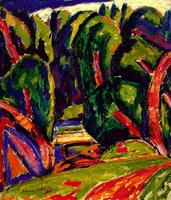
Red Tree
Marsden Hartley
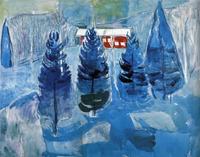
Red House and Spruces
Edvard Munch
Spring Dawn on the South Bank of river
Guan Zilan
Ancient life
Nicholas Roerich
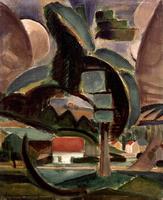
The Tree
Henri Le Fauconnier
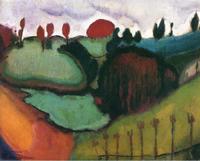
Landscape, Study for 'Paradise'
Marcel Duchamp
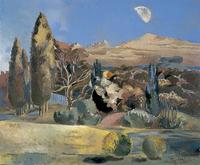
Landscape of the Moon's First Quarter
Paul Nash
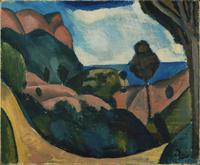
Landscape near Cassis
Andre Derain
Klostergarten
Helen Dahm
Grand Paysage Aux Arbres
Henri Matisse
New York Dawn, The Hudson
Leon Dabo
Green and Black French Landscape
Istvan Farkas
Gaspe Pink Sky
Milton Avery
Spring Evening During the Ice Break
Hugo Simberg
Maaliskuu
Pekka Halonen
Arbres
Gustave de Smet
Forest at Martigues
Andre Derain
Above the Trees
Emily Carr