
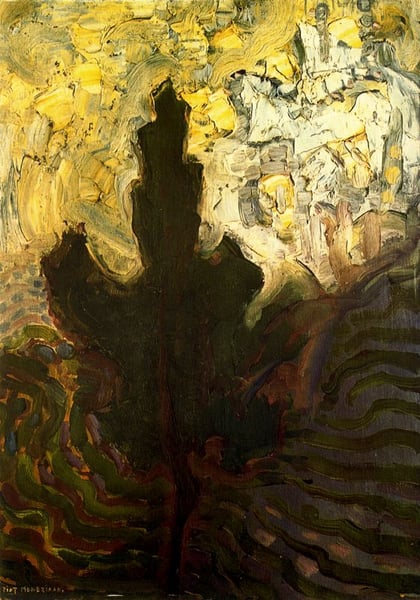
Analisi esperta di Untitled di Piet Mondrian
Stile: Post-Impressionism · Genere: landscape
Expert Analysis: "Untitled" by Piet Mondrian (Post-Impressionist Landscape)
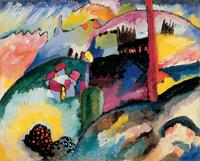
This early work by Piet Mondrian, executed in a Post-Impressionist style and classified as a landscape, holds significant art-historical value as a crucial marker of the artist’s creative evolution. While Mondrian is universally celebrated for his later Neoplastic abstractions—grids of black lines and primary colors—this landscape reveals the foundational visual language he would eventually distill.
What makes the work significant within its style/period:
-
Transitional Bridge between Naturalism and Abstraction
Painted during his Post-Impressionist phase (circa 1905–1910), the work shows Mondrian grappling with the tenets of that movement: visible, expressive brushwork; a subjective use of color; and a focus on capturing the essential mood of a scene rather than photographic detail. Yet even here, one can detect the artist’s incipient urge to simplify form—the horizontals of the horizon line, the verticals of trees or poles—foreshadowing the geometric reduction of his mature style. The landscape is not merely a record of a place but a step toward the universal, balanced compositions that would define his legacy. -
Post-Impressionism’s Influence on Mondrian’s Philosophy
Like van Gogh or Seurat, Mondrian was searching for a deeper spiritual or structural order in nature. In this untitled landscape, he emphasizes rhythmic patterns—repetition of shapes, subtle tonal contrasts—that elevate the ordinary Dutch countryside into a meditative, almost symbolic scene. This aligns with Post-Impressionism’s shift from impressionistic spontaneity to structured, intellectual expression. -
Contrast with His Later Oeuvre
The work’s significance is amplified by its stark contrast to the geometric abstracts that made Mondrian a modernist icon. It documents his journey: the same eye that sought calm through strict perpendicular lines and primary colors first learned to find harmony in the organic curves of clouds, fields, and waterways. For scholars, this piece provides evidence that Mondrian’s abstraction was not a rejection of nature but a progressive distillation of its essence—a fact that deepens our understanding of his entire career.
Conclusion:
While not a masterwork of Post-Impressionism in isolation, Mondrian’s untitled landscape is a vital historical artifact. It demonstrates how a major 20th-century innovator used the tools of his era to lay the groundwork for a revolutionary visual language, making it significant both as a example of early Mondrian and as a document of the transition from representation to abstraction.
Museum / Gallery
Visivamente simili
20 opere con composizione e palette affini
Winter wind
Eugene Leroy
Paysage Au Grand Arbre
Bela Czobel
A ventania
Anita Malfatti
Bacchus and Ariadne
Frank Auerbach
Landscape, Study for 'Paradise'
Marcel Duchamp
Untitled
Ligia Macovei
Landscape study
Richard Gerstl
Arbres
Gustave de Smet
Bay
Elmer Bischoff
Forest (Autumn)
George Stefanescu
Street At Cagnes
Chaim Soutine
Untitled
Ligia Macovei
Blossoming mountains
Martiros Sarian
Orange Earth, Yellow Trees
Karl Schrag
Czóbel Béla , Grosrouvres 1927
Bela Czobel
Orpheus
Martiros Sarian
Landscape with Tree
Ion Tuculescu
The Artist's House, View from the Rose Garden
Claude Monet
Grey Landscape
Eugene Leroy
Landscape with factory chimney
Wassily Kandinsky