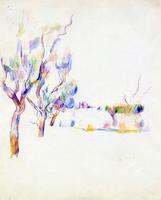
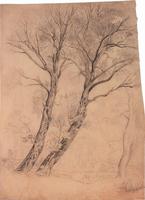
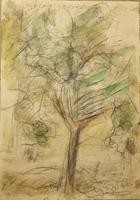
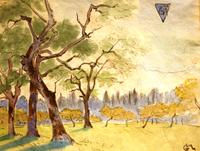
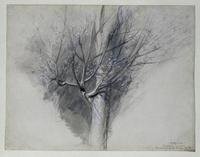
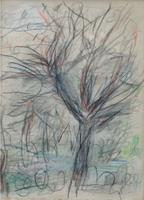
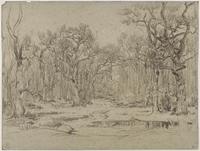
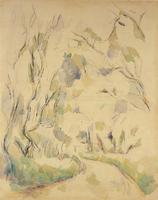
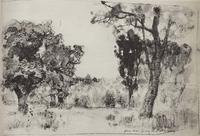
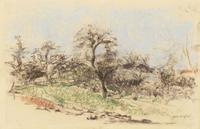
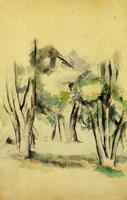
This artwork, Design for the Church of St. Jacob by Piet Mondrian, holds a unique significance as an early landscape study created under the influence of Impressionism—a style that seems antithetical to the geometric abstraction for which Mondrian later became famous. Executed within the landscape genre, the piece captures not only a specific architectural subject but also the fleeting qualities of light and atmosphere that were central to Impressionist practice.
The significance lies in its role as a transitional work. Here, Mondrian applies the broken brushwork and subdued yet vibrant palette characteristic of Dutch Impressionism to a subject—a church facade—that would later recur in his Cubist and neo-plastic phases in simplified, planar forms. In this early rendering, the church is still embedded in a natural, observing landscape; the artist focuses on the play of sunlight on stone and the merging of architectural mass with the surrounding environment. This piece demonstrates that even before his radical turn toward pure abstraction, Mondrian was deeply engaged with capturing the sensory experience of a specific place—a foundational impulse that he would later distill into universal visual language. As an Impressionist landscape, it stands as a vital record of Mondrian's formative negotiation between direct perceptual observation and the structural order he would soon impose upon nature.