Expert analysis of Caravaggio’s The Seven Works of Mercy
Style: Baroque, Tenebrism · Genre: allegorical painting
Artwork: The Seven Works of Mercy (1607) by Caravaggio
Style: Baroque, Tenebrism
Genre: Allegorical painting
Expert Analysis & Significance
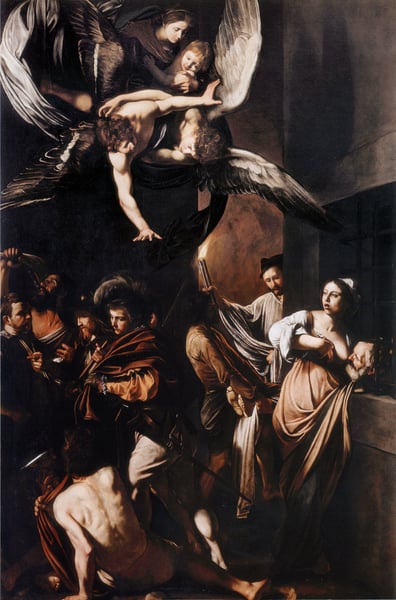
Caravaggio’s The Seven Works of Mercy stands as a masterwork of early Baroque painting, synthesizing the artist’s revolutionary tenebrism with a complex theological allegory that redefines the genre. Painted for the Confraternity of the Pio Monte della Misericordia in Naples, the work is both a literal and symbolic fusion of seven corporal acts—feeding the hungry, giving drink to the thirsty, clothing the naked, sheltering the homeless, visiting the sick and prisoners, burying the dead, and (in Catholic tradition) redeeming captives—into a single, vividly dramatic street scene.
Significance within Baroque & Tenebrism:
Caravaggio’s signature tenebrism—extreme contrast of deep shadow and stark, directional light—serves not merely as spectacle but as a theological spotlight. The diagonal shaft of light from an unseen source (likely symbolizing divine grace) picks out key figures: a man handing a flask to a desperate mouth (thirst), a woman nursing an aged prisoner’s breast (visiting the sick/prisoners), and a corpse being carried for burial. By plunging the background into near-total darkness, Caravaggio isolates each act as a vignette, yet they coexist in the same cramped space—a revolutionary departure from traditional multi-panel or sequential allegories. The viewer’s eye is forced to navigate the painting like a narrative puzzle, aligning the physical deeds with their spiritual meanings.
Allegorical Innovation:
Unlike static, idealized allegories of the Renaissance, Caravaggio presents the seven mercies through gritty, contemporary realism: the figures wear street clothes, the setting is an anonymous Neapolitan alley, and the facial expressions are raw (a tearful woman, a weary porter). This shock of the real makes the spiritual lesson immediate and urgent. Notably, the artist includes himself—or a figure resembling him—as a deacon carrying a torch, a meta-commentary on the artist as light-bringer. The painting’s composition also enacts the theme: the crowd of bodies presses together, forcing charity to occur in physical proximity, mirroring the confraternity’s mission to serve the urban poor.
Historical Impact:
The Seven Works of Mercy became a touchstone for Neapolitan Baroque painting, influencing artists like Mattia Preti and Luca Giordano. Caravaggio’s ability to condense a complex catechism into a single, emotionally charged moment—while using tenebristic chiaroscuro to heighten drama and theological gravity—cements this work as a pivotal example of how Baroque art married visceral experience with profound spirituality. It remains a landmark in allegorical painting, proving that moral instruction need not sacrifice pictorial immediacy or psychological depth.
Museum / Gallery
Visually similar
20 works with related composition and palette
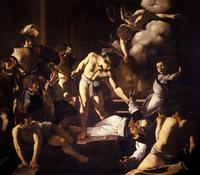
The Martyrdom of Saint Matthew
Caravaggio
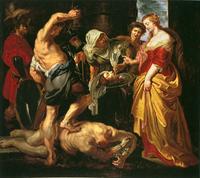
Beheading of St. John the Baptist
Peter Paul Rubens
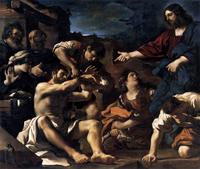
Raising of Lazarus
Guercino
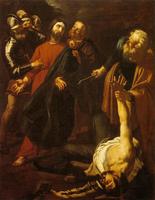
The Capture of Christ with the Malchus Episode
Dirck van Baburen
the Return of the Prodigal Son
Salvator Rosa
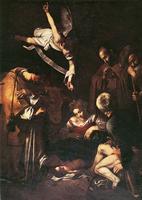
Nativity with St. Francis and St. Lawrence
Caravaggio
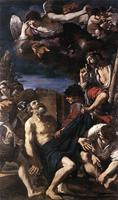
The Martyrdom of St Peter
Guercino
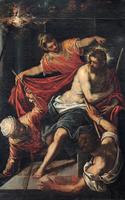
The Flagellation
Tintoretto
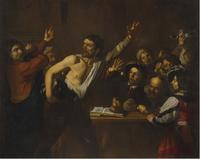
Christ Driving the Money Changers from the Temple
Dirck van Baburen
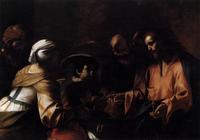
A Mother Entrusting Her Sons to Christ
Mattia Preti
The judgement of Solomon
Matthias Stom
Martyrdom of Saints Secunda and Rufina
Giulio Cesare Procaccini
The Paschal Lamb
Palma il Giovane
Samson Captured by the Philistines
Guercino
Mistérios Eleusinos, ou uma Oferenda a Ceres
Dirck van Baburen
Ecstasy of St. Margaret of Cortona
Giuseppe Maria Crespi
The Denial of St. Peter
Nicolas Tournier
Rebecca and Eliezer at the Well
Francesco Solimena
The flagellation of Christ
Ludovico Carracci
The mockery of Christ
David Rijckaert III