Expert analysis of Charles-Francois Daubigny’s Pond Gijlieu
Style: Realism · Genre: landscape
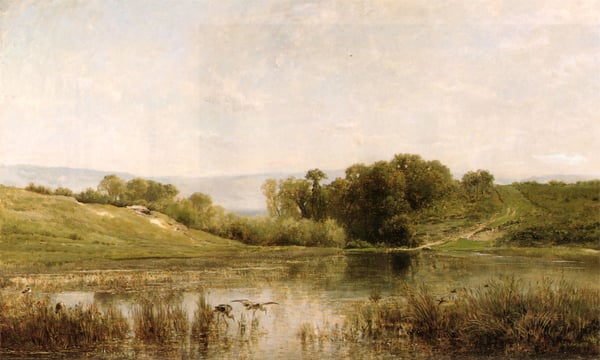
Expert Analysis: "Pond Gijlieu" by Charles-François Daubigny
Charles-François Daubigny’s Pond Gijlieu exemplifies the core principles of Realist landscape painting in mid-19th-century France. Created during a period when artists were increasingly turning away from idealized, historical, or romanticized views of nature, Daubigny instead embraced direct observation and a quiet, unadorned depiction of the rural environment.
Significance within Realism and the Barbizon School
Daubigny was a pivotal member of the Barbizon School, a group of painters who worked in the forest of Fontainebleau and its surroundings. Unlike the dramatic, heroic landscapes of the preceding Romantic era, Pond Gijlieu presents a humble, ordinary scene: a still pond bordered by trees and reeds, likely in the countryside of the Oise valley. The painting’s significance lies in its commitment to truthful representation—Daubigny often worked en plein air (outdoors), capturing the transient effects of natural light and atmosphere with a loose, rapid brushwork that would later influence the Impressionists.
Key Visual and Thematic Qualities
- Emphasis on Atmosphere and Light: The composition is dominated by a soft, silvery sky and the reflective surface of the water. Daubigny renders the pond with muted greens, browns, and grey-blues, avoiding sharp contrasts or artificial chiaroscuro. This naturalistic palette conveys a specific time of day (likely late afternoon) and weather (overcast or hazy), drawing the viewer into a direct, sensory experience of the landscape.
- Rejection of Narrative: Unlike history paintings or pastoral idylls, Pond Gijlieu lacks human figures or overt moral symbolism. The focus is purely on the optical truth of the pond, its water, and the textures of foliage. This marks a decisive shift toward the modern landscape—an autonomous subject worthy of study in its own right.
- Influence on Impressionism: Daubigny’s fluid handling of paint, his interest in changing light, and his willingness to leave visible brushstrokes (particularly in the sky and water) foreshadow the techniques of Monet and Sisley. In fact, Daubigny’s studio boat—from which he painted river scenes—became a model for Monet’s own floating studio.
Historical Context
The painting dates from a time when the French Academy still favored idealized, historical, or mythological landscapes. Daubigny’s refusal to “improve” upon nature was considered radical. Pond Gijlieu is therefore significant as a document of the Realist rebellion—an assertion that the simple, everyday countryside, observed without artifice, could carry its own profound beauty and artistic weight.
In summary, Pond Gijlieu is not merely a depiction of a wetland; it is a manifesto of Realist principles—honesty, direct observation, and a reverence for the mundane. Daubigny’s achievement here helped pave the way for the radical aesthetic of Impressionism and remains a touchstone for how artists learned to see nature anew.
Museum / Gallery
Visually similar
20 works with related composition and palette
River Scene with a Shepherd and Sheep by a Ferry
Alfred Parsons
Approaching Storm
Thomas Moran
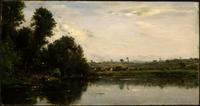
Washerwomen at the Oise River near Valmondois
Charles-Francois Daubigny
Wet Meadow
Fyodor Vasilyev
Near Krasnoye Selo
Fyodor Vasilyev
View of Lakhta near St. Petersburg
Lev Lagorio
Misty Morning
Ivan Shishkin
Riverside
Aleksey Savrasov
A Silent Pool - Autumn
Edward Wilkins Waite
Landscape with a Pond
Efim Volkov
Summer day at the river
Pericles Pantazis
Pond in a Old Park
Ivan Shishkin
Coppice (Noon)
Ivan Shishkin
Landscape
Volodymyr Orlovsky
Study at Orange County, New York
David Johnson
A Long Island River
Thomas Moran
Chill-October
John Everett Millais
Late Afternoon In Summer
Thomas Moran
Landscape
Isaac Levitan
The Banks of the Oise
Charles-Francois Daubigny