Landscape
Expert analysis of Volodymyr Orlovsky’s Landscape
Style: Realism · Genre: landscape
Expert Analysis of "Landscape" by Volodymyr Orlovsky
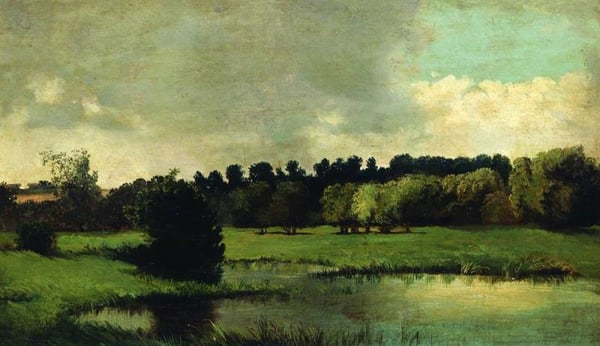
Volodymyr Orlovsky’s Landscape is a quintessential example of 19th-century Russian Realism, a movement that sought to depict nature with unidealized fidelity while imbuing it with a quiet, contemplative spirit. As a leading figure in the Ukrainian-Russian academic tradition, Orlovsky brings to this work his hallmark precision and sensitivity to atmospheric effects.
Significance within Realism and the Artist’s Oeuvre
Orlovsky trained at the Imperial Academy of Arts and was deeply influenced by the Peredvizhniki (the Wanderers), who championed truthful, often lyrical depictions of the Russian countryside. In Landscape, the artist avoids grand, dramatic vistas in favor of an intimate, unassuming scene—likely a stretch of fields, a winding path, or a grove of trees under a soft, expansive sky. This choice aligns with Realism’s reverence for the ordinary and the familiar.
What makes the work particularly noteworthy is Orlovsky’s mastery of light and atmosphere. The painting captures a specific time of day, perhaps late afternoon, when the sun filters through clouds, casting gentle shadows and enriching the greens and earth tones. The brushwork is smooth but not overly polished; it preserves a sense of spontaneity while achieving a remarkable depth of field. This balance of control and naturalism was Orlovsky’s signature, allowing the viewer to feel the breeze and the warmth of the sun on the grass.
Technical and Emotional Resonance
Landscape is significant for its ability to evoke a mood of serene isolation—a hallmark of Orlovsky’s best works. The composition guides the eye along a subtle diagonal or into a receding horizon, inviting meditation rather than action. Unlike the more overt social commentary of some Wanderers, Orlovsky’s landscapes prioritize pure aesthetic experience, celebrating nature as a sanctuary. This made him a bridge between academic formalism and the emerging plein-air practices of the later 19th century.
In the context of Orlovsky’s career, Landscape demonstrates his transition from studio-based idealism to a more observational, emotionally resonant realism. It stands as a testament to his skill in rendering the ephemeral qualities of the natural world—an achievement that secured his place as one of the most respected landscape painters of his generation.
Genre
Style
Visually similar
20 works with related composition and palette
Landscape
Ivan Shishkin
Approaching Storm
Thomas Moran
Woman Standing Near a Pond
Edward Mitchell Bannister
Pond in a Old Park
Ivan Shishkin
Waterfront
Károly Lotz
A june day
Charles-Francois Daubigny
Washerwomen at the Oise River near Valmondois
Charles-Francois Daubigny
River Scene with a Shepherd and Sheep by a Ferry
Alfred Parsons
A Bend in the River Oise
Charles-Francois Daubigny
Daybreak, the Oise, Ile de Vaux
Charles-Francois Daubigny
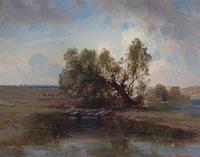
After the storm
Aleksey Savrasov
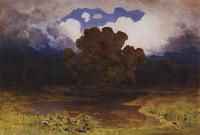
Forest Lake. Cloud
Arkhyp Kuindzhi
Near Arras, the Banks of the Scarpe
Camille Corot
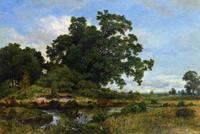
Study at Orange County, New York
David Johnson
The Serpentine, Hyde Park, London
Giuseppe De Nittis
Abenddämmerung
Heinrich Deiters
The Banks of the River
Charles-Francois Daubigny
Dark Trees, Cincinnati
John Henry Twachtman
Fisherman on the Banks of the River
Charles-Francois Daubigny
Summer Twilight
Edward Mitchell Bannister