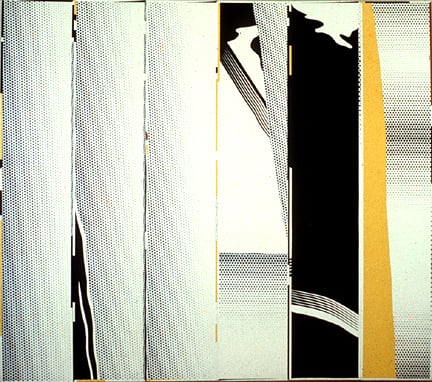
Mirror six panels #1
Dettagli
Analisi esperta di Mirror six panels #1 di Roy Lichtenstein
Stile: Pop Art · Genere: interior
Expert Analysis: "Mirror six panels #1" by Roy Lichtenstein (Pop Art, interior genre)
Roy Lichtenstein’s Mirror six panels #1 exemplifies the Pop Art movement’s radical redefinition of fine art through the lens of commercial and mass‑media aesthetics. Executed in the interior genre, the work ostensibly depicts a reflective surface, but Lichtenstein subverts traditional expectations of mimesis by reducing the mirror to a schematic, abstracted field of Ben-Day dots and diagonal hatch marks.
Significance within Pop Art:
- Deconstruction of representation: True to Pop Art’s mission, Lichtenstein transforms a familiar household object into a coded, mechanical image. The mirror—traditionally a tool for illusionistic depth—is flattened into a grid of dots and lines, making visible the artificiality of all visual perception.
- Appropriation of comic‑book language: The signature Ben-Day dots evoke cheap printing techniques, challenging the distinction between “high” art and popular illustration. The diagonal lines in the “reflection” mimic the visual shorthand used in comics to denote glare or light, further emphasizing the mediated nature of sight.
- Series as concept: As part of Lichtenstein’s “Mirror” series (1970s), this work pushes Pop Art’s fascination with reproduction to its logical extreme: the mirror reflects nothing but its own constructed surface. It is an interior scene that contains no interior—only the illusion of one.
Formal and conceptual impact:
The six‑panel structure introduces a rhythm of repetition and variation; each panel may suggest a different angle or moment of reflection, yet all are composed of identical dot patterns and linear marks. This seriality echoes industrial production, a core Pop theme. By choosing a mirror as subject, Lichtenstein asks viewers to question what an artwork represents: not an external reality, but the processes of its own making.
In essence, Mirror six panels #1 is significant because it crystallizes Pop Art’s critical dialogue with abstraction, mass media, and the nature of seeing—turning a banal interior object into a philosophical inquiry into representation itself.
Visivamente simili
20 opere con composizione e palette affini
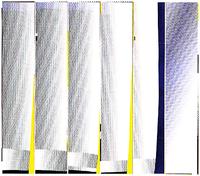
Mirror six panels #3
Roy Lichtenstein
Triptych
George Saru
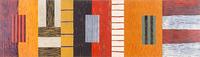
Backs Fronts Windows
Sean Scully
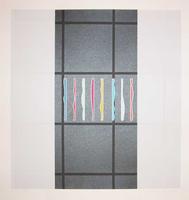
832
Funasaka Yoshisuke
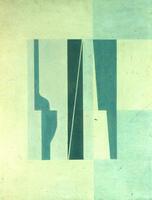
Composition 35
Stefan Sevastre
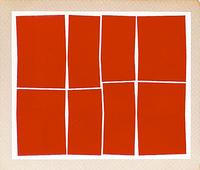
Metaesquema
Helio Oiticica
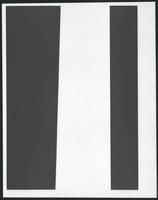
Black/White
Guido Molinari
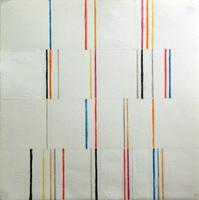
Serie hilos de agua (Buenos Aires)
Cesar Paternosto
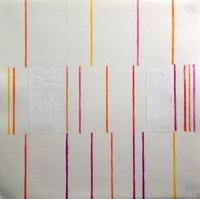
De la Serie Hilos de agua, (Buenos Aires)
Cesar Paternosto
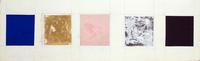
Monochrome blue, gold, pink, silver, black
Yves Klein
Rhythmische Progression drei gleicher Farbgruppen
Richard Paul Lohse
Triptyque
Genevieve Asse
Untitled (9 - 1 - A - 17)
Yves Gaucher
Untitled
Rubem Ludolf
Untitled
Friedrich Vordemberge-Gildewart
Two Abstract Compositions
Hryhorii Havrylenko
833
Funasaka Yoshisuke
June 21
Jack Tworkov
Paplito della Luce
Piero Dorazio
The Tree
Ibrahim Salahi