
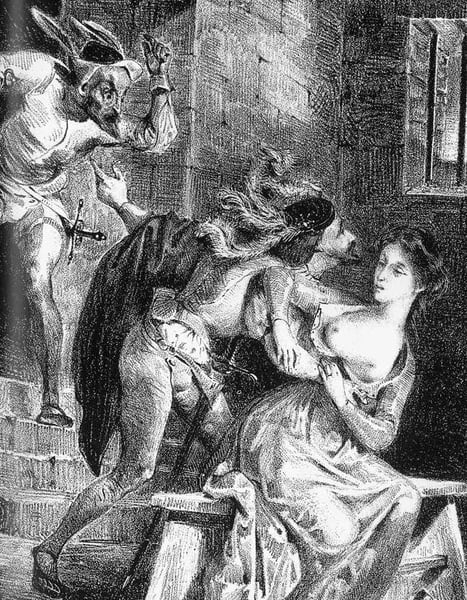
Expert analysis of Eugene Delacroix’s Faust rescues Marguerite from her prison
Style: Romanticism · Genre: literary painting
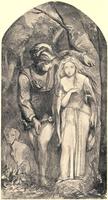
Eugène Delacroix’s 1828 lithograph, "Faust rescues Marguerite from her prison," represents a pinnacle of Romantic printmaking and literary illustration. Created as part of a celebrated suite of seventeen lithographs accompanying a French translation of Johann Wolfgang von Goethe’s Faust, the image captures the tragic climax of the play's first part. The scene depicts Faust desperately attempting to pull a maddened, condemned Marguerite (Gretchen) from her dungeon, while the demonic Mephistopheles looms in the background, urging them to flee before dawn. Goethe himself was so deeply moved by Delacroix’s dark, turbulent vision that he reportedly claimed the French artist had surpassed his own imagination in visualizing the narrative's intense emotional depths.
Visually, the artwork is a masterclass in Romantic dynamism and chiaroscuro. Delacroix utilizes aggressive, frenetic cross-hatching to plunge the stone prison cell into oppressive darkness, making the stark white of Marguerite’s flesh and garments practically glow with a spectral, vulnerable light. Her exposed breast and limp, swooning posture emphasize her physical fragility and shattered mental state, contrasting sharply with Faust’s urgent, muscular forward momentum. The composition is built on tense, unstable diagonals—from the steep stone staircase to the intersecting bodies of the lovers—creating a palpable sense of panic and claustrophobia that perfectly encapsulates the Romantic fascination with extreme psychological states, the macabre, and the sublime.
Symbolically, the print visualizes a profound spiritual tug-of-war. Mephistopheles, rendered with sharp, almost grotesque theatricality in the shadows, represents the looming threat of eternal damnation and the cold impatience of evil. Faust is caught in the middle, driven by earthly guilt and desperate love, physically trying to drag Marguerite back to the mortal world. Yet, Marguerite’s dazed expression and physical resistance hint at her ultimate literary fate: she refuses the devil's escape, choosing instead to face her execution and throw herself upon divine mercy. Through this masterful interplay of light, shadow, and desperate motion, Delacroix immortalizes the exact moment of her tragic, yet ultimately redeeming, surrender.
Visually similar
20 works with related composition and palette
Reineke Fuchs1
Wilhelm von Kaulbach
Illustration to "A Week of Kindness"
Max Ernst
Jeanne de Bourgogne
Achille Devéria
Illustration to "A Week of Kindness"
Max Ernst
Jeanne de Bourgogne
Achille Devéria
Illustration to "A Week of Kindness"
Max Ernst
The Judge Bias, Shedding Tears
Willem van Swanenburg
Martyrdom of Felicitas of Tuburbia in Mauretania, AD 201
Jan Luyken
ancho no se deja lavar en casa de los duques, aguafuerte y buril
Pierre Alexander Aveline
Illustration to "A Week of Kindness"
Max Ernst
Samson and Delila
Lucas van Leyden
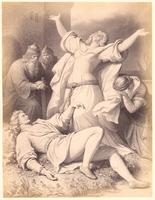
Isolde An Tristan’s Leiche
Wilhelm von Kaulbach
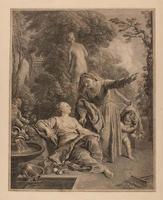
VERTUMNUS AND POMONA
Jacques Chereau
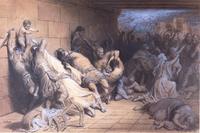
The Martyrdom of the Holy Innocents
Gustave Dore
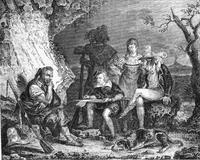
Depicted with Brigants
Salvator Rosa
El Genio De La Libertad
Rosario Weiss Zorrilla
Joseph and Potiphar`s wife
Rembrandt
Strolling Actresses Dressing in Barn
William Hogarth
David Vencedor De Goliat
Palma il Giovane
The Beautiful Lady Without goods
Dante Gabriel Rossetti