
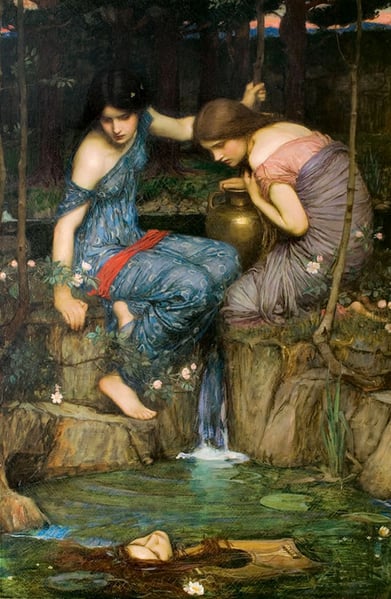
Expert analysis of John William Waterhouse’s Nymphs Finding the Head of Orpheus
Style: Romanticism · Genre: mythological painting
Expert Analysis: "Nymphs Finding the Head of Orpheus" by John William Waterhouse
Style: Romanticism | Genre: Mythological Painting
John William Waterhouse’s Nymphs Finding the Head of Orpheus exemplifies the Romantic fascination with tragic beauty, emotional intensity, and the sublime power of nature. As a mythological painting, it draws from the ancient Greek story of Orpheus—the legendary musician whose head, after his death by Maenads, continued to sing and was discovered by nymphs. Waterhouse elevates this gruesome episode into a poignant, dreamlike scene that balances horror and reverence, a hallmark of Romanticism’s interest in the supernatural and the sublime.
Significance within Romanticism:
- Emotional Atmosphere: The painting captures a moment of eerie stillness. The nymphs gaze upon the severed head with a mix of awe, sorrow, and mystical wonder, reflecting the Romantic emphasis on subjective emotion and the mysterious.
- Nature as a Living Force: Waterhouse surrounds the figures with a lush, shadowy landscape—dark waters, tangled foliage, and soft, diffused light. This setting is not mere backdrop but an active participant, mirroring the emotional weight of the scene and Romanticism’s view of nature as both beautiful and indifferent.
- Mythological Revival: Like many Romantics, Waterhouse revives classical myths to explore timeless themes of art, death, and transcendence. Orpheus’s severed head represents the immortal power of creativity—a Romantic ideal where art outlives the artist.
Artistic Execution:
- Composition: The nymphs are arranged in a frieze-like grouping, their poses ranging from curiosity to grief. The head of Orpheus, barely visible at the center, becomes the focal point, drawing the viewer into the narrative.
- Color and Light: Waterhouse uses a muted, earthy palette punctuated by soft glimmers of light on water and skin, creating a melancholic, almost Pre-Raphaelite luminosity that enhances the dreamlike quality.
- Symbolism: The presence of both water and the head underscores the dual themes of destruction (the murder) and rebirth (the continuing song), aligning with Romanticism’s fascination with cycles of life and death.
Why This Artwork Matters:
It stands as a quintessential Romantic reinterpretation of myth, where the macabre is rendered with lyrical beauty, and the human—or divine—fragility is honored. Waterhouse’s ability to fuse precise mythological detail with an emotional, atmospheric resonance makes this work a powerful example of how Romantic painters used ancient stories to explore modern sensibilities: the tragedy of genius, the solace of nature, and the eternal echo of art.
Museum / Gallery
Visually similar
20 works with related composition and palette
Psyche Opening the Golden Box
John William Waterhouse
Lamia
John William Waterhouse
Gather Ye Rosebuds While Ye May
John William Waterhouse
Phyllis and Demophoön
John William Waterhouse

Listen to my Sweet Pipings
John William Waterhouse
Garden of the Hesperides
Albert Herter
Psyche entering Cupid's Garden
John William Waterhouse
Hylas and the Nymphs
John William Waterhouse

Lamia
Herbert James Draper
Persephone
John William Waterhouse
Pandora
John William Waterhouse
Echo and Narcissus
John William Waterhouse
Sappho and Erinna in a Garden at Mytilene
Simeon Solomon
The Awakening of Adonis
John William Waterhouse
Circe Invidiosa
John William Waterhouse

The Time of Roses
John William Godward

In the Forest
Guillaume Seignac
Maidens picking Flowers by a Stream
John William Waterhouse
Flora and the Zephyrs
John William Waterhouse

Autumn
John William Godward