
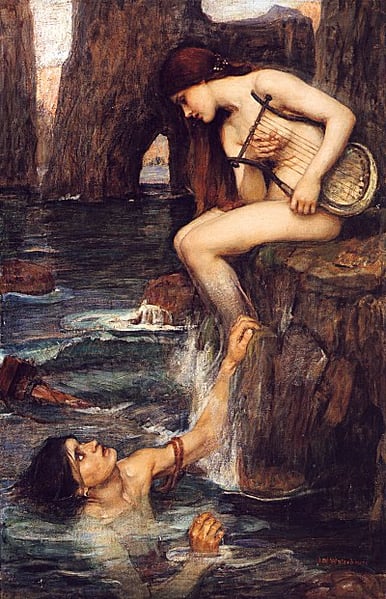
Description
Style : Romanticism · Genre : mythological painting
In *The Siren * (c.1900), John William Waterhouse depicts an exhausted shipwreck survivor clinging to a rock. He sees above him a beautiful young girl sitting on a rock playing harp. The female figure is the siren, a magical creature that inhabits the ocean and lures sailors to their doom with her beautiful song. In the painting, she holds an abalone shell harp and wears a pearl decoration in her hair. She is in the process of transforming into a mermaid, the lower parts of her legs are turning into fish scales and fins. Her auburn hair color is also significant, as it became an attribute of the femme fatale in the 19th century. The siren’s facial expression is passive and enigmatic, so it is unclear whether she intends to help or harm the sailor.
Waterhouse created a series of oil sketches and pencil drawings of sirens and mermaids. They were used for several paintings such as A Mermaid (1900), which was probably inspired by Alfred Tennyson’s poem The Mermaid (1830 ). In A Mermaid, the artist portrays a mermaid alone on a rocky beach: she is combing her long hair and singing the song of the sirens. The Siren was also inspired by the same series of sketches, and the initial idea for the composition came from Poetic Works of Percy Bysshe Shelley. However, unlike the painting, the sketch depicts a trio of mermaids. A possible inspiration for The Siren was The Depths of the Sea (1887) by Edward Burne-Jones that shows a mermaid dragging a sailor to the bottom of her watery grotto. In both paintings, the sirens seem like serene creatures that are unaware of the deadly effect of their song.
Waterhouse was attracted to the character of the siren for the same reason he was fond of subjects like Circe, Medea, and Lamia – all they are female characters whose beauty and power symbolize the dangers of femininity. In The Siren, Waterhouse focused on the intense encounter between the sailor and the siren without referencing a specific legend, myth, or literary narrative. This greatly differs from his earlier depiction of sirens in the painting Odysseus and the Sirens (1891), in which the sirens, half woman-half-bird launch a fierce attack on Odysseus’s ship. In Odysseus and the Sirens, the scene suggests a noisy and chaotic environment in which the sirens viciously attack the sailors. In contrast, The Siren captures an eerie, quiet atmosphere that emphasizes the tension between the seductress and the sailor, who is potentially her prey. The intimate connection between the siren and the sailor is similar to that between the male and female sitters in Waterhouse’s painting Nymphs Finding the Head of Orpheus (1900). In this instance, the young nymphs seemed hypnotized by the musician’s head floating in the water. Like The Siren, Nymphs Finding the Head of Orpheus was probably inspired by the same series of oil sketches and pencil drawings.
Museum / Gallery
Visuellement similaire
20 œuvres à la composition et à la palette proches

A Mermaid
John William Waterhouse

Sea Melodies
Herbert James Draper

The Little Sea Maid
Evelyn De Morgan

By Summer Seas
Herbert James Draper
Untitled
Herbert James Draper

the Siren
Edward Poynter

La Nymphe de la Grotte d'Azur
Jean Benner

Lamia
Herbert James Draper

The Charmer
John William Waterhouse

The Spirit of Song
Charles William Mitchell

Mary Magdalene In The Cave
Jules Joseph Lefebvre
The Pearls of Aphrodite,
Herbert James Draper
Pandora
Jules Joseph Lefebvre

Lamia
John William Waterhouse

Echo and Narcissus
John William Waterhouse

Nymphs Finding the Head of Orpheus
John William Waterhouse

Bather seated on a rock
Pierre-Auguste Renoir
Perseus and Andromeda
Jean Auguste Dominique Ingres

The Bather
William-Adolphe Bouguereau
The Capture
Herbert James Draper