Expertenanalyse zu Leon Baksts Le dieu bleu bayadere with peacock
Stil: Art Nouveau (Modern) · Genre: design
Expert Analysis: "Le dieu bleu bayadere with peacock" by Léon Bakst
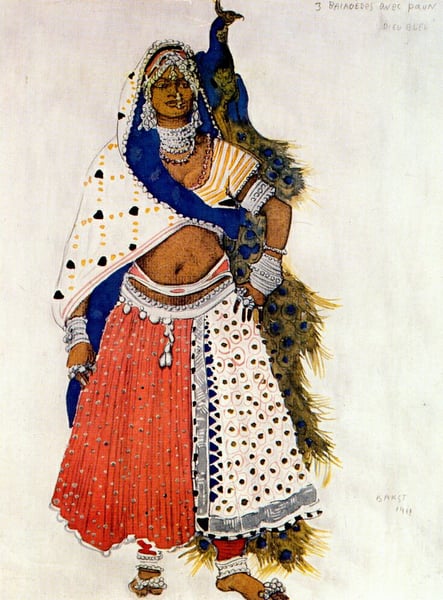
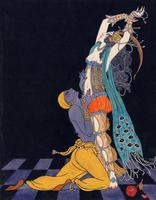
This work by Léon Bakst, created as a design for the Ballets Russes production Le Dieu Bleu (1912), exemplifies the synthesis of Art Nouveau's sinuous elegance with the exoticism and theatricality that defined early 20th-century modernism. As a leading designer for Diaghilev's company, Bakst revolutionized costume and set design by liberating color and form from naturalistic constraints.
Significance within Art Nouveau and Modernism:
-
Art Nouveau's organic line and decorative patterning are reinterpreted here through a theatrical lens. The peacock—a recurrent symbol in the movement for its sumptuous, all-over ornament—becomes a vehicle for Bakst's signature curvilinear rhythms and jewel-toned palette. The bayadère (a temple dancer) is draped in flowing fabrics that echo the peacock's tail, merging human figure with avian form in a continuous, undulating silhouette.
-
Orientalist influence and the Ballets Russes revolution: Bakst drew heavily on Indian, Persian, and Japanese art, filtered through Art Nouveau's love of flat, patterned surfaces. The deep blues, emerald greens, and golds reflect the Fauvist-inspired intensity that shocked Parisian audiences. This work is significant for breaking with 19th-century theatrical decor—instead of realistic backdrops, Bakst offered a vision of heightened, immersive color and stylized nature.
-
Design as a total artwork (Gesamtkunstwerk): Bakst's costumes and sets were integral to the narrative and movement of the ballet. Here, the peacock's tail is not merely decorative but implies ritual and metamorphosis, aligning with the ballet's plot of divine transformation. The design's emphasis on silhouette and rhythm directly influenced modern fashion (Poiret's harem pants) and graphic design.
-
Modernist break from naturalism: While Art Nouveau often clung to floral motifs, Bakst's piece pushes toward abstraction through the flattening of space and exaggeration of pattern. The peacock's feathers become ornamental bands, and the figure's pose is pristinely balanced between dance and frozen emblem. This prefigures the later decorative stylizations of Art Deco.
Conclusion:
Le dieu bleu bayadere with peacock is a landmark of 20th-century design, fusing Art Nouveau's decorative logic with the Ballets Russes's radical theatricality. It demonstrates how Bakst used diaphanous drapery, vibrant asymmetry, and symbolic fauna to create a modern, syncretic visual language—one that dissolved boundaries between fine art, fashion, and stage. The work remains significant for its role in liberating design from imitation of nature, and for its celebration of ornamental fantasy as a legitimate modernist expression.
Visuell ähnlich
20 Werke mit ähnlicher Komposition und Farbpalette
Le dieu bleu bayadere
Leon Bakst
Captive
Nicholas Roerich
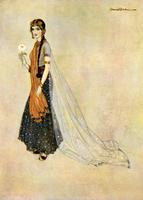
Asenath - from the Picture Book for the Red Cross
Edmund Dulac
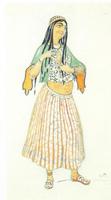
Captive
Nicholas Roerich
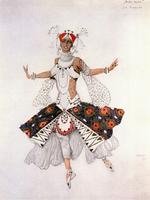
Le dieu bleu the bride
Leon Bakst
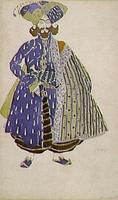
Aide de camp of the Shah, costume design for Diaghilev's production of the ballet Scheherazade
Leon Bakst
Garden of Kama
Byam Shaw
Two sketches of costumes
Sergey Solomko
Indo-persian dance
Leon Bakst
La peri Natasha Trouhanova as the Peri
Leon Bakst
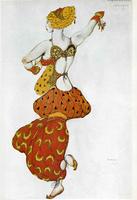
Scheherezade odalisque
Leon Bakst
Slave of the queen retinue Shemakhan
Konstantin Korovin
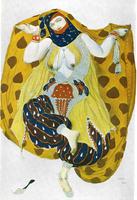
Scheherezade odalisque
Leon Bakst
Flower gatherer
Nandalal Bose
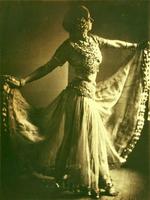
Ruth St. Denis
Alice Boughton
This glass was a lover like me
Hossein Behzad
Toilet of the bride
Sukhvir Sanghal
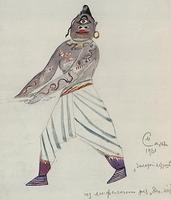
Costume design for the opera by Rimsky-Korsakov's "Golden Cockerel '
Martiros Sarian
Drawings of dances of Vaslav Nijinsky
George Barbier
Costume design of a clown for an opera by A. Spendiarov 'Almast'
Martiros Sarian