
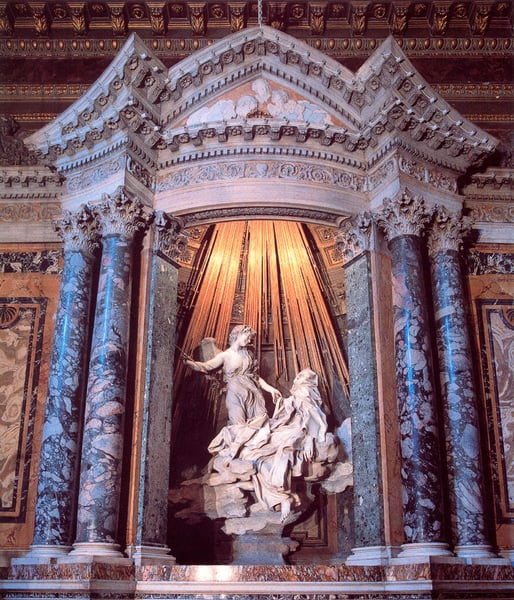
The Ecstasy of St. Teresa (within the Cornaro Chapel)
Details
Expertenanalyse zu Gian Lorenzo Berninis The Ecstasy of St. Teresa (within the Cornaro Chapel)
Stil: Baroque · Genre: sculpture
Expert Analysis: "The Ecstasy of St. Teresa" (Cornaro Chapel) by Gian Lorenzo Bernini
As a defining masterpiece of the Baroque style, Gian Lorenzo Bernini’s The Ecstasy of St. Teresa transcends mere sculpture to become a total theatrical experience. Created for the Cornaro Chapel in the Church of Santa Maria della Vittoria in Rome, this work epitomizes the Baroque preoccupation with emotional immediacy, dynamic movement, and the fusion of multiple art forms.
Significance within the Baroque Style and Genre
-
Theatrical Unity: Bernini orchestrates architecture, sculpture, and painting into a unified sensory spectacle. The sculpted figures of St. Teresa and the angel are set within a proscenium-like niche, framed by a hidden source of natural light (a yellow-tinted window) that pours down through gilded rays. This literal illumination symbolizes divine grace and heightens the dramatic intensity—a hallmark of Baroque art’s goal to engage the viewer physically and spiritually.
-
Emotional Intensity and Mystical Experience: The subject—St. Teresa of Ávila’s vision of an angel piercing her heart with a golden arrow—is rendered with astonishing psychological depth. Teresa’s face, with half-closed eyes and parted lips, conveys a state of rapture that is simultaneously ecstatic and pained. Bernini captures the paradox of spiritual transcendence through physical sensuality, pushing the boundaries of sculptural expression. The angel’s gentle smile and poised hand contrast with Teresa’s collapsed, swooning posture, creating a charged interplay of divine and human.
-
Dynamic Composition and Texture: Eschewing static poses, Bernini employs a spiraling, off-balance composition. The angel’s diagonal stance and Teresa’s reclining body seem to float on a swirling cloud, defying gravity. The sculptor’s virtuosic handling of marble—from the rough, striated folds of the cloud to the polished, soft skin of the figures—demonstrates a Baroque obsession with texture as a means of conveying movement and life.
-
Contextual Engagement: The Cornaro Chapel functions as a painted and sculpted “chapel-theater.” On the side walls, Bernini includes marble reliefs of members of the Cornaro family (the chapel’s patrons) observing the miraculous scene from opera boxes, as if they are audience members at a sacred drama. This blurring of reality and illusion invites the viewer to become a participant in the miracle, reinforcing the Counter-Reformation Church’s goal of making faith an immersive, emotional experience.
In summary, Bernini’s The Ecstasy of St. Teresa is significant not only for its technical brilliance but for its radical synthesis of media, its exploration of human spirituality through visceral emotion, and its embodiment of the Baroque ethos: art as a dynamic, persuasive, and enveloping encounter with the divine.
Museum / Gallery
Visuell ähnlich
20 Werke mit ähnlicher Komposition und Farbpalette
Tomb of Pope Alexander VII
Gian Lorenzo Bernini
Tomb of Pope Urban VIII
Gian Lorenzo Bernini
Tomb of Pope Clement XIII
Antonio Canova
St. Longinus
Gian Lorenzo Bernini
Altar of the Cappella del Sacramento
Gian Lorenzo Bernini
Habakkuk and the Angel
Gian Lorenzo Bernini
Daniel and the Lion
Gian Lorenzo Bernini
Martyrdom of St. Lucy of Syracuse in the Church of Sant'Ambrogio, Alassio
Giulio Benso
Saint Jerome
Gian Lorenzo Bernini
Sepulchre of Matilda the Great Countess
Gian Lorenzo Bernini
Triumph of the Eucharist
Antonio Corradini
The Throne of Saint Peter
Gian Lorenzo Bernini
Tomb of Zaccaria and Saint Athanasius
Palma il Giovane
San Rocco
Alessandro Vittoria
Funerary monument to Giovanni Luca Pallavicini
Giovanni Duprè
Truth Unveiled by Time
Gian Lorenzo Bernini
The Blessed Lodovica Albertoni
Gian Lorenzo Bernini
Duomo (lucca) - Interior
Giambologna
Constantine the Great
Gian Lorenzo Bernini
Design for a Pulpit
Louis Gustave Taraval