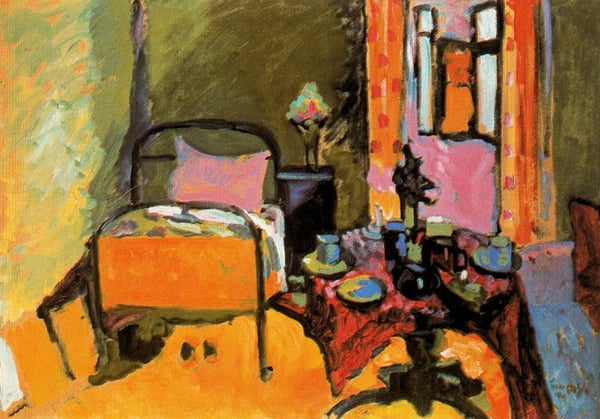
Bedroom in Aintmillerstrasse
詳細
Wassily Kandinsky の Bedroom in Aintmillerstrasse の専門的な分析
スタイル:Expressionism · ジャンル:interior
Expert Analysis: "Bedroom in Aintmillerstrasse" by Wassily Kandinsky
This work, painted in 1909, captures Kandinsky at a pivotal moment of transition from representational painting to the expressive abstraction that would define his legacy. Although the genre is an interior—a bedroom in his apartment at Aintmillerstrasse in Munich—Kandinsky treats the scene not as a documentary record but as a vehicle for emotional and spiritual content.
Significance within Expressionism
The painting is a striking example of Expressionist interiors, a genre that allowed artists to infuse domestic space with psychological intensity. Kandinsky displaces naturalistic color and perspective in favor of bold, non-descriptive hues—vibrant yellows, deep blues, and stark whites—that erupt across walls, floor, and furniture. The bed, window, and dressing table are recognizable yet distorted, their forms simplified into almost geometric planes. This reduction serves to heighten the sense of inner experience: the room seems to pulse with an emotional atmosphere, perhaps reflecting the artist's own state of mind as he prepared to abandon objective reality.
Stylistic Breakthrough
Crucially, this painting marks Kandinsky's growing departure from the influence of Fauvism and Post-Impressionism toward a more subjective, even symbolic, use of form. The sharp juxtapositions of color and the flattened spatial arrangement anticipate the complete abstraction of his later "Compositions." Here, the interior becomes a stage for color harmonies and dissonances, and the objects are merely anchors for pure painterly expression. It is in works like this that Kandinsky began to develop his theory of the spiritual in art, where color and line could evoke sound, emotion, and transcendence.
Historical Context
"Bedroom in Aintmillerstrasse" was created during Kandinsky's tenure in Munich, just before he co-founded the Blue Rider (Der Blaue Reiter) group. The painting thus belongs to his early Expressionist phase, when he was synthesizing Russian folk art, Bavarian glass painting, and the radical color experiments of Die Brücke. Its significance lies in how it demonstrates that even a mundane, private space can be transformed into a luminous, almost sacred environment—a hallmark of the Expressionist desire to reveal the hidden soul behind everyday appearances.
Museum / Gallery
視覚的に類似
構図やパレットが近い作品 20 件
Interior
Periklis Vyzantios
Cell at Mount Athos
Spyros Papaloukas
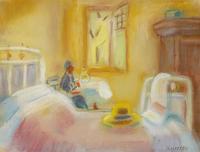
Harmony
Kmetty János
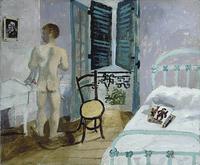
Nude in a bedroom, portrait of fr.Francis Rose
Christopher Wood
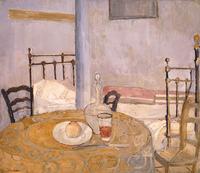
Archontariki lavra Mount Athos
Spyros Papaloukas
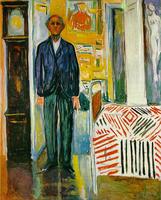
Self-portrait. Between the clock and the bed
Edvard Munch
The Artist's Room, Rue Lavin
Maximilien Luce
Interior, July 14th, Etretat
Henri Matisse
The Boy And The Girl In The Beds
Oleg Holosiy
The Dolls' School
Walter Osborne
Departure with oval mirror
Yiannis Tsaroychis
Evening in the Studio
Lucian Freud
The Bedroom, Pendlebury
L. S. Lowry
Mornington Crescent nude, contre-jour
Walter Sickert
The Dutch Girl
Walter Sickert
Collioure Interior
Henri Matisse
Nude with a Striped Blanket
Suzanne Valadon
Untitle
Bela Czobel
Grand Interior, Notting Hill
Lucian Freud
The workshop with Mimosa
Pierre Bonnard