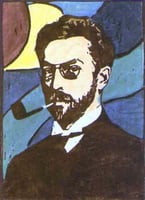
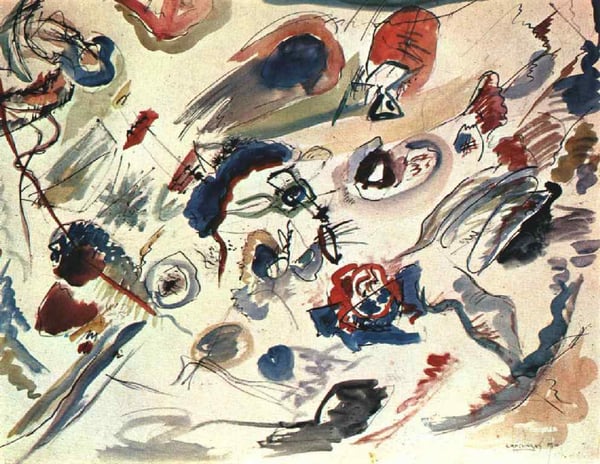
First abstract watercolor
Dettagli
Analisi esperta di First abstract watercolor di Wassily Kandinsky
Stile: Abstract Art · Genere: abstract
Expert Analysis: "First Abstract Watercolor" (1910) by Wassily Kandinsky
This work holds a pivotal place in art history as one of the earliest deliberate departures from representational painting. Kandinsky, a pioneer of abstract art, created this watercolor during a period of intense theoretical development, where he sought to liberate color and form from their descriptive roles.
Significance within the Abstract Art movement:
-
Breaking with representation: The work abandons any recognizable subject—no objects, landscapes, or figures—in favor of pure pictorial elements. This radical shift was grounded in Kandinsky’s belief that art could express spiritual and emotional truths without relying on the physical world.
-
Expressive use of color and form: Splashes of vibrant red, blue, yellow, and green collide with flowing, organic lines and indistinct washes. Kandinsky treated color as a language of its own, capable of evoking sound, mood, and even synesthetic experiences (he famously associated colors with musical tones). The loose, gestural quality of the brushwork anticipates later Abstract Expressionist painting.
-
Historical context: Dated 1910, this watercolor marks a decisive moment. While earlier modernists like Cézanne or Matisse had distorted reality, Kandinsky here rejects it entirely. The work directly reflects his treatise Concerning the Spiritual in Art (1911), where he argued for art that resonates with the viewer’s soul, free from narrative constraints.
What makes it significant:
- Influence on modern abstraction: This watercolor is widely considered the first fully non-objective artwork in the Western tradition. It opened the door for future movements such as Suprematism, De Stijl, and Abstract Expressionism.
- Expression of inner necessity: Kandinsky used spontaneous, intuitive application—colors and shapes emerge organically rather than being carefully pre-planned. This priority on emotional authenticity over visual fidelity became a cornerstone of abstract art.
In short, First Abstract Watercolor is not merely an experiment; it is a manifesto in pigment and paper, declaring that art can function purely through its own formal vocabulary. Its significance lies in its audacious claim that meaning does not require the world we see—only the world we feel.
Museum / Gallery
Visivamente simili
20 opere con composizione e palette affini
Untitled (First abstract watercolor)
Wassily Kandinsky
Study for "Composition VII"
Wassily Kandinsky
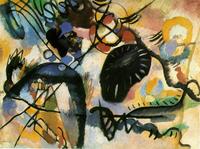
Black spot
Wassily Kandinsky
Untitled
Vasile Kazar
Untitled
Wassily Kandinsky
Drawing for Capturing the Air
Constantin Flondor
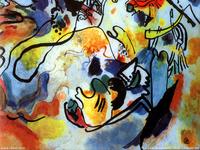
The last judgment
Wassily Kandinsky
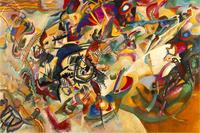
Composition VII
Wassily Kandinsky
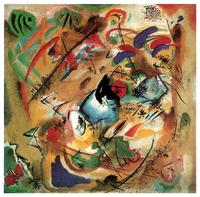
Improvisation (Dreamy)
Wassily Kandinsky
Nature Morte
Aurel Cojan
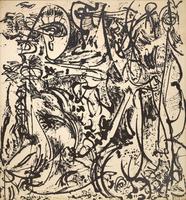
Echo (Number 25)
Jackson Pollock
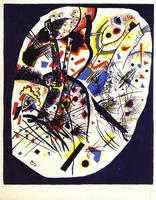
Small worlds III
Wassily Kandinsky
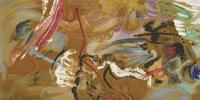
Untitled
Friedel Dzubas
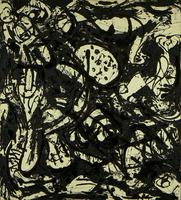
Black & White (Number 20)
Jackson Pollock
Composition
Aurel Cojan
Untitled (O'Connor-Thaw 770)
Jackson Pollock
Study for Agony
Arshile Gorky
To the Unknown Voice
Wassily Kandinsky
Carnival Fiesta
Rene Portocarrero
Untitled
Vasile Kazar