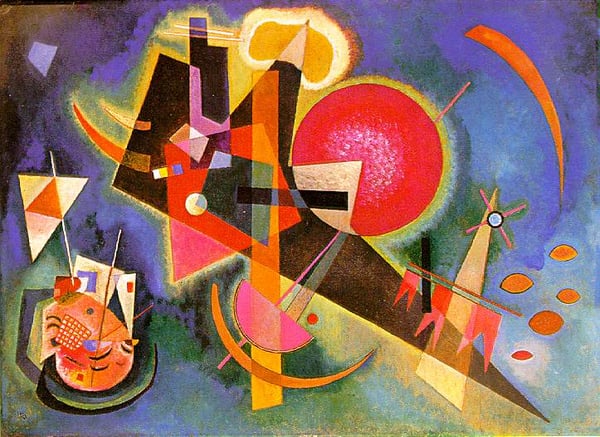
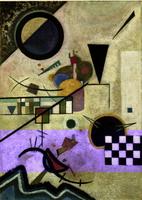
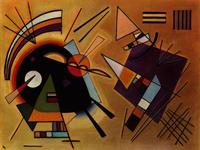
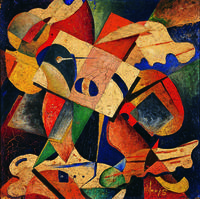
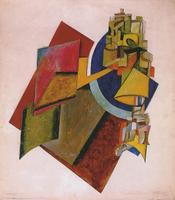
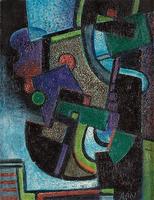
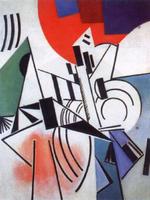
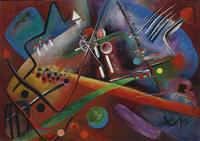
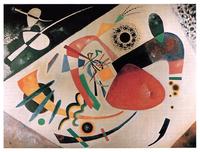
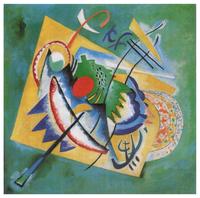
As an expert art historian, I will analyze "In Blue" by Wassily Kandinsky based solely on the provided facts: it is an Abstract Art work in the abstract genre.
Significance of "In Blue"
"In Blue" is a landmark work within the evolution of Abstract Art, a style in which Kandinsky was a pioneering figure. The painting epitomizes Kandinsky's revolutionary break from representational subject matter, instead focusing purely on the emotional and spiritual power of color and form.
The title itself, "In Blue," emphasizes the primacy of a single, dominant color. For Kandinsky, blue was the most "spiritual" color, evoking depth, transcendence, and calm. By making blue the central subject, he asserts that color—not a depicted object—can be the artwork's true content.
Compositionally, the painting exemplifies Kandinsky's belief in "inner necessity": the shapes and lines float in an ambiguous space, free from gravity or perspective. This autonomous language of form and color was radical for its time, directly challenging centuries of Western artistic tradition. "In Blue" is significant because it demonstrates the core principle of abstract art: that visual elements can communicate meaning and emotion directly, without needing to imitate the visible world.