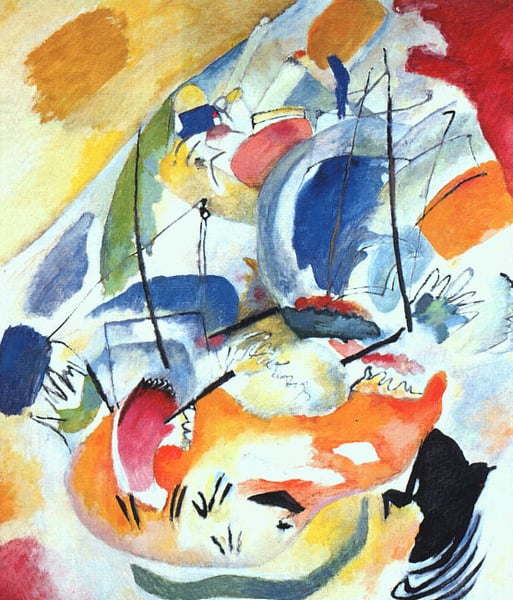
Improvisation 31 (Sea Battle)
Details
Expertenanalyse zu Wassily Kandinskys Improvisation 31 (Sea Battle)
Stil: Abstract Art · Genre: abstract
Expert Analysis of "Improvisation 31 (Sea Battle)" by Wassily Kandinsky
Wassily Kandinsky’s Improvisation 31 (Sea Battle) (1913) is a landmark work in the transition from representational painting to pure abstraction. Painted during a period of intense creative ferment, it belongs to Kandinsky’s celebrated “Improvisation” series—a group of works he described as largely spontaneous expressions of inner feeling rather than external observation. This piece is significant for several reasons:
1. The Pinnacle of Pre-War Abstraction
Improvisation 31 represents Kandinsky’s boldest step yet toward a non-objective visual language. While the title references a specific subject—naval combat—the canvas itself dissolves recognizable ships, water, and figures into a torrent of intersecting lines, slashing diagonals, and floating color patches. The composition is driven by dynamic forces: sweeping arcs clash with sharp angular forms, and layered washes of blue, black, red, and white generate a sense of violent collision. This is not a depiction of a battle but an equivalent of its emotional and sensory turmoil.
2. Color as Drama and Emotion
Kandinsky’s color theory is on full display. The deep blues suggest both the sea and a melancholic or spiritual depth, while aggressive reds and streaking blacks inject a sense of danger. The white highlights function as explosive flashes, tearing through the dark mass. The artist believed colors could trigger specific psychological and spiritual responses—here, the palette orchestrates tension, chaos, and resolution, making the painting a direct conduit for the viewer’s visceral experience.
3. A Dialogue with Contemporary Events
Though abstract, the work engages with the looming anxieties of Europe on the brink of World War I. Kandinsky, like many avant-garde artists, sensed an impending cataclysm; the “sea battle” may be read as a metaphor for global conflict. Yet the painting resists simple narrative—it remains improvisational, a freeform record of the artist’s inner response to external turmoil. This fusion of personal emotion with historical moment anticipates later abstract expressionist impulses.
4. Influence on the Development of Abstract Art
Improvisation 31 is pivotal because it demonstrates that abstract art can convey profound subject matter—struggle, power, and transcendence—without relying on literal imagery. Kandinsky’s achievement here helped legitimize abstraction as a serious artistic language, inspiring subsequent movements from Abstract Expressionism to Lyrical Abstraction. The painting’s raw energy and compositional freedom mark a decisive break from even the fragmented forms of Cubism, pushing toward a world of pure, autonomous form.
Conclusion
In Improvisation 31 (Sea Battle), Kandinsky synthesizes the emotional intensity of Expressionism with the radical formal experiments of early abstraction. It stands as a testament to his belief that art should express the “inner necessity” of the artist, not merely imitate nature. For its historical moment, its pioneering use of color and line as independent players, and its powerful evocation of conflict without depiction, this work remains a cornerstone of early 20th-century modernism.
Genre
Stil
Visuell ähnlich
20 Werke mit ähnlicher Komposition und Farbpalette
Improvisation 30 (Cannons)
Wassily Kandinsky
Improvisation 28 (second version)
Wassily Kandinsky
The last judgment
Wassily Kandinsky
Picture with a black arch
Wassily Kandinsky
Untitled
Vasile Kazar
Fish fight
Max Ernst
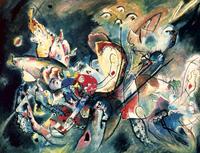
Troubled
Wassily Kandinsky
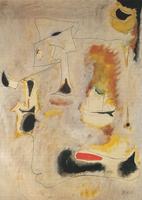
The Observer
Arshile Gorky
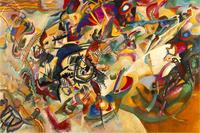
Composition VII
Wassily Kandinsky
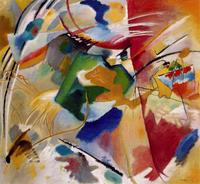
Painting with green center
Wassily Kandinsky
The Garden in Sochi
Arshile Gorky
Atravesando el noche mas oscuro
Justin Earl Grant
Grey oval
Wassily Kandinsky
Secretary
Willem de Kooning
The Garden in Sochi
Arshile Gorky
Ricordo Verde
Giuseppe Santomaso
Untitled
Hans Hofmann
Composition V
Wassily Kandinsky
Study for "Composition VII"
Wassily Kandinsky
Composition surréaliste
Endre Rozsda