Expert analysis of Wassily Kandinsky’s Sky Blue
Style: Abstract Art · Genre: abstract
Expert Analysis of "Sky Blue" by Wassily Kandinsky
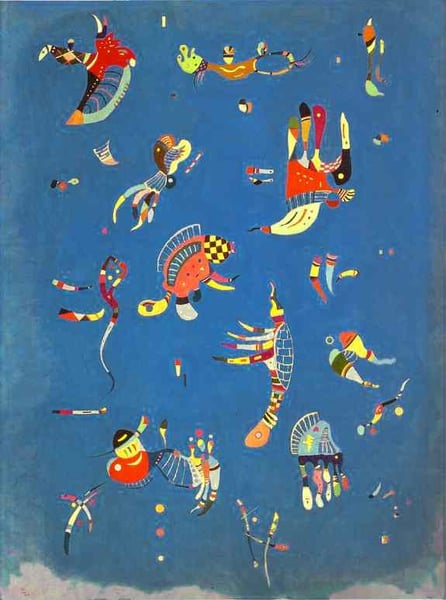
Wassily Kandinsky’s “Sky Blue” (1940) stands as a pivotal late-career masterpiece that encapsulates the artist’s lifelong pursuit of spiritual expression through pure abstraction. Painted during his final years in France, this work exemplifies Kandinsky’s transition from the geometric rigor of his Bauhaus period to a more organic, biomorphic vocabulary—a shift that aligns with the broader Surrealist influence and his own evolving theories of color and form.
Significance within the Abstract Art Movement
As one of the founding fathers of abstraction, Kandinsky consistently sought to detach art from representational subjects in favor of universal, emotional resonance. “Sky Blue” is a quintessential example of this ambition. Here, the artist abandons recognizable objects entirely, substituting them with floating, amoeba-like shapes and delicate, curving lines suspended in a luminous azure field. This composition is not merely decorative; it is a visual analogue for music—a concept Kandinsky championed—with each form acting like a note in a symphonic arrangement. The title itself, “Sky Blue,” suggests an atmospheric, boundless space that invites the viewer into a meditative, non-material realm.
Color as Spiritual Catalyst
Kandinsky believed that color possessed intrinsic emotional and spiritual properties. In “Sky Blue,” the dominant hue—a serene, cool blue—functions as the painting’s philosophical core. Blue, in Kandinsky’s theoretical writings, represents transcendence, depth, and the infinite. The lighter, skyward shades evoke a sense of uplift, while the darker forms anchored below hint at earthly gravity. This chromatic tension creates a dynamic equilibrium, demonstrating Kandinsky’s conviction that abstract art could guide the soul toward higher consciousness.
Biomorphism and the Subconscious
The floating, quasi-biological shapes in “Sky Blue” reflect Kandinsky’s late-career embrace of biomorphism—a style also explored by contemporaries like Joan Miró and Yves Tanguy. These forms, reminiscent of embryos, cells, or cosmic debris, suggest a universe in a state of becoming. Unlike his earlier, more rigid geometric abstractions, these organic outlines feel fluid and improvisational, implying movement, growth, and metamorphosis. This shift underscores Kandinsky’s belief that abstraction must evolve to capture the ineffable rhythms of life and the subconscious.
Legacy and Influence
“Sky Blue” is significant not only as a culmination of Kandinsky’s personal aesthetic journey but also as a landmark in the history of abstract art. It demonstrates that abstraction can be lyrical, poetic, and deeply human—a counterpoint to the more austere, rationalist strains of geometric abstraction. In this painting, Kandinsky achieves a rare synthesis of control and spontaneity, intellect and emotion, offering a blueprint for subsequent generations of Abstract Expressionists and color-field painters.
In summary, “Sky Blue” is a testament to Kandinsky’s radical vision: an artwork that transcends visual representation to become a direct channel for spiritual experience. Its blend of luminous color, organic form, and atmospheric space secures its place as a cornerstone of 20th-century abstract art.
Museum / Gallery
Visually similar
20 works with related composition and palette
Various Parts
Wassily Kandinsky
Composition
Joan Miro
Celebration
Desmond Morris
A floating figure
Wassily Kandinsky
Grouping
Wassily Kandinsky
Carnival Fiesta
Rene Portocarrero
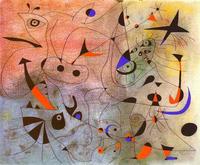
Constellation: The Morning Star
Joan Miro
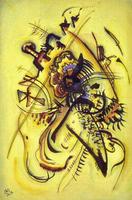
To the Unknown Voice
Wassily Kandinsky
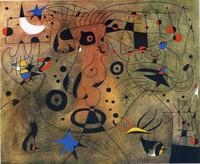
Woman with Blond Armpit Combing Her Hair by the Light of the Stars
Joan Miro
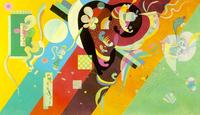
Composition IX
Wassily Kandinsky
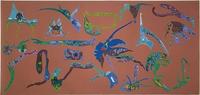
Sixteen Elements from Chile 1
Oyvind Fahlstrom
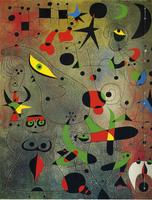
Constellation Awakening at Dawn
Joan Miro
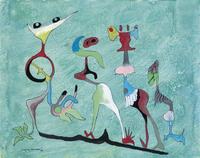
The Ambiguous Group
Conroy Maddox
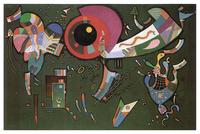
Around the circle
Wassily Kandinsky
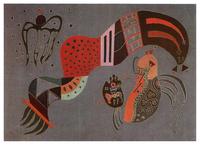
Tempered Elan
Wassily Kandinsky
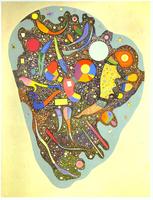
Colourful Ensemble
Wassily Kandinsky
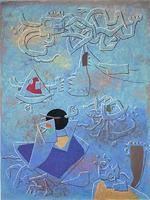
Nocturno
Willi Baumeister
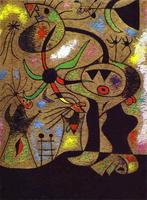
The Escape Ladder
Joan Miro
Untitled
Wassily Kandinsky
Fantasy in Equilibrium
Jock Macdonald