Expert analysis of Wassily Kandinsky’s Various Parts
Style: Abstract Art · Genre: abstract
Expert Analysis: "Various Parts" by Wassily Kandinsky
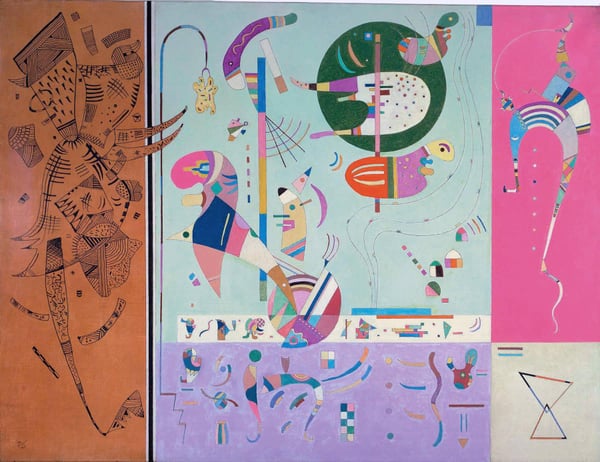
Wassily Kandinsky’s “Various Parts” stands as a quintessential example of early 20th-century abstraction, a movement the artist himself helped pioneer. Though the title suggests an assemblage of discrete elements, the work transcends mere fragmentation to become a unified exploration of color, form, and spiritual resonance—hallmarks of Kandinsky’s mature practice.
Significance within Abstract Art:
Kandinsky is widely credited with creating some of the first purely abstract paintings, stripping art of recognizable objects to express inner emotional and spiritual truths. “Various Parts” exemplifies this radical departure. Rather than depicting a landscape or figure, the canvas becomes a field of interacting shapes and hues: floating circles, intersecting lines, and balanced blocks of color. These “parts” are not random; they follow Kandinsky’s own synesthetic theories linking color to sound, emotion, and spiritual vibration. For instance, a vibrant yellow rectangle might suggest sharp, trumpet-like energy, while a deep blue circle evokes a cello’s resonance.
Visual Composition and Technique:
The composition likely balances geometric precision with lyrical improvisation. Kandinsky often employed a tension between rigid outlines and fluid, painterly areas. In “Various Parts”, we can imagine sharp angles contrasted with soft washes, creating a visual rhythm that mirrors musical structure. This reflects his belief that painting and music share a direct route to the viewer’s soul—an idea articulated in his seminal text Concerning the Spiritual in Art.
Historical Context:
Created during Kandinsky’s Bauhaus period or shortly after, “Various Parts” embodies the synthesis of art, design, and spiritual philosophy that characterized his pedagogy. It represents a departure from his earlier, more biomorphic improvisations toward a cooler, more geometric abstraction—yet retains the emotional intensity that makes his work foundational for later movements like Abstract Expressionism.
Why It Matters:
“Various Parts” is significant because it challenges the viewer to find unity in dispersion. Kandinsky proves that abstraction need not be chaotic; each “part” has a deliberate role in a larger, harmonious whole. The work encapsulates his lifelong quest to make visible the invisible—emotion, sound, and the cosmic order—through the universal language of pure form and color. It stands as a testament to abstraction’s power to communicate beyond representation, making Kandinsky a pivot point in modern art history.
Museum / Gallery
Visually similar
20 works with related composition and palette
Fantasy in Equilibrium
Jock Macdonald
Sky Blue
Wassily Kandinsky
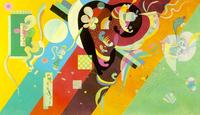
Composition IX
Wassily Kandinsky
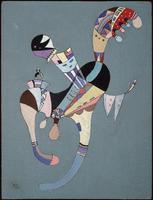
A floating figure
Wassily Kandinsky
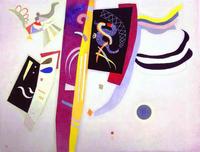
Orange-Violet
Wassily Kandinsky
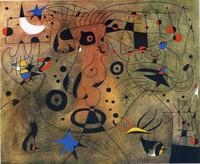
Woman with Blond Armpit Combing Her Hair by the Light of the Stars
Joan Miro
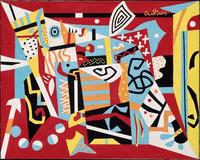
Hot Still-Scape for Six Colors - 7th Avenue Style
Stuart Davis
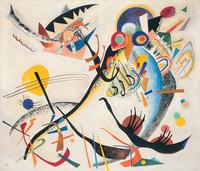
Blue segment
Wassily Kandinsky
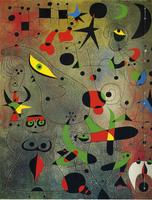
Constellation Awakening at Dawn
Joan Miro
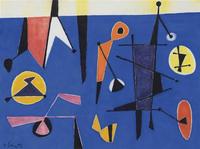
Marée haute
Gustave Singier
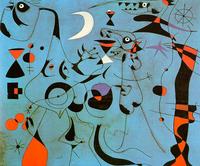
Figure at Night Guided by the Phosphorescent Tracks of Snails
Joan Miro
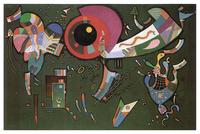
Around the circle
Wassily Kandinsky
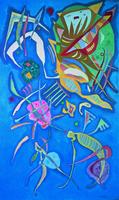
Grouping
Wassily Kandinsky
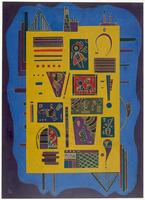
Conglomerat
Wassily Kandinsky
The Escape Ladder
Joan Miro
Abstract 1
René Marcil
Tolérance
Georges Troubat
Introducing Miss America II
Steve Wheeler
Painting
Joan Miro
Dones rodejades pel vol d'un ocell
Joan Miro