Expertenanalyse zu Wassily Kandinskys Small Worlds VI
Stil: Abstract Art · Genre: abstract
Expert Analysis: "Small Worlds VI" by Wassily Kandinsky
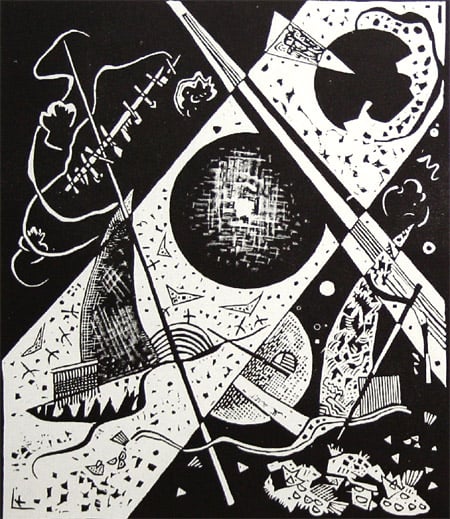
Wassily Kandinsky’s Small Worlds VI (1922) stands as a pivotal example of his mature abstract vocabulary, created during his influential tenure at the Bauhaus. This work belongs to his celebrated Small Worlds series—a suite of twelve prints that systematically explore the transition from organic, expressive abstraction to the geometric rigor that would define his Bauhaus period.
Significance within Abstract Art
-
Synthesis of Emotion and Structure: Kandinsky famously sought to convey spiritual and emotional states through pure form and color. In Small Worlds VI, he achieves a dynamic equilibrium between free, biomorphic shapes and precise geometric elements—circles, arcs, and angular lines. This balance mirrors his theoretical writings (e.g., Concerning the Spiritual in Art and Point and Line to Plane), where he argued that abstract forms could evoke specific sensations akin to musical harmony.
-
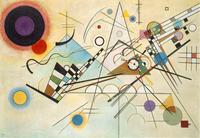
Bauhaus Principles: Executed shortly after Kandinsky joined the Bauhaus, Small Worlds VI embodies the school’s ethos of integrating fine art with craft and design. The print medium itself—likely a combination of woodcut, etching, or lithograph—demonstrates his interest in reproducible, tactile processes. The composition’s clear, structured layering prefigures his later geometric works like Composition VIII.
-
Synesthetic Color and Contrast: Although the print is monochromatic (Kandinsky often produced these in black and white or with limited color), the interplay of dense black lines, white negative space, and hatched textures creates a vivid rhythmic pulse. The “small world” of the title suggests a microcosm—a self-contained universe where each form interacts with precision, echoing Kandinsky’s belief that art should reflect cosmic order.
Why It Matters
Small Worlds VI is significant because it captures a crucial moment in the evolution of abstraction: the move from the spontaneous, emotional improvisation of the pre-war Blue Rider period toward the disciplined, Constructivist-inspired geometry of the 1920s. Here, Kandinsky proves that abstract art can be both intuitively expressive and intellectually structured—a legacy that influenced generations of modernists, from the Abstract Expressionists to the Op Art movement. The work’s emphasis on compositional clarity and rhythmic tension makes it a masterclass in how line, shape, and space can speak without reference to the visible world.
Museum / Gallery
Genre
Stil
Visuell ähnlich
20 Werke mit ähnlicher Komposition und Farbpalette
Small worlds IV
Wassily Kandinsky
Study for "Circles on Black"
Wassily Kandinsky
The Nightingale's Song at Midnight and the Morning Rain
Joan Miro
On White II
Wassily Kandinsky
Orange
Wassily Kandinsky
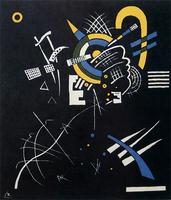
Small Worlds VII
Wassily Kandinsky
Transverse Line
Wassily Kandinsky
Komposition
Johannes Itten
Green composition
Wassily Kandinsky
Composition VIII
Wassily Kandinsky
Small dream in red
Wassily Kandinsky
Small worlds III
Wassily Kandinsky
Composition IX
Wassily Kandinsky
Picture XVI, The Great Gate of Kyiv. Stage set for Mussorgsky's Pictures at an Exhibition in Friedrich Theater, Dessau.
Wassily Kandinsky
Xilografia
Julius Evola
A Centre
Wassily Kandinsky
Capricious
Wassily Kandinsky
Joy of Everlasting Journey
Vladimir Kolosov
Bortnyik Sándor, Absztrakt Kompozicio
Sandor Bortnyik
No Title
Gustavo Ramos