Expert analysis of Wassily Kandinsky’s Small Worlds VII
Style: Abstract Art · Genre: abstract
Expert Analysis of "Small Worlds VII" by Wassily Kandinsky
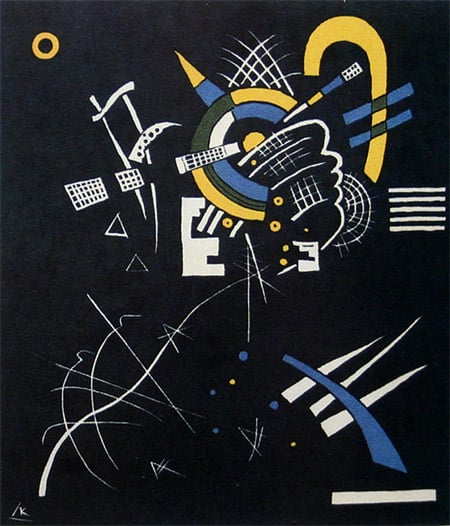
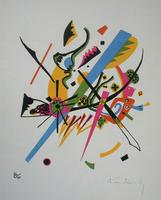
Wassily Kandinsky’s Small Worlds VII (1922) is a pivotal work from his series of twelve prints, each exploring a “small world” of abstract form and color. Executed during his early Bauhaus period, this piece marks a critical transition from the spontaneous, organic improvisations of his earlier years toward the rigorous geometric abstraction that would define his later oeuvre.
Composition and Visual Language
The print combines lyrical, biomorphic shapes with precise geometric elements—a hallmark of Kandinsky’s synthesis of intuition and intellect. Circular forms, floating lines, and angular planes interact against a muted, earthy background, suggesting a cosmic or microcosmic landscape. The interplay of warm and cool tones creates a pulsating rhythm, while shifts in scale and overlapping shapes generate depth without illusionistic space. This deliberate tension between chaos and order embodies Kandinsky’s theory of “inner necessity,” where form and color express spiritual emotion.
Significance in Abstract Art
Small Worlds VII is significant for several reasons:
- Bridging Styles: It represents Kandinsky’s move from the free-form Improvisations to the structured Compositions, showing how he systematized abstraction without losing its emotional power.
- Bauhaus Pedagogy: As a professor at the Bauhaus, Kandinsky used this series to demonstrate his principles of form and color taught in his courses, making it a direct application of his theoretical writings (e.g., Point and Line to Plane).
- Medium as Message: The work is a lithograph—a reproducible print—challenging the unique, “auratic” art object. By creating multiple “small worlds,” Kandinsky democratized abstraction, inviting viewers to enter his universe without hierarchy.
- Influence on Modernism: The series foreshadows later abstract movements, including Abstract Expressionism’s emphasis on gesture and Color Field painting’s focus on chromatic relationships, solidifying Kandinsky’s role as a founding father of non-objective art.
Within the Context of Its Period
Created in 1922, Small Worlds VII reflects the aftermath of World War I and the utopian aspirations of the Bauhaus. Kandinsky sought a universal visual language—one that transcended national boundaries and spoke directly to the soul. In this print, the geometric shapes evoke both modern technology (precision, machinery) and the spiritual (circles as symbols of eternity, triangles as dynamic energy). This duality makes the work a touchstone for understanding how abstract art became a vehicle for both rational construction and mystical expression.
In summary, Small Worlds VII is not merely an abstract composition but a manifesto of Kandinsky’s belief that art could harmonize the material and the spiritual. Its mastery of form, color, and rhythm continues to resonate as a landmark of 20th-century abstraction.
Museum / Gallery
Genre
Style
Visually similar
20 works with related composition and palette
On White II
Wassily Kandinsky

Transverse Line
Wassily Kandinsky
Red spot II
Wassily Kandinsky
Small worlds
Wassily Kandinsky
Small dream in red
Wassily Kandinsky
Painting
Joan Miro
Hot Still-Scape for Six Colors - 7th Avenue Style
Stuart Davis
Bortnyik Sándor. Ma Album 2
Sandor Bortnyik
Dark freshness
Wassily Kandinsky

Orange-Violet
Wassily Kandinsky
Fantasy in Equilibrium
Jock Macdonald
Dominant curve
Wassily Kandinsky

Studio per composizione
Enrico Prampolini
Dialogue II
Constantin Flondor
Blue segment
Wassily Kandinsky
Contrasting sounds
Wassily Kandinsky

Delicate Tension. No. 85
Wassily Kandinsky
Black and Violet
Wassily Kandinsky
G&W
Stuart Davis
Cidade de Chaves
Nadir Afonso