Analisi esperta di Bust of Manuel Humbert di Amedeo Modigliani
Stile: Expressionism · Genere: portrait
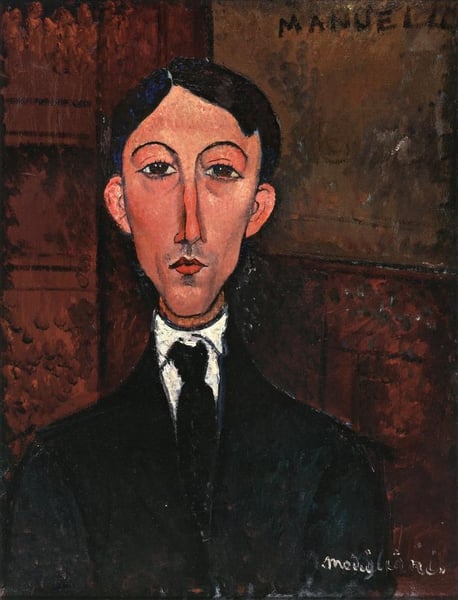
An expert analysis of Amedeo Modigliani's “Bust of Manuel Humbert” must begin by acknowledging how it epitomizes the artist’s radical approach to portraiture within the broader context of Expressionism. Though Modigliani was associated with the École de Paris, his work consistently transcends mere stylistic labeling to achieve a singular fusion of psychological intensity and formal elegance.
Formal Analysis: The Modigliani Signature
The painting immediately displays Modigliani’s hallmark vocabulary: an elongated neck, a facial oval that is subtly tilted, and the iconic almond-shaped, blank eyes that seem to look inward rather than outward. The sitter’s features are stylized, almost mask-like—a clear influence of African tribal masks and Cycladic sculpture, which Modigliani collected and studied. Yet the bust format (cutting off the figure at the torso) emphasizes the monumental weight of the head and shoulders, compressing the space and focusing all attention on the face.
The brushwork is fluid but not sketchy; the contours are drawn with a sinuous, continuous line that defines the nose, chin, and jawline with sculptural clarity. The palette is restrained—earthy ochres, muted browns, and a warm grey—allowing the subtle modeling of light and shadow to create a sense of volume without resorting to academic chiaroscuro. The flatness of the background pushes the figure forward, echoing Modigliani’s interest in primitivism but filtered through a distinctly modern, expressionist lens.
Significance within Expressionism and Modigliani's Oeuvre
-
Psychological Depth through Distortion
Unlike many Expressionists who used violent color or aggressive brushstrokes to convey emotion, Modigliani achieves a quieter, more melancholic intensity. The elongation of Humbert’s neck and the slight asymmetry of his features suggest vulnerability and introspection. The subject—Manuel Humbert, a fellow Catalan painter and friend—is not portrayed with literal fidelity but with an essence: a sense of dignified loneliness that characterizes many of Modigliani’s sitters. -
Synthesis of Tradition and Modernity
The bust format recalls Renaissance portrait busts (e.g., Donatello or Desiderio da Settignano), yet Modigliani replaces their naturalistic detail with an almost abstract geometry. The work bridges the gap between Cézanne’s structural blockiness and the flat decorative patterns of Matisse, while adding a highly personal, lyrical distortion. This makes the portrait a key example of how Expressionism could be less about emotional outburst and more about spiritual form. -
The Role of the “Bust” in Modigliani’s Career
Modigliani primarily painted full-length figures or head-and-shoulders portraits. The bust format allows him to concentrate all expressive energy on the face and neck, which he treated as a continuous, rhythmic curve—almost like a sculpted torso. The title “Bust” also nods to his parallel career as a sculptor; even in oil paint, he transfers a sculptural tactility to the canvas.
Significance for the Artwork’s Period
“Bust of Manuel Humbert” exemplifies the École de Paris at its most refined moment (circa 1916–1919), where artists like Modigliani, Soutine, and Chagall combined avant-garde formal experiments with a humanistic core. It is significant because it reclaims portraiture—a traditional genre—for modernist Expressionism by rejecting photographic realism in favor of a vision that is both archaic and contemporary.
In conclusion, Modigliani’s portrait is significant not for biographical accuracy but for its ability to translate the sitter’s presence into a timeless, hieratic image—one that speaks to the expressionist goal of revealing the inner life through formal means. The elongated neck, the empty eyes, and the serene geometry all conspire to make Manuel Humbert a universal figure of quiet enduring humanity.
Visivamente simili
20 opere con composizione e palette affini
Paul Guillaume
Amedeo Modigliani
Manuel Humberg Esteve
Amedeo Modigliani
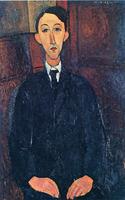
Portrait of the painter Manuel Humbert
Amedeo Modigliani
Portrait of Blaise Cendrars
Amedeo Modigliani
Paul Guillaume
Amedeo Modigliani
Oscar Miestchaninoff
Amedeo Modigliani
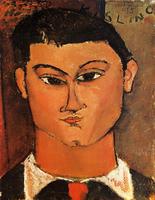
Portrait of Moise Kisling
Amedeo Modigliani
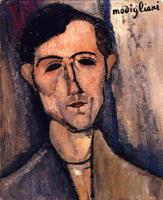
Man's Head (Portrait of a Poet)
Amedeo Modigliani
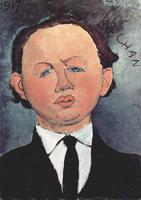
Portrait of the Mechanical
Amedeo Modigliani
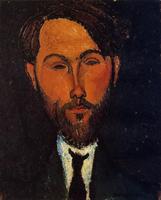
Portrait of Leopold Zborowski
Amedeo Modigliani
Portrait of a Boy
L. S. Lowry
Pierre Reverdy
Amedeo Modigliani
Frans Hellens
Amedeo Modigliani
Portrait De George Besson
Henri Matisse
Portrait of Elena Pavlowski
Amedeo Modigliani
Max Jacob
Amedeo Modigliani
Portrait of Raymond
Amedeo Modigliani
Portrait of Leopold Zborowski
Amedeo Modigliani
Portrait of Emile Lejeune
Chaim Soutine
Untitled
Jean Helion