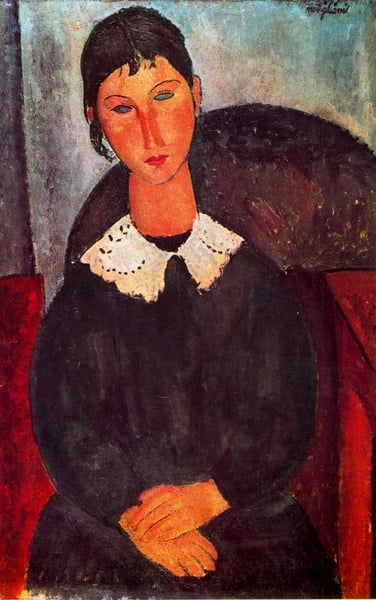
Elvira with a white collar
Подробности
Экспертный разбор работы «Elvira with a white collar» художника Amedeo Modigliani
Стиль: Expressionism · Жанр: portrait
Artwork: Elvira with a White Collar by Amedeo Modigliani
Style: Expressionism
Genre: Portrait
Expert Analysis
Amedeo Modigliani’s Elvira with a White Collar exemplifies the artist’s distinctive fusion of Expressionist emotional intensity with a highly personal, sculptural approach to portraiture. Painted during his mature period (c. 1918), the work reveals Modigliani’s departure from naturalistic representation in favor of psychological and formal abstraction—a hallmark of early 20th-century Expressionism.
Significance within Expressionism:
Modigliani synthesizes the raw, emotive power of Expressionism with the elongated, mask-like features derived from African and Cycladic art. The sitter, Elvira—a frequent model—is rendered with a sinuous, elongated neck and an oval face that echoes the stylized forms of primitive sculpture. Her almond-shaped, vacant eyes (often left without pupils) convey an introspective, almost melancholic detachment, inviting the viewer into an intimate, yet alienated psychological space. The bold, dark contours and flat planes of color, typical of the Fauve and Expressionist palette, heighten the emotional charge, while the stark white collar acts as a dramatic focal point—a geometric counterpoint to the organic lines of the face and dress. This juxtaposition underscores Modigliani’s innovative use of structural simplicity to evoke complex inner states, aligning him with Expressionists like Egon Schiele or Ernst Ludwig Kirchner, yet distinguished by his lyrical, elegance.
Artistic Innovation:
The portrait’s significance lies in Modigliani’s ability to merge portraiture with modernist primitivism. The white collar—crisp, angular, and almost architectural—anchors the composition and provides a formal tension against the fluid, cascading brushstrokes of the blouse and hair. This interplay of hard and soft, light and dark, reflects the artist’s deep engagement with sculptural form (he was a sculptor earlier in his career). The collar also subtly suggests a status or identity, but Modigliani subverts conventional portrait symbolism by abstracting features to their expressive essence. The work thus transcends mere likeness, becoming a universal meditation on vulnerability and dignity.
Cultural and Historical Context:
Created during Modigliani’s final years in Paris, surrounded by bohemian circles and struggling with poverty and illness, Elvira with a White Collar embodies the Expressionist desire to convey subjective truth over objective reality. The painting’s compressed space and tilted perspective reject Renaissance perspective, emphasizing the emotional reality of the sitter. Today, it stands as a masterwork of early modern portraiture, demonstrating how Modigliani—through his signature elongation, muted tonalities, and psychological depth—elevated the human face into a timeless symbol of inner life.
Museum / Gallery
Визуально похожие
20 работ с близкой композицией и палитрой
A girl in yellow dress
Amedeo Modigliani
A woman with white collar
Amedeo Modigliani
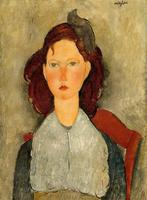
Young Girl Seated
Amedeo Modigliani
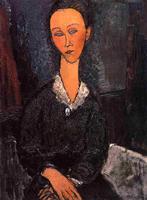
Lunia Czechowska
Amedeo Modigliani
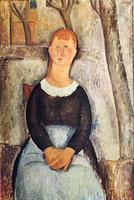
The Pretty Vegetable Vendor
Amedeo Modigliani
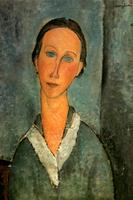
Girl in a Sailor's Blouse
Amedeo Modigliani
Portrait of a Young Woman
Amedeo Modigliani
Head of a Girl
Amedeo Modigliani

Young servant girl
Amedeo Modigliani
The Servant Girl
Amedeo Modigliani
Girl with a pink ribbon
Gustave de Smet

Eighth grade
Victor Zaretsky
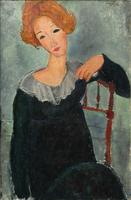
Woman with red hair
Amedeo Modigliani
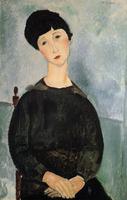
Seated Young Woman
Amedeo Modigliani
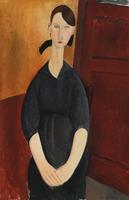
Paulette Jourdain
Amedeo Modigliani
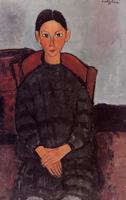
A Young Girl with a Black Overall
Amedeo Modigliani
Servant Girl
Amedeo Modigliani
Woman with Scottish Dress
Amedeo Modigliani
The Pretty Housewife
Amedeo Modigliani
A young girl
Amedeo Modigliani